Meet the Faculty: Ian VanderBurgh

Our “Meet the Faculty” interviews provide a window into the work lives of faculty across the University of Waterloo. Faculty members talk about the day-to-day joys and struggles, and share tips for getting the work done and staying mentally and physically healthy in academia.

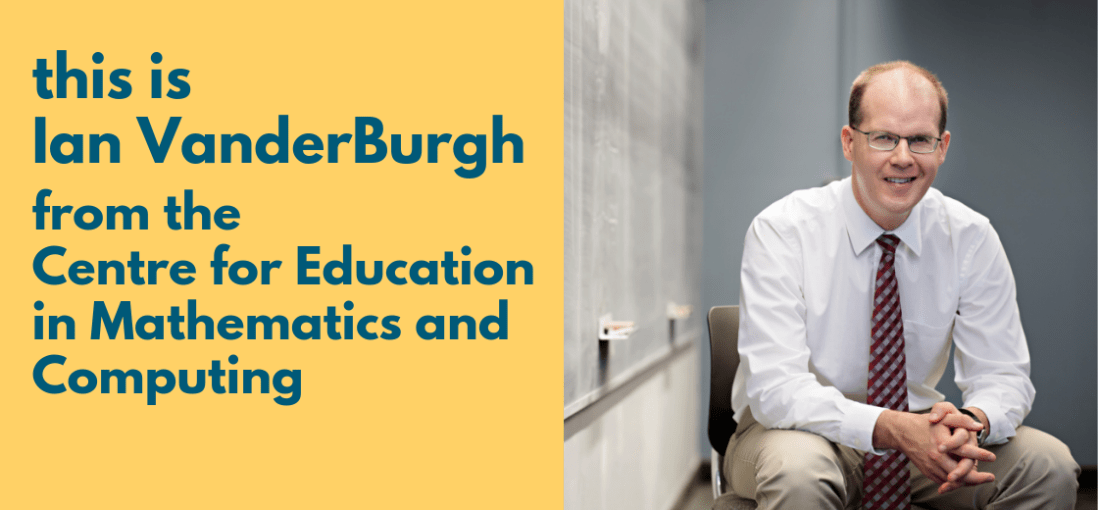
Ian VanderBurgh is a lecturer and director of the Centre for Education in Mathematics and Computing (CEMC) in the Faculty of Math.

What is the Centre for Education in Mathematics and Computing and what do you do as director?

CEMC is the outreach arm of the Faculty of Mathematics. We do activities in elementary and secondary schools to promote mathematics and computer science to students and teachers: contests, school visits, workshops and conferences, and an online master’s program for teachers.

My role is to help other people do what they love and need to do, and to try not to get in the way. And help solve problems when they need to be solved.

What do you teach these days?

Most of my teaching comes in our Master of Mathematics for Teachers, which is an online, part-time, professional master’s program for active high school teachers—and occasionally undergrad classes.

What other roles do you have on campus or in the community?

On campus, I am the chair of the University’s Complementary Teaching Assessment Project Team. We’re looking at ways of assessing teaching other than student course perception surveys. That’s been a great experience for me so far and it’s an important thing for the University to be looking at. I’m heavily involved in undergrad admissions for Math as well.

Outside of the University, I’m the pianist for the Grand Philharmonic Choir and also accompany the Wilfrid Laurier Concert Choir sometimes, too.

Continue reading “Meet the Faculty: Ian VanderBurgh”
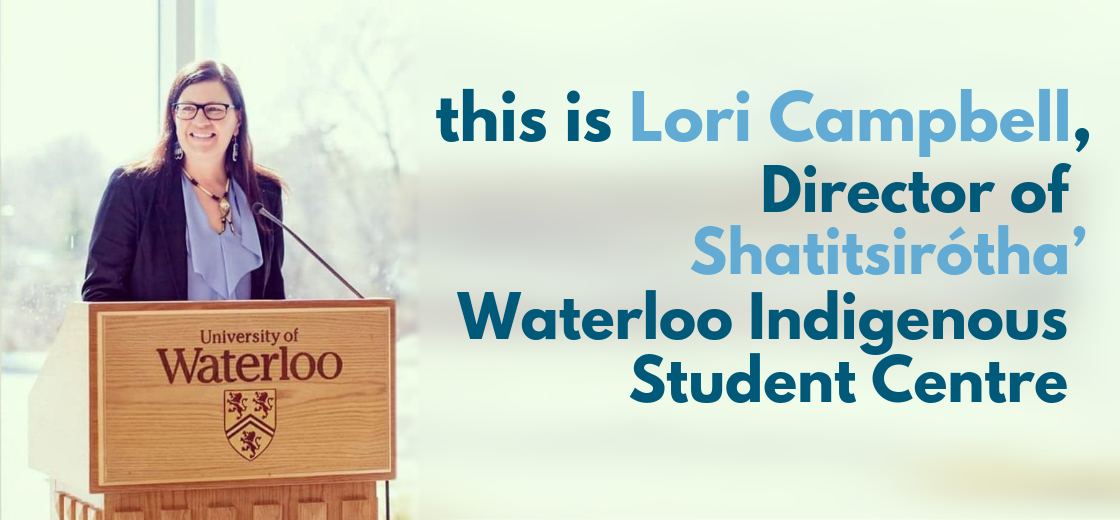
People You Should Know: Lori Campbell, Waterloo Indigenous Student Centre

Our “People You Should Know” blog series interviews key people and offices at the University of Waterloo so you can make the most of their services. 

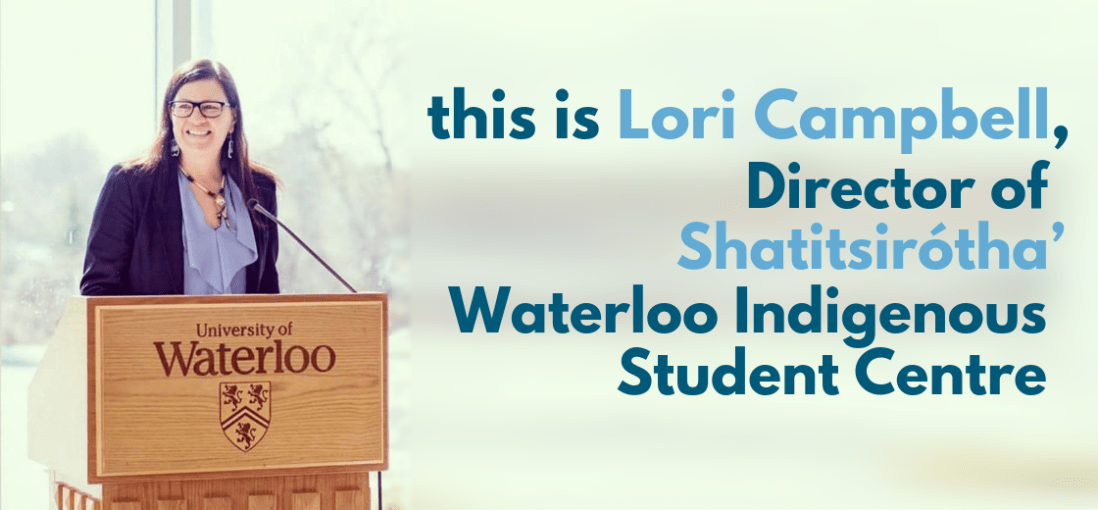
Lori Campbell is a 2-Spirit nēhiyaw atāpihtāwikosisān iskwew. Okawiya mōniyawi-sākahikanihk, Treaty 6 territory in kīwētinohk kisiskāciwan ohcīw. (Translation: a 2-Spirit Cree-Métis woman. Her mother is from Montreal Lake First Nation, Treaty 6 territory in northern Saskatchewan.) She’s the Director of Shatitsirótha’ Waterloo Indigenous Student Centre (WISC), which is located at St. Paul’s University College at the west end of the campus. We interviewed Lori to help you better understand her role and how it relates to yours.

What does your role involve?

The Centre provides a range of services for Indigenous-identifying students and leads educational opportunities for Indigenous and non-Indigenous students, staff, faculty, and administration.

The academic support part of my role includes providing strategic direction on Indigenous education; developing an Indigenous student recruitment strategy; building relationships with internal and external stakeholders; and developing Indigenous academic programming and an Indigenous research agenda.

Why might faculty members be interested in what you do?

Our centre is a refuge for engaging and supporting relationships among faculty, students and staff at the University of Waterloo and in the Indigenous community. We initiate, celebrate, and support cultural and academic events that promote respect, research, relationship building, and reconciliation.

Continue reading “People You Should Know: Lori Campbell, Waterloo Indigenous Student Centre”

Service Opportunities for Lecturers

Brought to you by the FAUW Lecturers Committee.

Lecturer appointments at Waterloo usually include a service component of anywhere from 20% to 60%. This blog post will address some of the questions lecturers have about navigating this element of their job.

Why should I bother with service?

Service is assessed in your performance review. It is important to seek service opportunities not only because the service you do is directly related to the merit score you receive at the end of the year, but also because it is directly related to the success of the shared governance of the University. In order to be fairly represented, lecturers must be part of the decision-making process. The best way to do that is by serving not only within your department but across your Faculty and the University.

How do I find out what service opportunities are available?

If you’re not sure where to start in finding service opportunities, we recommend you speak to your chair, who may be able to identify needs at least at the department level.

Continue reading “Service Opportunities for Lecturers”

Meet the Faculty: Kim Hong Nguyen

Our “Meet the Faculty” interviews provide a window into the work lives of faculty across the University of Waterloo. Faculty members talk about the day-to-day joys and struggles, and share tips for getting the work done and staying mentally and physically healthy in academia.

We’re starting with Kim Hong Nguyen. Kim Hong is an assistant professor in Communication Arts and a faculty representative for Waterloo Women’s Wednesdays.

Kim, what do you teach and research?

My research and teaching explore the relationship between equity, power, and identity in public controversies related to communication practices. I teach students how our communicative practices and interpretative frameworks intersect with race, gender/sexuality, class, and other visible identity markers. I write about controversies that raise new questions about how to perform and talk about identity. Controversies that interest me are ones that focus on the use of one word, a trope, an expression, or a cultural practice and create questions about who can say, do, and perform them.

What are you passionate about in your work?

Though I might not be the best public speaker, I am passionate about communicating well and all that that entails. This means I want all of my students to communicate well, but also learn how to be good, forgiving listeners. I hope my teaching provides them a space to explore what that means and a space to practice. This also means that my research explores how the public communication practices of visible minorities are interpreted and tries to identify the different frameworks that allow for that public communication to be seen as effective and not effective.

Continue reading “Meet the Faculty: Kim Hong Nguyen”

People You Should Know: Mat Thijssen, Sustainability Office

Our “People You Should Know” blog series interviews key people and offices at the University of Waterloo so you can make the most of their services. 

Mat Thijssen is the University of Waterloo’s Sustainability Manager. We interviewed him last fall to get to know the Sustainability Office better and talk about how faculty can contribute to sustainability at Waterloo.

Mat, what does the Sustainability Office do?

The Sustainability Office strives to implement Waterloo’s Environmental Sustainability Strategy, working in partnership with offices across campus to build sustainability into how the University operates, our daily actions, and our academic mission. We provide expertise and training, support engagement efforts and collaboration around sustainability, and monitor and report on our progress. As Sustainability Manager, I oversee these efforts.

How do faculty fit in?

I often work with faculty members to give class lectures relevant to a course, provide data to or be interviewed by students for course projects, and even identify large class or group projects through the Living Lab, which is under development. Faculty also often ask us about actions they can take personally and professionally to be more sustainable on a day-to-day basis. Editor’s note: you can find such actions in the Sustainability Guide (PDF) released by the Sustainability Office in 2018.

Continue reading “People You Should Know: Mat Thijssen, Sustainability Office”

6 Things FAUW is Working on Right Now

We’ve got a lot more going on, but here are six items we discussed at the January 15 Board of Directors meeting.

1. Explaining the salary changes for lecturers

Our first meeting of 2019 kicked off with an update from Benoit Charbonneau regarding the report of the Working Group on Salary Structure. As announced in December, the working group recommended changes to the salary thresholds for lecturers. We’re working on a public report explaining the changes and how they affect you.

2. An important reminder: Mental health training counts as professional development

In light of the PAC-SMH Report and Recommendations on mental health and wellness, we want reiterate that mental health training for faculty counts as professional development and can be reported on annual performance reviews in the same way as other professional development activities.

Continue reading “6 Things FAUW is Working on Right Now”

What Indigenous students want faculty to know

Last month, I had the opportunity to sit down with three Indigenous students at the University of Waterloo to hear what they would like faculty members to know about their experiences as Indigenous students in higher education.

Kiel Harris (Gitxsan/Gitanyow) is a third-year student in Planning who grew up in northern British Columbia on two different reserves. Kiel had already completed a college diploma before coming to Waterloo and is, therefore, older than many in his cohort. Kelsey Hewitt (Anishnaabe/Lac Seul First Nation) is a third-year student in Geography and Environmental Management who grew up in Kitchener-Waterloo. Kelsey also identifies as a mature student, having not started university straight out of high school. Finally, Anika McAlpine (Cree/Moose Cree First Nation) is a first-year student in Medicinal Chemistry who grew up off-reserve in northern Ontario, in a community that has a large Indigenous population.

Our conversation was broad and far-reaching, touching on challenges related to creating a visible Indigenous space on campus, concerns about implicit bias if students declare their Indigeneity to their professors, and the transitional issues Indigenous students from remote communities might face.

In this blog post, I focus on the students’ ideas about what faculty members can do right now to support Indigenization and Indigenous students in their classrooms. I’ve organized their thoughts chronologically, beginning with the first day of class and carrying through to final assessments.

Continue reading “What Indigenous students want faculty to know”

People You Should Know: Lori Curtis, Academic Freedom and Tenure Committee

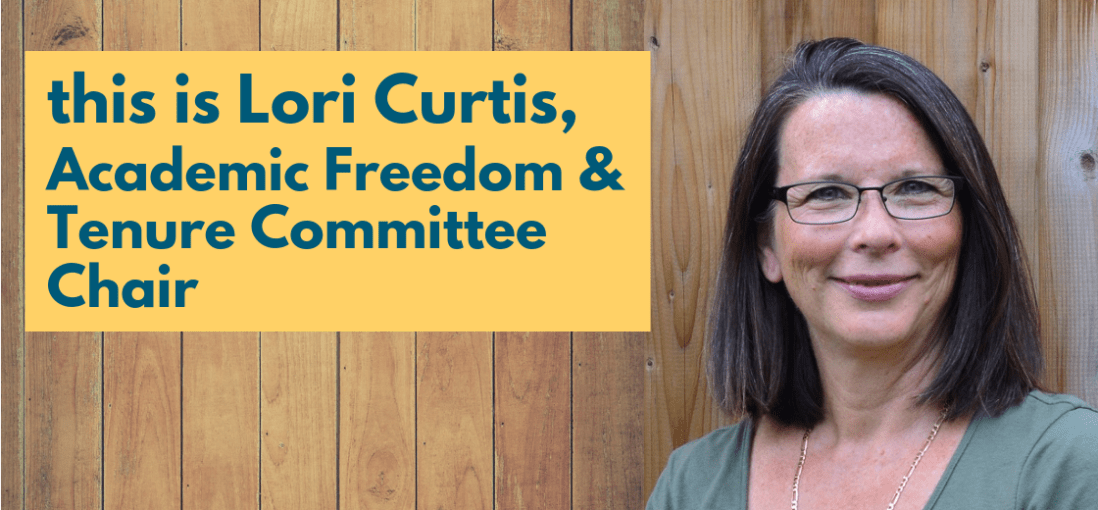
This is Lori Curtis, Academic Freedom & Tenure Committee chair

Our “People You Should Know” blog series interviews key people and offices at the University of Waterloo so you can make the most of their services. 

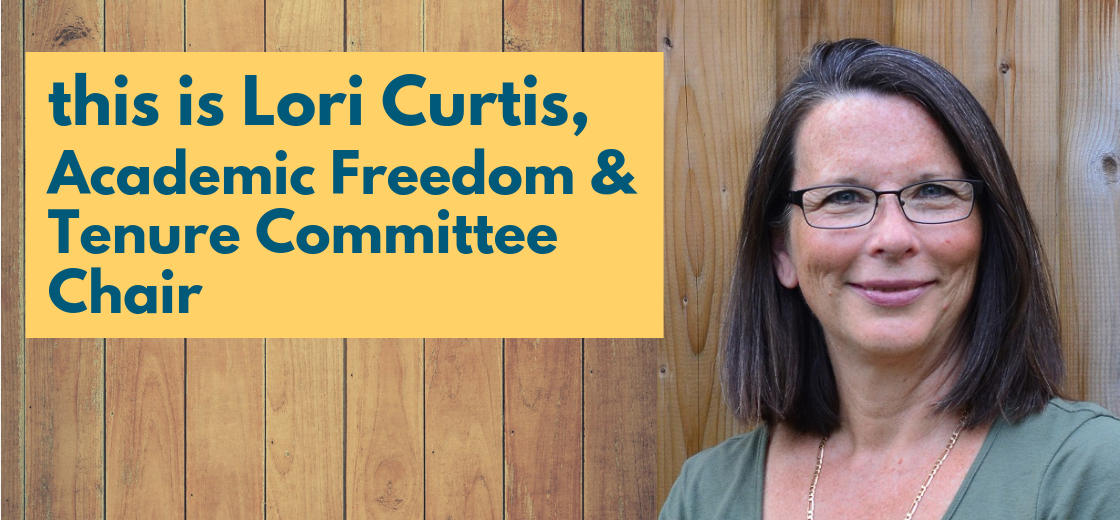
We’re kicking off this series with Lori Curtis. Lori is the new chair of the Academic Freedom & Tenure Committee (AF&T), which helps faculty members at Waterloo with a wide range of workplace questions and problems. We sat down for an interview in her office in November.

This is Lori Curtis, Academic Freedom & Tenure Committee chair

FAUW: Lori, What is the Academic Freedom & Tenure Committee?

Lori: It’s senior faculty members who can act as an academic colleague for other faculty—a peer who knows the academic situation that you’re in. They can attend meetings with you, help you work through issues, or just listen.

We get a lot of questions on tenure, promotion, and contract renewal. We also, unfortunately, talk to faculty who are having issues with other faculty members.

What do you bring to this role?

I have an eclectic background. I used to be a nurse, I’ve worked in government, and in a couple of universities. I’ve worked in both unionized and non-unionized environments so I can talk people through the difference between us and a unionized organization.

I think I bring a bit of logic to academia. Sometimes academics haven’t worked outside the university environment, and I don’t want to say they don’t quite understand the real world, but sometimes they don’t quite understand the real world. I also bring a bit of experience with mental health work.

Continue reading “People You Should Know: Lori Curtis, Academic Freedom and Tenure Committee”

Double Recap: General Meeting and December 6 Board Meeting

December 4 general meeting

Missed the general meeting? Here’s a quick recap, excluding items covered in previous blog posts. See the general meeting slides (PDF) and the agenda package (PDF) for more details.

  1. We had an inquisitive group of about 60 faculty members who ate a lot of pizza and not a lot of raw veggies (not judging; we love pizza).
  2. We’ve had a few changes to the budget since you saw it in April. Some of the new expenses are: giving the Renison Association of Academic Staff an interest-free loan and startup funding, helping fund a bike cage on campus, and upping our sponsorship of the Centre for Teaching Excellence conference breakfast. We’re still expecting a decent surplus.
  3. Members approved our audited financial statements for May–April 2018 (the mini-fiscal year that got us onto the same fiscal year as the University) and adopted RLB as our auditors for next year.
  4. The Elections Committee announced winter 2019 elections: four at-large representatives, one representative from AHS, and one lecturer representative. As per our new elections procedures (announced on the blog and posted online in September), members can only run for one seat at a time. Remember that you need to be a voting member to run or vote in FAUW elections.
  5. Members approved the service agreement with the Renison Association of Academic Staff, making their members affiliate members of FAUW.
  6. George Freeman gave his take on the themes that emerged at the University’s strategic plan consultations. Check out the slides for a list.
  7. We heard your feedback on the Freedom of Speech policy. We’ve summarized and forwarded this to the Secretariat and they are incorporating at least some of it. If you want to give more feedback or see a revised draft, you can meet with the University President and representatives from the Secretariat in the Senate room (NH 3407) at 3:30 on Monday, December 17.

December 6 board meeting

At our last board meeting of 2018, we talked about:

  1. How graduate teaching is counted. To no one’s surprise, there’s some inconsistency across campus on this front. But we just confirmed at FRC that teaching a stand-alone lecture-based graduate course counts toward your workload. Make sure you’re getting teaching credit for these courses! And if you’re teaching overload, make sure that’s being tracked and made up for later. In other words: Don’t teach for free.
  2. Appointment letters. Again. Ninety percent of faculty associations receive copies of their members’ appointment letters. This helps them advise members on negotiating a starting salary, startup funds, and anything else that’s negotiable. We can’t advise prospective faculty right now, because we don’t have any data. We don’t even know what’s negotiable in every department. While we’re working on getting at least some of that information, we’re going to start asking new faculty directly if they’re willing to share copies of their letters, and we will also send a request to all new faculty from the last five years. If you’re willing to share your own, we’d be happy to add it to our data set! You can send it to Erin Windibank at windibae@uwaterloo.ca. We will of course keep your letter confidential.
  3. Lecturer eligibility for DTPC and FTPC. The Lecturers Committee is wondering why Policy 77 (Tenure and Promotion of Faculty Members) excludes lecturers from serving on and even voting on the makeup of departmental and faculty tenure and promotion committees, considering that these committees grant/deny continuing status to lecturers. Our take on this is that the policy pre-dates the existence of modern lecturer appointments and is out of date. We know that some departments and Faculties are following the spirit, rather than the letter, of the policy, and do include lecturers. We are hopeful that Policy 76 (Faculty Appointments, which is nearing the end of its review process) can provide an interim solution to this problem.

What you should know about the Ontario University Pension Plan (video)

The University Pension Plan (UPP) is Ontario’s new multi-employer pension plan for university employees. It has been developed by a consortium that includes the Council of Ontario Universities (representing employers), OCUFA, CUPE and other employee representative groups. Three universities—Queen’s, Toronto, and Guelph—are lined up to be the first participants, with a transfer from their current plans scheduled for 2019. If those transfers proceed smoothly, it is likely that other universities will be encouraged to join the UPP in the future.

On November 16, FAUW hosted Professor Mary Hardy (Statistics and Actuarial Science) for a talk in which she described and critiqued the UPP in terms of affordability, risk, fairness, and adequacy, and reviewed the case for and against membership of the UPP from the perspective of UW (and Laurier) pension plan members and retirees.

We’re happy to make a video of the talk and the slides available to help inform our members and other university employees.

Continue reading “What you should know about the Ontario University Pension Plan (video)”