To Correct the Record

David Porreca, FAUW President

On 15 November 2023, a message was posted to the Lecturers Connect blog that caught my attention due to several factual errors it contains. This brief post aims to correct each of these in turn.

“While Prof. Hardy retired in July, she only got removed in November on the grounds that she is no longer a member of FAUW.”

The Faculty Relations Committee decided to remove Prof. Mary Hardy at its second meeting of this year’s cycle back in September, not November. The removal of Prof. Hardy is completely unrelated to the removal of Dr. Tan for reasons of conflict of interest.


“We strongly believe that FAUW and Lecturers Connect have common goals in improving Lecturers working conditions, and should work together in achieving these goals.”

FAUW very much shares these goals. The means by which to achieve them was what was in question when it came to Dr. Tan’s removal from the P76/77 PDC: her involvement in P76/77 negotiations for Lecturers on behalf of FAUW along with her leadership position in a union drive for Lecturers outside of FAUW are clearly incompatible.


“…the future union “to maintain a close relationship with FAUW in the same way that Renison Association of Academic Staff (RAAS) does…”

The biggest difference is that the RAAS members were never originally part of FAUW, so them having a separate union was never an issue for the integrity of the organization.


At the November 7th Town Hall, the FAUW President mentioned that neither the governance review nor a FAUW unionization drive are among FAUW’s top priorities.”

The governance review is very much among our top priorities, but it is not an exercise to be taken lightly. We need a full complement of staff in order to undertake this sorely needed review and give it the attention it truly needs and deserves.


“Collegial governance works when the two parties agree. But what if they disagree? Is there really any way to influence the employer? Unfortunately, FAUW has little to no leverage in this.”

FAUW has plenty of leverage, since our agreement is necessary for any changes to any policy that affects terms and conditions of employment of faculty (Class F and FS policies), or the MoA. The fact that we are not unionized provides additional leverage in terms of having the possibility of unionization remaining on the table at any and all times. Institutions get the unions they deserve, and UW’s administration hasn’t warranted one – yet. The added advantage is that unlike for a union and the lever of striking, our leverage does not threaten to disrupt students in their studies.


“Early in the history of the labour movement, it has been understood that the employer and employees quite often have conflicting goals…”

There exist conflicting goals, but there is also plenty of too-often-overlooked common ground. Collegial collaboration is often more productive, less expensive, and yields beneficial results with less effort than adopting a reflexively adversarial stance.


“…unions have their own staff, whose salary are usually paid entirely from members’ dues. In contrast, FAUW’s staff is being paid by the university, at least partially.”

FAUW’s staff are 100% paid through FAUW dues.


“[FAUW’s governance] review was launched in November 2021 and supported by the Canadian Association of University Teachers (CAUT), but still has not gotten off the ground two years later.”

We retain the support of CAUT in undertaking the governance review. As stated above, it is the lack of staff support that has hindered FAUW from beginning the governance review in earnest. In the two years since the governance review was mandated, FAUW has only been fully staffed for approximately six months.
Message to the FAUW membership re: 28 June attack: Part II


This message is intended to outline the various queries and demands that the Faculty Association directs at the administration in reaction to the horrific attack on a class on 28 June.

1. Emergency Communications

  • UW has an emergency communications app that was never used throughout the incident. Why?
  • Who made the decision that the app would be taken offline? Why?
  • What plans are in place for alternative emergency communications when the app is unavailable?
  • Why were conflicting instructions given to faculty, students, and staff?
  • Who on campus is responsible for emergency communications?
  • Was the app back up and running when the senior administration made the decision to continue classes normally, except in HH, during that evening?
  • Who is the vendor for this app? How often is the app unavailable?

2. Extremist threats and violence

  • How does the administrations currently track threats of extremist and hate-motivated violence on campus?
  • How are extremist individuals and groups identified and what measures are in place to protect students, faculty, and staff from them?
  • What are the immediate plans to protect instructors and students that might be especially targeted, for example, in courses in Gender and Social Justice, Black Studies, Indigenous Studies?
  • What are the immediate plans to protect staff and offices that support these courses and areas of study and research?
  • What are the medium and longer term plans to develop protections and to combat hate and extremism on campus?
  • How will faculty members with relevant expertise be involved in developing these plans?
  • How will students and staff be involved?
Continue reading “Message to the FAUW membership re: 28 June attack: Part II”

FAUW Statement on the Violent Campus Attack on 28 June 2023

FAUW is appalled at what appears to be an act of extremist violence in one of our classrooms last Wednesday afternoon.

Associate Professor of Philosophy, Associate Chair (Undergraduate Studies), and FAUW Parliamentarian, Dr. Katy Fulfer, was attacked in the middle of a class she was teaching. Two students were also attacked. We extend our deepest sympathy to all three and wish them a speedy recovery.

My purpose in writing to FAUW members this morning is to add FAUW’s voice to the outcry against this heinous attack and also to offer the Association’s support and sympathy to those affected, beginning with Katy herself, her students, and the rest of the campus community.

Anyone wishing to sign a card and convey a message of support to Katy is invited to come to the FAUW offices on Monday or Tuesday next week, 10:00 – 15:00 in MC 4002.

A message setting out a list of questions and demands that FAUW will bring to the senior administration will follow early next week.

Again, let me extend our deepest sympathies to the victims of last week’s hateful attack.

David Porreca
FAUW President

FAUW President’s Report, Part I

David Porreca, FAUW President, 21 June 2023

The Faculty Association of the University of Waterloo is at an important moment in its history. During a long and difficult policy negotiation process with the university administration regarding lecturers’ terms and conditions of work, our association Board passed a motion on June 9 “that FAUW supports the unionization of Lecturers within FAUW and will commence a certification drive to that end.”

By way of providing a clear picture of how we came to this decision, and how we can move forward together, I have written a series of blog posts. I want to begin this series of blog posts with a reminder of what FAUW has managed to accomplish for its membership over time, lecturers and regular faculty members alike in most cases – note that some items are more recent than others:

  • For lecturers: A reduction in course load from seven to six per year, at substantial cost to the institution
  • For lecturers: “Two-years-less-a-day” contracts have been abolished, such that those on two-year contracts are now eligible for benefits
  • For lecturers: Salary floors and thresholds raised substantially (à two negotiations ago)
  • For lecturers: A two-week vacation carryover that does not expire until the individual has a non-teaching term
  • For all: A 5% raise over two years, during an economic downturn, at substantial cost to the institution (this is on top of the regular salary negotiations that will resume this Fall and into next year on their regular schedule)
  • For all: Eye care benefit of $85/yr, which is infinitely better than nothing (which is what we had until the last round of bargaining). Moreover, because it’s tax-free, amounts to +/- 2x that amount; other higher ed institutions have other deals that may look better on this particular item, but our benefits package is likely better than theirs in other respects (FAUW’s benefits negotiations have focused on ensuring that members are protected against the costs of catastrophic illness – it has chosen to prioritize members who have the greatest medical needs)
  • For all: Better compassionate care and bereavement leaves, with no waiting period for new hires
  • Better parental leave benefits
  • Better access to retirement benefits
  • A pension plan that is among the most robust in the province
  • A better process for disability accommodations
  • Better dental benefits than previously
  • A regular salary anomaly review process

But is it enough? No, because you are telling us it’s not, and we are listening. Stay tuned for Part II: What Does “certification within FAUW” Involve?


FAUW Nominations and Election Committee needs YOU!

By Patrick Lam and David Porreca

A quick blog post this time to put on everyone’s radar the need to populate FAUW’s Nominations and Elections Committee (NEC). This is the committee responsible for finding good people to fill all the faculty representative positions on the University-operated committees where we (as faculty) need a voice, which is a key part of collegial governance at the University. We currently need AT LEAST ONE additional person to bring this Committee back to full capacity.

In addition, the NEC solicits nominations for FAUW’s own internal governance positions, such as the President and the elected members of the FAUW Board of Directors. There will be three vacancies on the FAUW Board as of 1 July 2023.

Please email patrick.lam@uwaterloo.ca by June 16th if you, or someone you know, would like to serve on this committee!

Inaugural Blog Post… + Samosas!-David Porreca, FAUW President (Department of Classical Studies)

First: A hearty (and heart-felt) thank-you to Mary Hardy for shepherding FAUW through the difficult past few months, stepping into the breach and supporting the association when the help was sorely needed.

Second: Another note of thanks for the support the membership has shown in entrusting me with the FAUW presidency in these fraught times. I intend to do my level best to honour that trust.

But how?

My focus is on FAUW’s core duties: defending and enhancing the term and conditions of employment of faculty members at the University of Waterloo (that’s YOU). My first task is to assist in the formation of a strong negotiating team for the upcoming round of negotiations toward a salary settlement that should take effect on 1 May 2024. Stay tuned for announcements on that front.

FAUW’s core duties also include the defence of the following three basic principles—a well-balanced tripod, so to speak: collegial governance, academic freedom, and equity. Over-emphasizing any one of them at the expense of the others leads to an imbalance that risks toppling the whole.

Continue reading “Inaugural Blog Post… + Samosas!-David Porreca, FAUW President (Department of Classical Studies)”

Keeping Our Foot on the Equity Gas Pedal

A post from the FAUW Lecturers Committee and FAUW Equity Committee.

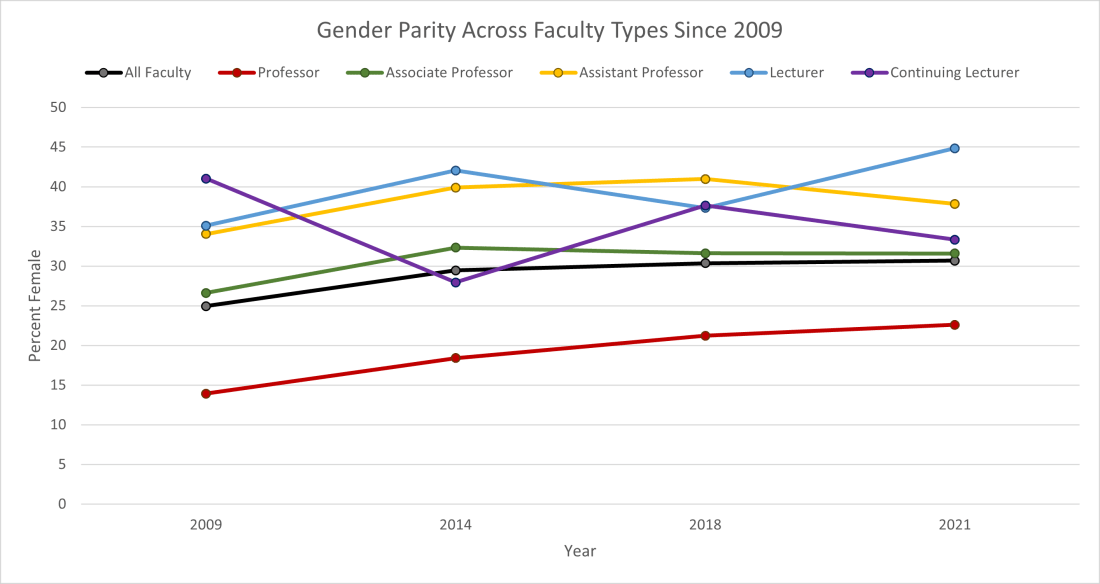
The University of Waterloo made an important commitment to make progress towards gender equity by joining the HeForShe initiative in 2014 and meeting its faculty HeForShe commitments in 2018. Of particular note for this blog post is the goal of 30% female faculty representation. Efforts towards gender parity, particularly in faculty positions, need to be long-term and sustained to ensure that equity considerations in the hiring process, promotion process, and general work culture become and persist as the norm. What is more, equity needs to occur at the micro level (i.e., faculties and departments) in addition to the macro level (i.e., university-wide). When looking at gender parity in our faculty members since 2009, university-wide, the impact of the HeForShe campaign and other equity initiatives is clear. Faculty-wide female representation has increased steadily from 25% in 2009 to almost 31% in 2021. While this is indeed progress, there are some areas for improvement. In this post, we would like to track UW’s gender parity, but it is important to note that the data we draw from is limited in that it retains cis-gender binary distinctions. 

Looking at specific faculty roles, it is clear there is a need for sustained long-term equity efforts. First, female representation at the full professor level is much lower compared to other faculty roles. While there was a fairly steady rate of female representation at the associate professor level (~31.6%), there was a decline in female representation in assistant professors and continuing lecturers from 2018 to 2021. These could be early warning signs that we are taking our foot off the metaphorical equity gas pedal. The decline in assistant professor female representation is particularly worrisome, given that this is the beginning of the current professorial ranks (i.e., assistant, associate, and full professor) and declines in female representation at this rank will make it impossible to achieve the long-term change needed at the full professor rank. We all need to keep our foot on the gas pedal to ensure that equity gains are sustained in the long-term across all faculty ranks.

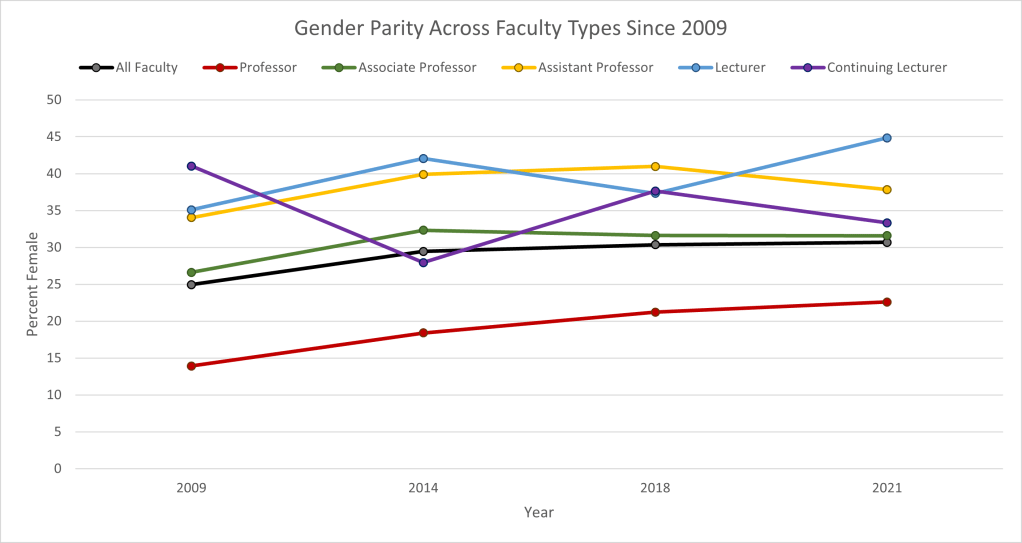
Graph depicting female representation in different faculty types in 2009, 2014, 2018, and 2021. For all faculty, female representation was 25% in 2009, 29% in 2014, 30% in 2018, and 31% in 2021. For full professors, female representation was 14% in 2009, 18% in 2014, 21% in 2018, and 23% in 2021. For associate professors, female representation was 27% in 2009, 32% in 2014, 32% in 2018, and 32% in 2021. For assistant professors, female representation was 34% in 2009, 40% in 2014, 41% in 2018, and 38% in 2021. For continuing lecturers, female representation was 41% in 2009, 28% in 2014, 38% in 2018, and 33% in 2021. For all lecturers, female representation was 35% in 2009, 42% in 2014, 37% in 2018, and 45% in 2021.
Figure 1. University Level Gender Parity Across Faculty Types 2009 – 2021. Data Source: Statistics Canada University and College Academic Staff System (UCASS)
Continue reading “Keeping Our Foot on the Equity Gas Pedal”

Faculty need more support to meet increasing teaching workload and expectations

faculty members need more support to meet increasing teaching workload and expectations

FAUW members, other instructors, and the many staff members who support teaching and learning at the University of Waterloo have gone above and beyond over the last two years to continue delivering excellent education to Waterloo students. The abrupt change to remote teaching last year accelerated positive innovations that were already in the planning stages. Together, we have learned new technologies, developed new digital assets, and experimented with new pedagogical approaches. Quickly adopting and adapting these approaches and innovations has required a huge effort by dedicated instructors and students alike.

This change has also come at a cost to many students due to technology issues, a sense of disconnection, and a lack of appropriate learning environments. For students who have not yet developed independent study skills and self-discipline, the switch to remote has been particularly difficult. As we prepare to return to on-campus teaching in the coming months, we have an opportunity to ensure that we carry forward the positive features and the lessons from this experience into a future of teaching and learning that is better for everyone.

These changes are far from over. The University—all universities—must significantly increase the resources available to enable instructors to deliver adaptable and universally accessible teaching.

Continue reading “Faculty need more support to meet increasing teaching workload and expectations”

Real academics don’t take vacations?

Our recent post “Help Dr. X take their vacation” received many spirited replies.

Some offered practical suggestions for Lecturers like Dr. X who teach three terms a year:

  • Post online content instead of class instruction for two weeks. How would chairs feel about this? What about students who listen to the online content and then email with a question or ask for help? Would the answer “I’m on vacation and will get back to you” be satisfactory?
  • Get someone else to cover your classes for two weeks. This sounds great, except … who would that be? Would you regularly take on extra work to “cover” for a colleague on vacation?
  • Take a holiday during fall break and reading week. Since many faculty use the “break” to mark or to prepare, a holiday at this time would take very careful planning. And some faculty have been called out for not being available to students or for not answering work emails during these times.

It’s also worth noting that Lecturers are far more likely than Professors to be held to the requirements of Memorandum of Agreement 11.2.3: “Vacation shall be scheduled at a time or times which are mutually satisfactory to the Member and the Department Chair.”

But some replies to the blog, both in the comments and elsewhere, hinted that vacations weren’t really the “done thing.”

Do academics even take vacations?

A recent meme suggests that eschewing vacations is a particularly North American phenomenon.

Could the “American” attitude also be the normal academic one? Do we dismiss the very idea of taking time away from our jobs?

If so, what are the costs of an academic culture that values, not just work, but overwork? What, for example, are we modelling for (and expecting from) our graduate students if “no vacations” is the accepted norm? Is this healthy—physically, socially, psychologically?

Continue reading “Real academics don’t take vacations?”

12 questions to help you thrive in your mid-career years

12 questions to help you plan your midcareer years

The “mid-career slump” is a well-documented dip in job satisfaction and direction that is common among recently tenured faculty members. You can read about the phenomenon in this collection of articles we’ve gathered for FAUW workshop participants over the last few years.

With some reflection and planning—and by using your new job security to take some risks and try new things—you can avoid, or at least mitigate, the mid-career slump. The articles in the folder linked above provide some practical suggestions, and the National Center for Faculty Development & Diversity, which UW just joined, has a one-hour webinar on “Getting to Mid-career and Beyond” coming up on March 23. (To activate your NCFDD membership, visit www.facultydiversity.org/join and follow the prompts.)

FAUW also offers a workshop on this topic. At the most recent session in December 2020, five mid-career faculty members shared advice for avoiding the mid-career slump and mapping out the years following tenure (or the lecturer equivalent at UW: a continuing appointment).

Based on the experiences and advice of these panelists, here are 12 questions to help you design and make the most of the next few (or many) years of your career by looking at where you are now, identifying new opportunities, and planning with the end in mind.

Continue reading “12 questions to help you thrive in your mid-career years”