
FAUW Issues Update

David Porreca, FAUW president

It has been an extremely busy start to the Fall term.  Now that we are at the mid-way point, it is time to provide you, dear reader, with an update as to what has been keeping us at FAUW on our toes over the past several weeks.

ADDS status

The task force on the Approved Doctoral Dissertation Supervisor status regulations is pursuing its work with a view to reporting to the Faculty Relations Committee and the Graduate Student Relations Committee in November.  We are looking at solutions to ensure good graduate supervision that meets students’ needs while addressing the manifold concerns with how the current ADDS policy is communicated, applied and enforced.  At FAUW’s request, the Provost’s Office has written to each individual faculty member who has been hired in the past 6 years to inform them of the current policy, and equivalent language has been included in employment letters for those colleagues hired this past year.

Since doctoral dissertation supervisors can belong to a number of different categories of faculty members (e.g., visiting, clinical, tenure-track, tenured at UW, hired with tenure from elsewhere), the eventual policy would need to be formulated in such a way as to address the issues relating specifically to each one.

New AF&T chair

I am very pleased to announce that our colleague Christopher Small from Statistics and Actuarial Science had kindly agreed to replace Peter Van Beek as the Chair of FAUW’s Academic Freedom and Tenure Committee when the latter ends his term of office at the end of August 2014.  The AF&T Chair is a challenging position that can have an enormously positive impact on the careers of our members, and we at FAUW are very pleased that Christopher has expressed such keenness to take on the role.

Athletics

Our blog post from September 9 highlighted some of the issues relating to athletics that affect faculty members’ working environment.  New concerns have come to light in the meantime:

    University of Waterloo Physical Activities Complex

  1. There is no controlled access to the change rooms (e.g., turnstiles), which is commonplace in most reputable athletics facilities.
  2. All staff members who dispense towels and oversee the (otherwise) uncontrolled access to the change rooms must walk through the men’s change room area in order to gain access to their office space.
  3. Upon examination of the floor plan of the PAC, it turns out that the female change room is about ½ the size of the men’s. Unless there is a demonstrable difference in usage rates between the two groups, this layout is evidently problematic from an equity perspective.
  4. A rough estimate sees 1/3 of the lockers in the men’s change room being broken and unusable, and another 1/3 being unused (those with the locks upside down). In other words, the space is under-used by a substantial margin. The lockers are in a deplorable condition, and we should all be grateful that campus ambassadors do not take visitors through the change rooms.

In light of the above, the Faculty Association is pushing for renovations to the PAC that would

  • Restore separate change rooms for faculty and staff
  • Replace the lockers with new equipment
  • Maintain safe access to the emergency exits
  • Ideally, address the concern over equity

If all groups of stakeholders – faculty (FAUW), staff (UWSA), graduate students (GSA), undergraduate students (Feds) and the university administration (via Athletics or the Provost’s Office) – could come together to fund such renovations, all the stated groups would benefit at a modest cost to each.

Also, feedback from female colleagues as to the state of the women’s change rooms at the PAC would be greatly appreciated.  Please comment below or e-mail the FAUW president at dporreca@uwaterloo.ca.

Best practices in hiring

FAUW’s Status of Women and Equity Committee (SWEC) produced a 6-page report on “Best Practices in Hiring” for faculty members. This document has received endorsement by Deans’ Council and will be presented to the Executive Council of the university in late November. Recognition of the need for such a document at those high levels of university administration is an encouraging sign to be sure, as long as we eventually see proportional corresponding action.

Grad House memberships

Some of you have been asking about how faculty memberships at the Grad House work. Henry Ensley, manager of the Grad House, has written a letter explaining how it all works.

Instructor evaluations

FAUW is being consulted on what shape we would like to see course evaluations take in the future. Discussions will include student representatives and qualified staff from CTE. If you have strong feelings or ideas you’re willing to share about course evaluations, please comment below or e-mail the FAUW president at dporreca@uwaterloo.ca.

OCUFA Queen’s Park Lobby Day

UW’s Kate Lawson (OCUFA President) and David Porreca (FAUW President) met with four local MPPs on Wednesday 23 October at Queen’s Park: Ted Arnott (PC – Wellington–Halton Hills); Catherine Fife (NDP – Kitchener–Waterloo); Rob Leone (Cambridge) and Hon. John Milloy (Kitchener Centre). We had four basic messages to deliver to our representatives:

  1. That the province needs to fund an independent study on the working conditions of contract academic staff across the province in order to help resolve long-standing concerns about their job precariousness, lack of real academic freedom and potential for exploitation.
  2. That the province needs to provide temporary solvency relief to university sector pension plans for those institutions that need it.  We had been asking for a 1-year extension of such relief in order to give enough time to OCUFA to complete its study on university-sector pension plans. Much to our relief, however, in the middle of our meeting sessions, news came out that the province had granted a 3-year window of solvency relief.
  3. That the province needs to restore funding to its faculties of education. This question did not concern UW as much, so I shall not belabour it here.
  4. That the province need not incentivize differentiation between universities in the province because institutions of higher education are already plenty differentiated as it is, from small liberal arts colleges to the University of Toronto, with UW standing out – among other things – for its long-standing commitment to the co-op stream and for having a full Faculty of Mathematics.

Our messages were well-received, in particular, the first point, with members from all three parties agreeing to request such a study from the Minister of Training, Colleges and Universities.

Scheduling

FAUW is anxiously awaiting the results of the latest simulation of the new scheduling system, as discussed in last week’s post by Bryan Tolson.

Senate bylaws

The Secretariat has announced plans to undertake a full-scale revision of the Senate bylaws. The first phase of this initiative is restricted to housekeeping changes, but revisions to Section 5 (selection of members of the Senate) are being left for last as they are more likely to be substantive. These revisions require great vigilance to ensure that nothing deleterious to our working lives as faculty members happens as a result of the proposed changes.  Faculty senators are encouraged to exercise active vigilance when these documents become available for consideration.

UW’s numbered policies

The Secretariat is also undertaking a full-scale multi-phased revision of all 69 of UW’s numbered policies (still listed as 1-77, with some gaps).  The first phase will involve housekeeping changes (e.g., regularizing and updating the names of buildings and offices that are mentioned in the policies), but later phases will also involve substantive changes.  Through the Faculty Relations Committee, the approval of the Faculty Association will be necessary for any changes that are to be made to Class F, FS and A policies.  FAUW plans to devote substantial time and energy to make sure that any changes are favourable to faculty members’ interests.  The numbered guidelines and procedures will also be subject of an eventual analogous revision.

Work-Life Balance Report update

The joint FAUW/Provost’s Office Work-Life Balance Report that was presented to Senate back in February 2013 is becoming integrated purposefully into the “Value System” focus area of UW’s newly released (but-not-yet-fully-Senate-approved) Strategic Plan.  FAUW’s Status of Women and Equity Committee produced a “Compassionate Care and Bereavement Leave” report that will be considered in conjunction with the WLB report at the same level.

Event reminders

Please mark your calendars for the following events:

Privacy Colloquium: Wednesday, December 4, 2 – 5 in M3 1006, with reception to follow.
Fall General Meeting: Monday, December 9, 11-1, Location TBA. Light lunch provided

Scheduling System Update

Bryan Tolson, FAUW Director, Civil & Environmental Engineering

UW continues to move closer to implementing a proposed new scheduling system based on InfoSilem software. FAUW has been working hard to understand the impacts of the proposed system and has taken the position that the new software should not be implemented until it has been clearly demonstrated that it produces better results for all stakeholders than what we currently have. The Provost has agreed to this request. We want to share what we understand about the proposed scheduling system and urge you to join the discussion on this important issue.

Why you should care

As we all know, the inherent flexibility in course scheduling is one of the principal benefits of being a faculty member. This benefit functions to improve our work-life balance and allows us to do our jobs to the best of our ability.  For some of us, this means that we get to teach when we believe we teach best.  For others, it means we get to define blocks of time for research tasks and regular out of town research meetings and these blocks of time help us work as efficiently as possible. For some, like me, this benefit functions to ensure we can have a life where we can pick up the kids from daycare at a reasonable time or take them to hockey practice.

Moving to the proposed system could reduce our scheduling flexibility.  Such a change is totally reasonable if it is demonstrably required, e.g., students are not graduating on time under the current scheduling system. It is not so clear-cut given the primary reason for the new system, as FAUW understands, is to provide virtually all students with conflict-free schedules instead of forcing them to settle for their #2 or #3 choices of electives. To me, this lack of clarity defines the scheduling problem as a balancing act between undergraduate student scheduling preferences and faculty preferences (benefits).

Current status of the proposed scheduling system

FAUW has been told that the results of Simulation 3, which is the proposed system’s attempt at scheduling the 2013 Fall term for comparison with the actual Fall schedule, will be made available to individual faculty members within a few weeks.  FAUW is very concerned about the results of Simulation 3 will be the last piece of evidence examined to ultimately deem the proposed system better and hence go live with the software for scheduling the summer 2014 term. Despite Simulation 3 being the most realistic test of the scheduling software to date, there remain serious problems and ambiguities that are currently unresolved.  Let me share a few of these with you (note that this is not an exhaustive list):

  • Simulation 3 results will not be an accurate representation of reality because
    • An unknown and potentially significant number of faculty who are teaching in the 2013 Fall term did not specify their teaching constraints or preferences (you should have been asked for yours by your departmental scheduling representative and the assumption by the Registrar’s Office is that you have been asked).
    • The settings for faculty preferences in Simulation 3 will virtually ensure all faculty preferences are met because all preferences are ranked equally.  While in a real schedule build, these preferences would be assigned the lowest priority.
  • FAUW does not know the form of the objective function the scheduling software is actually trying to optimize when it builds a schedule.
  • Despite the reality of balancing student preferences with faculty preferences, there is no plan currently to use the software in a way to understand the balance or tradeoff between these competing objectives
  • There are seemingly no plans to conduct a simulation (i.e., test the software) for the Winter or Summer terms
  • We are concerned about the impact of this new system on the academic life of our students because we feel they also have not been consulted adequately

Another reason Simulation 3 is not accurate is that faculty members were not told what the software could do with individual schedules if preferences to the contrary were not specified.  For example, the software settings used in Simulation 3 could create a schedule that has you teaching back to back classes or teaching 5 hrs in one day…unless you specified an instructor preference to avoid these.  After I examined all the things the software could do based on the Provost’s Advisory Committee on Timetabling (PACT) documentation for Instructor Accommodation requests, I developed my list of Accommodation requests (my constraints and preferences) that I plan to submit for the next Simulation (or real schedule build).  I list them below so that other members can have some insight into the kind of accommodation requests they want to consider.

Bryan Tolson’s instructor accommodation requests for Winter & Spring terms

  • 4:30 – 5:30 pm, M-F:  child care logistical constraint.  Level 1[a]
  • No teaching at after 5:30 pm, M-F:  child care logistical constraint.  Level 1[a]
  • Regular University Level Administrative meetings (no teaching):
    • Mondays 3:30 – 5:30.  Level 1
    • Thursdays 2:30 – 4:30. Level 1
  • No back to back lectures.  Level 3
  • No lectures longer than 1.5 hrs.  Level 3
  • Prefer teaching 1 lecture per day.  Level 3[b]
  • No lectures on Fridays after 2:30 (Winter).  Level 3[c]
  • No lectures on Fridays after 11:30 (Spring).  Level 3[c][d]
  • No lectures 3:30 – 4:30 (Spring).  Level 3[d]

a There are two levels of child care accommodations with Level 1 having higher priority than Level 2.
By default the software assumes you prefer 2 days of non-teaching and thus squeezes two or more classes per day for one or more days.
c Many others will likely ask for this so if I don’t, the chances I teach Friday afternoons skyrocket.
d Teaching in the summer is not great because of an increase in family activities. Hence, if I‘m teaching I want my days to end early enough to allow for these activities.  Plus there should be more flexibility to build faculty-friendly schedules during the spring term.

How much you have to justify each of your preferences depends on your department, I suppose.  After you submit accommodation requests, I am not sure how much chairs will filter these requests.  I am also not sure if there is a feedback loop to tell you if an accommodation has been rejected by the chair.  So there appear to be some important departmental level discussions that you may want to ens
ure take place. If you are unclear about the definition of Level 1, 2 and 3 accommodations, this is something your chair/department scheduling representative or the PACT committee should be telling you.  Go to the same sources for the other potentially undesirable things the scheduling software will enable by default to happen to your schedule. FAUW will eventually step in to clarify these questions to our members if that becomes necessary but we are hopeful the communication lines to faculty are soon wide open.

Next steps for FAUW and faculty members

We will continue to try and understand the proposed system and work with the Registrar’s Office to iron out problems that come up.  We want to understand if the new system is better for faculty.  We want the best balanced schedule for everyone on campus.  Assuming the proposed scheduling system becomes a reality, we want a smooth transition and our insistence on continued simulations (testing) will help in that regard.  Reaching these goals requires feedback from our members.  If you are as concerned as we are about the proposed scheduling system and want to be more engaged, there are three things you can consider doing:

  1. Contact your departmental scheduling representative and make sure you understand how the process in your department works for specifying instructor accommodations.
  2. If you are teaching this term, please provide direct feedback to your scheduling representative or chair on your satisfaction with the scheduling results of Simulation 3 (which will supposedly be released within a few weeks).  Please respond to the survey you will eventually be asked to fill out regarding Simulation 3.  Be aware that the official feedback mechanism to the administration on faculty satisfaction will go through the chair/department scheduling representative and not FAUW.
  3. Consider contacting one of your Faculty’s PACT representatives with feedback they can bring to their next meeting.  PACT members are listed on the STEP Project website.

FAUW’s ideal case scenario

Each individual faculty member should be empowered to designate a certain number of hours per week of non-teaching time, regardless of the rationale.  So far, this solution has been deemed infeasible for reasons that are unclear to us, but we will continue to explore ways in which it can be achieved.  Importantly, any such solution must have minimal impacts on our students’ timetabling.  Please contribute to the discussion by commenting below.

Privacy Colloquium

After a lengthy period of looking at various possibilities by a broad group on campus, the University is currently considering adoption of online processing of expense claims using Concur, a US-based company with a US-hosted system. As part of the consultation process, we are organizing an information session on the privacy aspects if we were to go ahead with Concur for this purpose. There will be two speakers, Jim Turk, Executive Director of the Canadian Association of University Teachers (CAUT), and Fred Carter, Senior Policy and Technology Advisor of the Ontario Privacy Commissioner’s Office. Following their presentations, there will be a question and answer session with a panel that includes the two speakers, together with other experts.

Prior to the Colloquium, Karen Jack, the University’s Privacy Officer, will send a list of questions to Fred Carter of the Ontario Privacy Commissioner’s Office, and Jim Turk of CAUT, asking that these be addressed as part of the presentations at the Colloquium. Your suggestions for questions of concern and interest would be much appreciated; please make them on the following web page by October 22.

https://uwaterloo.ca/online-expense-claims/privacy-colloquium-questions

The colloquium will be held on Wednesday, December 4th,  2 – 5 pm (followed by reception), in M3 1006. Please mark the date on your calendar for this important event.

Come back next week for a post breaking down what’s going on with the new scheduling system!

News from the OCUFA Director

—Jasmin Habib, FAUW Ontario Confederation of Faculty Associations (OCUFA) Director

The OCUFA Board of Directors meeting that FAUW President David Porreca and I attended at the end of September was intense. While FAUW is engaged in important discussions about, for example, scheduling and the balance between work and home lives, both David and I were struck with the very serious threats that appear to be facing some of our colleagues across the province.

For example:

Major reforms to pension and benefits packages are likely. Some of the richer benefits packages, for example, those that offer post-retirement research allowances (Professional Expense Reimbursements), are likely to be hardest hit.

Program Prioritisation and Planning processes are underway at several universities and it appears they will lead to deep cuts to programs and academic staff.  Reports across the province are that these cost-cutting measures will be made at the expense of pedagogical excellence.

Serious concerns were also raised about a leaked document that sets out the Province’s “Differentiation Policy Framework”. Since we can all agree that our universities are already “differentiated,” at least to some extent, we do not have any clear sense as to why this particular policy has been introduced or exactly how it will be implemented.  As one Director put it: it seems that the Province is finding all sorts of bottom-drawer policies that may not make any programmatic sense (they may even contradict one another) but they just haven’t been tried out yet. What is most worrisome is that it appears – on the face of it – that smaller universities and their programs will be at highest risk.  To date, OCUFA has not been invited to comment on the matter, which is troubling. Nonetheless, they have made a public statement, as follows: “OCUFA will oppose any policy framework that allows government to interfere in academic decision making, properly the responsibility of university senates.”

For those who would like to learn a little more about what OCUFA does, I would encourage you to visit their website at www.ocufa.on.ca or the OCUFA Facebook page. There, you will find reports and policy statements and a link to Academic Matters.

There are several events that the OCUFA Executive, Directors and Committee members will be engaged with throughout this academic year, including:

  • In October, OCUFA arranges to have its Directors and Faculty Association Presidents meet with local MPPs. These meetings allow for a kind of face-to-face interaction that is quite rare but certainly incredibly important, especially as there is every possibility we will be moving into a critical election sometime early in 2014. David will be attending these meetings on behalf of the FAUW.
  • In November, the OCUFA University Finance Committee will be organising a workshop where they hope “to de-mystify budgets and the budget process.” David and I plan to attend these meetings on behalf of FAUW.
  • And, early next year, OCUFA, together with its standing committees (Collective Bargaining, Grievance, and Status of Women), is planning to organise a workshop “After Bill 168: Occupational Health and Safety in the Academy.” I plan to attend this workshop and it is likely that a member of the FAUW Status of Women and Equity Committee and/or the Academic Freedom and Tenure Committee will be joining me.

Last but certainly not least: OCUFA will be hosting its annual conference in February. This year’s theme is “Future View”. The focus of panel discussions and keynote speakers will be on how we might re-imagine research, teaching and service in the future. A big concern: how might our practices have to change as governments shift their funding priorities away from our post-secondary institutions? Stay tuned!

Highlights: OCUFA 141st Board of Directors Meeting

David Porreca, FAUW President

The OCUFA Board of Directors, with representation from 27 member faculty associations, meets three times a year in September, February, and May. The September meeting includes association presidents, as well as OCUFA directors. FAUW’s OCUFA director, Jasmin Habib, attended the meeting with David Porreca.

This blog post will provide the main headlines from this past weekend’s OCUFA Board meeting, with more ample elaborations to follow later in the week.

  • University of Ottawa has recently concluded their collective bargaining session to obtain a new contract spanning the period from 1 May 2012 to 30 April 2016 with a 2% across-the-board increase in each year of the agreement. In addition, in years three and four, there is a 1.5% catch-up increase. Increases to pension contributions will also occur in years three and four, with a blended increase rate of 0.8%.  New vision exam and care coverage was also negotiated.
  • [Corrected] Our colleagues at St. Jerome’s University are currently in conciliation in relation to their contract negotiations and have filed for a no-board report. The next meeting with the Employer is scheduled for October 18th. The Association hopes to reach a negotiated settlement at that time. Stay tuned!!
  • In related news, two faculty associations currently are negotiating their first contracts with their administrations (Brescia and UOIT Teaching faculty), while 17 other Ontario associations will be negotiating over the course of this academic year. This means there will be lots of recent, local precedent to follow when FAUW enters negotiations in 2014-15.
  • 22 October is Ontario MPP Lobby Day for Ontario Faculty Associations. I will be attending.
  • The Ontario government has established a technical working group to advise on the design, governance and transition issues associated with the implementation of a new pooled asset management entity for Ontario’s broader public-sector pension funds, as recommended in the Morneau report. This group is still only in the preliminary deliberations stage of its activities, which both OCUFA and FAUW will be monitoring with all due care.
  • The “draft discussion paper” of Ontario’s Proposed Differentiation Policy Framework was discussed. More on this soon.
  • A motion was passed at the instigation of the Waterloo delegation to have OCUFA send a message opposing the attempts to curtail the civil liberties of people involved in the broader public sector in Québec in relation to the freedom of religious expression. Consultation with stakeholders in that province to assess the state of the matter will be done before any formal message is sent.
  • A motion was also passed unanimously to have the OCUFA Executive send a strong message to PM Stephen Harper asking him to secure the release of two Canadian academics arbitrarily arrested in Egypt: Tarek Loubani (Assistant Professor of Emergency Medicine, Western University) and John Greyson (Professor, Film Studies, York University). They are on an ongoing hunger strike. There’s more information on this at http://tarekandjohn.com. View their latest statement here, or this update on their situation from the Toronto Star.
    [As of this morning Prime Minister Harper has called for the release of Tarek Loubani and John Greyson.]
  • Re: Bill C-377: The principal concern about this private member’s bill is that the financial disclosure provisions contained in it would allow any forensic accountant to deduce the strike fund of any/all collective bargaining units in Canada, a self-evidently punitive union-busting measure that would not serve the Canadian citizenry well.  This bill was sent back to Parliament from Senate with major revisions that would have enabled the transparency the bill seeks while excising its most egregiously harmful portions. OCUFA Directors heard that the Harper government is now sending the bill back to Senate in its original form, without any changes, to be voted upon. Faculty members are encouraged to write to Canadian Senators to urge that they not support this bill.  Even the Conservative government of New Brunswick has expressed its explicit support of unions’ efforts in that province to oppose this piece of legislation.

Shining the Spotlight on Gender Equity at UW

Diana Parry, Associate Professor and Special Advisor to the President on Women’s and Gender Issues at UW

Professor Diana Parry, Special Advisor to the President on Women's and Gender Issues at UW
Credit: Mathew McCarthy, Record staff

Thank you to FAUW for inviting me to write a guest blog post about my new position as Special Advisor to the President on Women’s and Gender Issues at UW, which I started in July. The ultimate goal of my work is to engage our campus community to move gender equity forward for the benefit of everyone. In this post, I tell you a little bit about me and my research by way of answering a couple of questions: Why have I been asked to take on this role? And, what do I hope to do while in this position? I also want to provide you with more information about how you can take part in the process and have your voice heard.

Why have I been asked to take on this role?

I have been a faculty member at UW for ten years now and am currently an Associate Professor in the Department of Recreation and Leisure Studies. My research explores the personal and political links between women’s leisure and health, broadly defined. Using a feminist lens, my research privileges women’s standpoints and aims to advance social justice by challenging the medical model of scholarship. In addition to my research focus, I am an active member of the university community, previously as the chair of FAUW’s Status of Women and Equity Committee (SWEC), and currently as a member of the Women’s Studies Board at UW, a member of the Ontario Confederation of University Faculty Associations’ Status of Women Committee and a contributor to Senate at UW. Taken together, my research and committee experiences place me in a good position to advance the goals of my current position.

What do I hope to achieve while in this role?

The mandate of the position calls on me to work collaboratively with senior administrators, faculty, and the new Director of Equity to advise on policy and structural level gender equity issues, which will help shape the development of a long-range plan for the university with clear and actionable goals. The purpose of the long-range plan is to foster a supportive and nurturing university environment in which female faculty can maximize their career opportunities.

To make these recommendations “actionable”, the faculty of the university at large must be involved in shaping the plan and strategies that follow. To this end, I have begun two initiatives. First, I am developing a case that considers why diversity matters at UW. The case aims to act as a catalyst that sparks conversations about gender equity issues on campus and promotes the development of strategies to address these issues. Second, I am creating a Women’s and Gender Issues Advisory Council, a group of various stakeholders (students, staff, and faculty) across campus committed to addressing gender equity issues that will provide input and guidance in the development of the long-range plan.

Finally, to keep the campus community informed, I have begun work on a communications strategy to disseminate information and knowledge gained as I move forward in my role as Special Advisor. To build this knowledge base, I am reaching out to stakeholders across campus to collect their questions, concerns, thoughts, and ideas related to gender issues on campus. If you have something to share, please get in touch with me. I can be reached by phone at 519-888-4567 ext. 33468, email at dcparry@uwaterloo.ca, or if you prefer, drop by my office to chat (BMH 2114). I would love to hear from you. Working together, we can shine the spotlight on gender issues at UW and enact change to better our campus community for all faculty members.

More FAUW Burning Issue Updates

David Porreca, FAUW President

In this week’s blog post, I provide an update on some of the principal issues raised in last week’s post, with a particular emphasis on scheduling.

Reminders

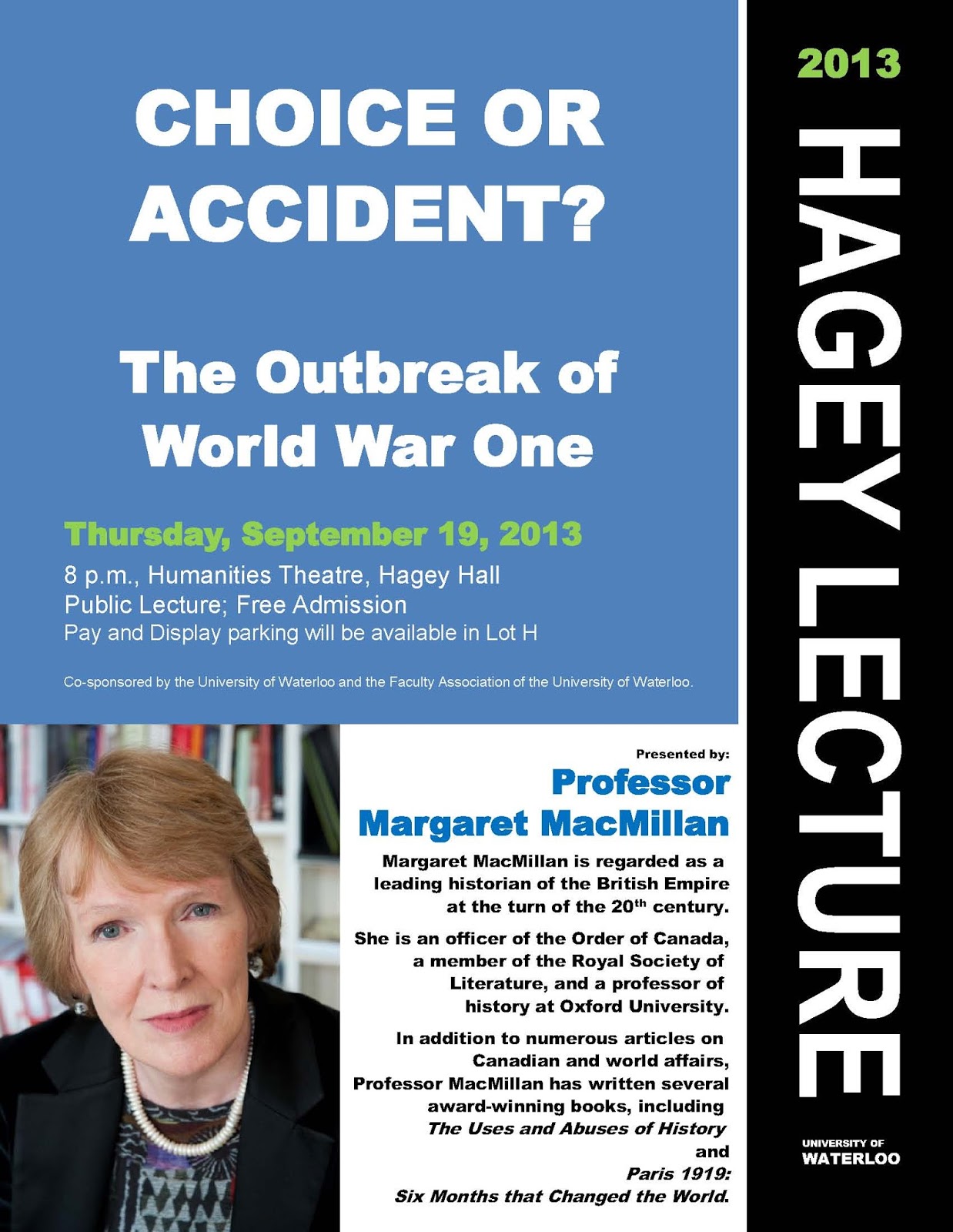
2013 Hagey Lecture Poster

First, a reminder to attend CAUT’s “Get Science Right” inaugural town hall meeting at the Waterloo Public Library on Tuesday 17 September, 15:00-17:00.  Our own Melanie Campbell (Physics) and David DeVidi (Philosophy) are among the contributors to the discussion panel.  The main theme of the event – the first among many that will happen across the country – is the Federal Government’s excessive and ideologically-driven involvement in how science is funded, conducted and published in Canada.  Any faculty member who applies for federal funding for her or his research is affected by the changes that have been imposed upon the Tri-Council agencies (CIHR, NSERC, SSHRC), so this event is a crucial one for the future of primary research in our country.  Come join the discussion.

Second, a reminder to attend this Thursday’s Hagey Lecture, where Professor Margaret MacMillan (History, Oxford) will deliver a lecture entitled “Choice or Accident? The Outbreak of World War One”.  This free event is held in the Humanities Theatre in Hagey Hall20:00 on 19 September.

Online Expense Claims Colloquium

Planning is afoot for the fact-finding colloquium on financial data security in non-Canadian cloud-based servers.  The intent of this event – to be co-sponsored by FAUW, the Secretariat and the Dean of Mathematics – is to inform the University’s decision in purchasing an online expense claims system to replace the now bygone policy on per diems.  The target dates for this event will be 4 or 5 December.

Changeover in Administration & more general thoughts

In addition to the list of administrative positions that UW is seeking to fill that were mentioned in last week’s blog post, the Director of the Office of Student Success is also an important position that remains empty.  FAUW is alert to the impact that new people in positions of authority can have, and we are making sure that faculty interests are protected by having proper representation on all of the relevant hiring committees.

In fact, from the reports I hear at various OCUFA and CAUT meetings, it becomes clear that having good people on hiring committees is one of the most effective means faculty members have at their disposal to ensure that university operations function as they should.  By this I mean that the function of the university is to promote scholarship broadly construed, i.e., the dynamic interplay between research and teaching, faculty and students.  Basic job competency notwithstanding, those candidates for upper-level positions who can stand by that vision of a university are generally less likely to make decisions that are harmful to the academe.

New Scheduling System

As a result of discussions over the past week, I am pleased to report that the Registrar’s Office is planning to follow FAUW’s suggestion and supply faculty members with two alternative schedules using real-time data: one as the schedule currently exists using the old methodology, and a second one using the new Infosilem scheduling software.  The gathering of faculty members’ preferences between these two options will be coordinated through departmental scheduling representatives and funneled upward to the Registrar’s Office from there.  FAUW plans to make sure that the rationale behind faculty members’ expressed preferences also be taken into account.

The above good news notwithstanding, FAUW still faces a problem of perception when dealing with the implementation of this scheduling system.  Indeed, in our efforts to make sure that the old scheduling system does not get replaced with one that is worse than the system we currently have, FAUW has been perceived as being an obstructionist force.  FAUW’s consistent message has been that we want the new system to be better than what we currently have for all stakeholders and interests (students, administrative staff, faculty members and room allocation), and that it should not be allowed to go ahead until such time as it is demonstrated to all stakeholders’ satisfaction that it is in fact better.

Time allocation is every faculty member’s most critical zero-sum game, so this new scheduling system has the potential to be very disruptive to our work environment if it is not done right.  Having a scheduling system that is known to be disadvantageous to faculty members is a very effective anti-recruitment and anti-retention tool for top professorial talent (as was the lack of adequate daycare facilities, an issue that is about to be resolved in no small part thanks to FAUW’s intervention).  If UW is to live up to its claimed reputation as a top-notch research institution, it would behoove it to make sure it has a scheduling system to match.

CAUT Gets Science Right, and Other FAUW News

David Porreca, FAUW President

Welcome back!  In this inaugural FAUW blog post for the 2013-14 academic year, I would like first to send out a keen welcome to all 70+ new faculty members who have joined UW over the last hiring cycle.  FAUW now represents ~1,150 faculty members.  I also plan to bring this blog’s readership up to date on the wide assortment of issues both new and ongoing from last year.


CAUT: “Get Science Right”

The Canadian Association of University Teachers is holding its inaugural Town Hall meeting that is part of its “Get Science Right” campaign, 17 September 3-5pm at the Waterloo Public Library.  This cross-country series of gatherings are intended to alert the Canadian citizenry about the federal government’s attitudes and policies toward a number of imbricated issues: the importance of primary, curiosity-driven research in general; the funding formulae for the Tri-Agencies; the muzzling of government-funded Canadian scientists; and the active discouragement and closure of scientific research when its results prove politically inconvenient.  The CBC will be filming an episode of The Fifth Estate at this event, and all faculty members who do research are encouraged in the strongest possible terms to attend.

Upcoming Hagey Lecture

The 2013 Hagey Lecture will be presented by historian Margaret MacMillan on Thursday, 19 September at 8pm in the Humanities Theatre, Hagey Hall. Admission is free. The topic of the lecture will be “Choice or Accident: The Outbreak of World War One”. Margaret MacMillan is regarded as a leading historian of the British Empire at the turn of the 20th century. She is an officer of the Order of Canada, a member of the Royal Society of Literature, and a professor of history at Oxford University.

Bright Starts Daycare

Good news: the construction of the Bright Starts amalgamated daycare building (between the train tracks and the Optometry building on Columbia) is still on schedule, to be ready for occupancy in mid-November. Barring unforeseen impediments, only delays in provincial inspection and licensing will keep this new facility from beginning its operations on schedule in January 2014.

Replacing Per Diems: Online Expense Claims?

UW is considering the purchase of an automated online expense claims system intended to replace the now-abandoned system of per diem expense claims. This process has raised a number of concerns regarding the security of faculty members’ private financial transactions if a non-Canadian cloud-based provider is selected to supply the software package. Consequently, in collaboration with the Secretariat and the Dean of Mathematics, FAUW is helping to organize a half-day colloquium on electronic security issues so as to inform the university’s decision when it comes to this critical software purchase. Stay tuned to this space for more information about this important event!

Changeover in Administration

UW is undergoing a massive changeover in the individuals occupying the upper levels of administration.  The following high-profile positions are currently awaiting permanent occupants:

  • University Registrar
  • Vice-President Academic and Provost
  • Associate Provost, Human Resources
  • Equity Officer (brand-new position created to address ongoing concerns about equity in hiring at UW, among other things)
  • Director of Institutional Analysis and Planning (Allan Starr has recently been hired into this position)

Scheduling

FAUW will be watching very carefully the progress of the testing being done on the proposed new scheduling system this fall.  FAUW is holding firm to its position that the new scheduling system will not be allowed to go live until it is shown to be better than the current system for all constituents (i.e., faculty members, students, administrative staff) and for room allocation.

With respect to faculty members, FAUW aims to have each colleague receive two schedules: one hypothetical created using the new system, and the real one arrived at using the current scheme and that is actually the live schedule for the term. FAUW is volunteering to coordinate the compilation of faculty members’ preferences for one schedule or the other.  Stay tuned!

No Faculty/Staff Change Room in PAC?

Over the summer, it has come to FAUW’s attention that the separate, dedicated change room for faculty and staff has been closed without a replacement planned until further notice.  Faculty members and staff are now meant to share change rooms and shower space with students.  This is an unacceptable situation for a number of very good reasons – the ease of use of camera phones and the potential for sexual harassment lawsuits come to mind.  An informal survey conducted by FAUW over the summer showed that the overwhelming majority of faculty members responding (38 of 40) were upset at the change in PAC facilities. This change also affects UW staff, and I am pleased to report that both FAUW and the Staff Association will be encouraging a return to the status quo ante (or some acceptable alternative) in the strongest possible terms.

Secure, Covered Bike Parking

Thanks to FAUW’s suggestion, four spots for covered, secure bike parking have been installed outside of Rod Coutts Hall with a view to assessing how much demand for these there actually is. While this is a commendable start, it is FAUW’s view that such secure facilities fall under the category of “build it, and they will come.” The cost-to-benefit ratio for this initiative should make its spread across campus both inevitable and a no-brainer. Further deployment of these facilities is a priority for FAUW, and we will continue to encourage the university administration to see its merits and virtues for the entire community – students, faculty and staff (e.g., greater fitness and work-life balance; improving security of UW community transportation infrastructure; stemming the flow of incessant reports of bicycle thefts to UW Police; encouraging the reduction in fossil fuel use).

Short-Term / Long-Term Disability Claims

The concerns that FAUW had raised in the summer of 2012 about the improper collection and transfer of information between Short-Term and Long-Term disability claims between UW and its insurance provider, Great-West Life, have largely been resolved to FAUW’s satisfaction.  Many thanks to all those who contributed to its eventual resolution, both from within FAUW and from UW’s staff in Human Resources.

Et Cetera

Other items on FAUW’s to-do list for this year:

  • The prioritization of the implementation of the Work-Life Balance Report’s recommendations, as well a
    s those contained in the Status of Women and Equity Committee’s Compassionate Care and Bereavement Leave Report.
  • Defining the relationship between FUAC faculty members and their main-campus departmental counterparts.
  • Discussions surrounding the definition of ADDS status are ongoing, and the working group in charge of revisiting this set of regulations aims to report to Faculty Relations Committee and the Graduate Relations Committee this term.

Vote Results and Summer Farewell

David Porreca, FAUW President

I am pleased to announce the results of the two votes on modifications to the Memorandum of Agreement that were held in late June. I would like to extend thanks to those who cast their ballots and contacted the Faculty Association with questions and concerns.

Motion 1 (Article 12)

The modifications to this article will enable future housekeeping changes to the rest of the Memorandum of Agreement. The Board of Governors will need to approve this change at its next meeting in October 2013 in order for this change to take effect.
Results:
Decline 0
No 9
Yes 184

Motion 2 (Articles 8 and 14)

The modifications to these articles are necessary for UW to comply with the “Tri-Agency Framework for Responsible Conduct of Research.” All universities across the country receiving Tri-Agency research funding have been compelled to adopt analogous changes to their operating procedures to ensure compliance.
Results:
Decline 3
No 12
Yes 136

Some comments re: Motion 2

In the process of arriving at the wording that was voted upon, numerous reasonable objections were raised regarding the items contained under MoA section 14.2.2. Aside from item (n), these definitions of what constitutes breaches of research integrity are drawn directly from the Tri-Agency Framework and have been imposed verbatim upon all universities across the country, without anyone having the option of changing them.

I have been collecting the objections and suggested changes that have come my way from concerned faculty members and members of the FAUW Board of Directors [if you happen to have more, please send them to David Porreca, FAUW president: dporreca at uwaterloo dot ca]. The plan is to compile these and, with the help of the Secretariat, issue an official UW response to the Tri-Agency’s Framework that would suggest improvements for the Framework’s next iteration.

FAUW will also be contacting other faculty associations at research-intensive institutions to encourage them to formulate analogous responses in the hope that such aggregated pressure will prevail upon the Tri-Agency administration to arrive at a more acceptable wording for its list of unacceptable practices.

A final note

This blog is going on hiatus for the rest of the summer. Expect a brand-new post on 9 September that will provide details about ongoing issues that FAUW is carrying forward from the last academic year, as well as plans for new initiatives for 2013-14.

This blog has been in operation since the end of January, and has become one of the key communication fora between the Faculty Association and its membership. I would like to offer my personal thanks to those who have helped keep me motivated to produce the posts you have been reading and thereby make the blog possible: Pat Moore, Administrative Officer for the Faculty Association, and Jim Tigwell, Communications Coordinator for the Faculty Association.

Many thanks also to the guest contributors (George Freeman, Jim Tigwell, Peter van Beek) who helped keep the content flowing. Finally, thank you to YOU, dear Reader, for your comments and feedback these past several months. Your attention makes all the effort worthwhile. More in September!

Vote on Memorandum of Agreement Changes

This topic has been updated on the FAUW website.

Dear FAUW Colleagues,

After a year-long discussion with UW administration, the Faculty Association is holding an electronic ratification vote on proposed changes to the MoA.
The vote will be in two parts:

  1. To approve the addition of a formal modification clause (new Article 12.10) to the MoA that creates procedures for housekeeping changes that need to be made from time to time. 
  2. To approve minor changes to Article 8 and significant changes to Article 14 in order to abide by the “Tri-Agency Framework for Responsible Conduct of Research”. These changes reflect the mandatory changes in procedure that are being imposed upon all universities that receive Tri-Agency (CIHR, NSERC, SSHRC) research funding. The objective of the changes is not to have a wholescale revision of the article, but rather to preserve as much as possible of the wording from the current version while still abiding by the regulations being imposed. 

Here is a concordance indicating where the wording from the current MoA has been maintained:

MOA – Proposed amendments concordance with current version
(updated 20-Jun-13)

Proposed Current/Comment
8.1 (change is underlined) 8.1 – addition indicates that Article 14 applies to situations dealing with research
8.4 8.4
8.4(e) 14.4.5– the provision that a statement is discipline should be listed with the other disciplinary measures; “public” added for clarity
12.10 New – need process to handle amendments
14.1.1 14.1.1
14.1.6 Drawn from 8.2 to make right to have a colleague clear in Article 14
14.1.7 14.4.9
14.2.2 Most are directly from the Framework (sections 3.1.1, 3.1.2, 3.1.3, 3.1.4)
(m) – current 14.2.2 (j) slightly reworded
(n) – current 14.2.2 (c) slightly reworded
14.3.1 14.3.1
14.3.2 14.3.2
14.3.3 14.3.3
14.4.3 14.4.1
14.4.6 Drawn from the practice used under Policy 77, Tenure and Promotion of Faculty Members to form appeal tribunals
14.5 The reporting requirements as set out in the Framework (section 4.4)
14.6.1 14.4.7
14.6.2 14.4.10
14.6.3 14.4.4

All other provisions are to fulfil the requirements of the Tri-Agency Framework: Responsible Conduct of Research.

The vote will open on Tuesday 25 June at 9:00 a.m. and close on Friday 28 June at 12:00 noon. A reminder will be sent to members when the vote opens.

Please note that only signed-up members of the Faculty Association can vote on these changes. If you are not yet a member and are interested in having your voice heard, please fill in the membership form by Friday 21 June at noon. It is quick and easy!

The Faculty Association is cognizant of the short notice of a vote that this message entails. While it is far from ideal, we hope you can give due consideration to the proposed changes.

If you have any questions about the above, please do not hesitate to contact the Faculty Association President.