
Hear their Stories: Welcoming and Understanding Refugees

By Lamees Al Ethari, PhD, a lecturer in the Department of English Language and Literature.
Watching Syrian refugees arrive in Canada these past few weeks has ignited memories of displacement and migration for me and my family. I am not a refugee. I have not been stranded in UN camps that provided the basic needs for human survival. I have, however, lived through the traumatic experience of war and displacement. I have stood for hours at the borders of neighboring countries and pleaded with officers as they rummaged through my clothes and threatened to send me back on the long, dangerous route to Baghdad that seemed to never end.
As an Iraqi, I lived through both Gulf Wars and was forced in 2006 to find some way out of the country in order to escape the constantly rising violence and instability that plagued Iraq. We left Baghdad with three suitcases of our belongings and a prayer for better days to come. The experiences of trauma and displacement were not issues that we easily overcame or dealt with. At times, I feel that I can still smell the scents of morning as I wake up at my grandfather’s home surrounded by family. At times, I am jolted awake by memories of American troops raiding our streets. I am always burdened by mixed feelings of unquenchable longing for a home that is no longer there and a life that has dissolved in the midst of conflict, fear and hate. 
I do not believe we will ever fully recover from that experience; however, through supporting each other and finding support in the communities that surrounded us, we were able to focus on moving forward and constructing a new sense of belonging and identity here in Canada. We have learned to establish a home and a way of life that integrates our culture and our beliefs with the diverse cultures and beliefs of those around us here in Kitchener-Waterloo.
The excitement and interest surrounding the arrival of Syrian refugees that I have witnessed in the past couple of months is heartwarming. People in our communities are doing their best to support the cause both here and abroad. However, as the excitement recedes, we have to acknowledge some issues when we deal with these families and individuals. While there is no formula to follow when dealing with people in such traumatic situations, we can still keep in mind some of the following points:
  1. First and foremost, remember that these people may have suffered the loss of family members and friends, the loss of traditions and culture, and of course the loss of home. They are struggling with accepting this loss and are most likely traumatized.
  2. The whole concept of a new “home” is in itself traumatizing. Trying to adjust to new weather conditions, new positions in society, and a new sense of identity is not an easy shift. That little hyphen (Arab or Syrian-Canadian) is heavy with issues of confusion, acceptance and belonging.
  3. Although everyone thinks about the topic of language, not many focus on its ability to create a strong sense of isolation. The inability to express certain emotions or certain concepts because they cannot be translated is very difficult. The language barrier plays a major role in leading people to avoid socializing and adjusting.
  4. Canadian and Middle Eastern cultures are different, but that does not mean that these people have been isolated from the world. Arab culture and Arab media have evolved greatly in the past few years and people have come to accept many aspects of Western culture.
  5. That said, however, many families still hold to strict cultural and religious ideologies because they were raised within societies that enforced them. The idea is to accept who they are, not change them.
  6. The process of adjustment will take time. That sense of gratefulness may not easily surface because there is so much to take in during this move to resettle and adjust.

The most important thing is to listen. Each of these individuals is unique and each one of these Syrians has a personal narrative that tells a story of a journey, of loss and of trying to find content within the safe borders of a new home.

On March 15 at the Kitchener Public Library (7–9 pm), Lamees will participate on a Faculty of Arts panel addressing global and local perspectives on the Syrian and other refugee crises.
How’s it Goin’ @ UW for You? An Event for New Faculty

Starting a new position can be daunting and sometimes even a little lonely. Wouldn’t it be nice to meet and talk to others who are also adjusting to a new life in Waterloo? You could ask them questions like “Where’s the best place to get good Thai food?” or “How did you find the Math and Computing building?” To this end, the Faculty Association would like to invite new faculty to come and share your experiences and travails with each other over refreshments on February 3rd.

Even if you are not that new (or don’t feel new anymore), please come to welcome the newest members of our community. Come enjoy the company. Come to meet new colleagues. Come to eat, drink, and compare notes. Members of the Faculty Association Board of Directors will also be present to answer questions such as “What does AF&T stand for?”

When and where

This will be a double-dip event on Wednesday, February 3 that includes an alcohol-free coffee break in the afternoon, and an alcohol-friendly Happy Hour at the Grad House.

1:30 pm – Coffee BreakLight snacks & beverages will be served in DC1301 beginning at 1:30 pm and ending at about 3:00 pm.

4:30 pm – Happy Hour
Nachos and other pub foods will be provided on the second floor of the Grad House beginning at 4:30 pm and ending at about 6:00 pm. (The Grad House also has a good selection of beer available for purchase – and pop and juice, if that’s more your thing).

We all know how busy everyone’s schedule is, so feel free to come late and leave early.

RSVP

Please RSVP here if possible so that we can determine how much food to arrange.

How to find the events

DC1301 is the glass-walled “fishbowl” lounge just off the main lobby of the Davis Centre.

The Grad House is located at the south end of campus, on the hill between the Dana Porter Library and South Campus Hall.

Fall 2015 Electronic Grade Submission Deadline

By: Sally Gunz, FAUW President

This message is especially for those lucky souls whose exams are sometime between now and the end of 22 December. The Registrar’s Office has agreed to extend the time for submission of your final grades until 4:30 pm on Monday, 4 January, which is the first day the University is open. You will get official notification likely Monday. We all know there are a number of irritants around the exam processes. The registrar has agreed that we will work on these in the new year. But in the meantime, this short extension is a small gift for those grading away in the salt mines over the holidays. May it all go smoothly and, more importantly, quickly.

CAUT Refugee Foundation: Call for Donations

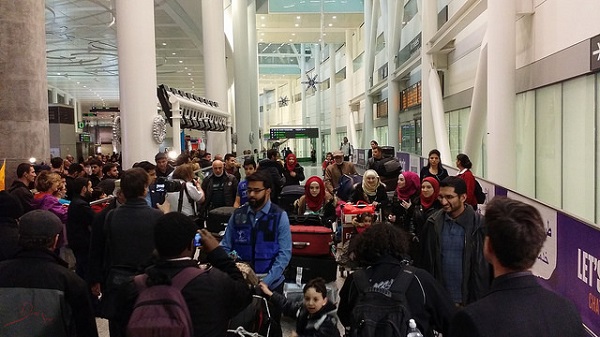
A Syrian family at Toronto's Pearson International Airport, amid a crowd of media and onlookers.
The first Syrian refugee family arriving in Toronto. Photo by Domnic Santiago / Flickr [CC BY 2.0]

CAUT has issued an urgent appeal for donations to the CAUT Refugee Foundation, which has been reactivated in light of the current Syrian refugee crisis and has requested its member associations to send out its call for funds. The Foundation was initially created in the 1970s to offer support to refugees fleeing Vietnam for Canada. The Canadian government has pledged to match dollar-for-dollar every contribution that individual Canadians make to a registered Canadian charity for Syrian refugees until Dec. 31, 2015.

The Foundation is a registered charity with the Canada Revenue Agency, allowing it to issue tax receipts. The Executive Committee is encouraging academic staff associations and their members to donate to the Foundation to support refugee relief and resettlement efforts. Funds collected on behalf of the Foundation will be provided to the Canadian Red Cross. The Red Cross and Red Crescent are supplying food, water and first aid to refugees across Southern Europe and the Middle East.

FAUW has pledged $1000 to the Foundation and would like to encourage our members to consider supporting either the CAUT Refugee Foundation as well, or another charitable organization of their own choosing addressing the challenges of this humanitarian disaster. If you would like to back a campus initiative already underway, you might support a project being spearheaded by two people in Arts, Andrea Charette and Lamees Al-Ethari. They have organized a Relief Kit and Blanket Drive through Mennonite Central Committee and are also encouraging monetary donations to Mennonite Coalition for Refugee Support.

Cheques can be made to the order of the CAUT Refugee Foundation and sent to:

CAUT Refugee Foundation
2705 Queensview Drive
Ottawa, Ontario
K2B 8K2

Read more on the CAUT website.

Thomas King Presents the 2015 Hagey Lecture Tomorrow Night

By: Sally Gunz, FAUW President

Please join us for the Hagey Lecture, Tuesday, November 17, 8 pm Federation Hall. The speaker is the outstanding Canadian author, Thomas King. He will present Love in the Time of Cholera: Canadian Edition. Visit the Hagey Lectures website for more information.

 You may pre-register to ensure a seat. The doors will open at 7.30 pm. We look forward to seeing you there and you are welcome to join us for the reception following the lecture.

Council of Representatives

By: Sally Gunz, FAUW President

We had excellent discussions at the Council of Representatives meetings last Friday (November 6). This is a really important way for the FAUW Board to interact with the faculty community. If your department/school does not have a representative yet, please consider volunteering. We intend to make much more use of this group to get effective input, but for this to work we do need coverage from all units.

The easiest way to find out about this is to visit the FAUW Council of Representatives webpage. Please suggest to your chair/director that you are willing and able to fill this role. S/he will no doubt be pleased to be able to tick this box and we will be very pleased to have you join this group.

Student Get Out the Vote Campaign

by: Sally Gunz, FAUW President

Thanks to all faculty who passed on the student messages re: voting for the federal election.

We hear that the voting initiative was very successful. At UW, just under 5,000 students voted during the special ballot days (October 5-8). Across Canada there were more than 70,000.

Given how many students would otherwise have been effectively disenfranchised because they were away from their home riding, this is was an important and successful initiative. We trust this will convince Elections Canada to continue this for future elections.

Claiming Academic Regalia as a Professional Expense

by: Sally Gunz, FAUW President

For many years, you may have been advised that you could not claim the cost of academic regalia on your professional expense allowance. We have good news. As of this claim year (2015-16), you can include this on your claim, assuming that you bought it from this fiscal year on (sorry, nothing retroactive in this position).

Now in reaching this monumental position, the University does want you to understand that if Canada Revenue Agency doesn’t agree with the University’s position and decides that this is in fact a taxable benefit, you will be on your own for any taxes/interest.

Dare I suggest, if that were to happen, perhaps you could tip the CRA off to all the faculty from all the other universities in Canada who have been able to include these expenses from time immemorial? No, that would be snitching. We don’t do that here of course!

A First Attempt

by: Sally Gunz, FAUW President

Three weeks into our new Board term and we at FAUW are all starting to sort out our new roles. Fortunately there is some breathing space while we orient ourselves. The living might not be exactly ‘easy’ in the summer but at least for those who teach, many committees go into hibernation. Now that August approaches, may grading be swift and holidays start. The good weather awaits.

Welcome to all new faculty who joined UW on July 1. We will meet in early September more formally but good luck with all the initial stages of settling in. Please consider FAUW a good source for information, advice, and general assistance at a time when university processes, etiquette and guidelines may appear to be more than a little bit of a mystery. Call any one of us with your questions.

Also welcome to new Board members Shannon Dea, Heidi Engelhardt, Elise Lepage and Paul Wehr. A very big thanks to our departing Board members Roydon Fraser, George Freeman, Jasmin Habib, and Frank Zorzitto. We are losing an immense amount of experience at FAUW. Turnover is always part of a healthy renewal process in any organization but we will certainly miss our departing colleagues. 

With the vast experience of three weeks in the job of FAUW president, I can make some general and brief observations. FAUW works on a very wide range of issues on behalf of all regular faculty with contracts one year or longer. David Porreca (past-president) handed me a list, many pages long, of tasks. I have been attempting to group tasks into some semblance of an organizational chart that ultimately will be posted on this site. To date we have no less than ten sub-committees, more than 40 representatives to university-wide bodies, and on and on.  The work load is extensive and increasingly we will be turning to faculty outside of the Board structure to work on tasks. The Council of Representatives will be a very important resource.

One glaring deficit at the Board level is voting member representation from Math, AHS, and Environment. This can and should be remedied quickly and one of the important changes to the constitution of FAUW that we shortly will propose is a mandated minimum of one representative from each Faculty. Meantime, once more we will turn to those outside of our Board structure in order to ensure that local issues are fully represented.

Over this next year I propose to write here on different Board functions. FAUW is very mindful that it is a representative body. It does not take positions without solid consultation. The first stage of that is ensuring the community understands issues even exist. In this blog I will discuss important discussions taking place about the role of lecturers at UW.

A number of people have noted recent name-changes to the lecturer position at the University of Toronto. Despite the prominence in the press, this is not a particularly new move and nor is it unique to U of T. Several other universities already have such changes in place. Where do things stand at UW?

Policy 76 defines all faculty appointments and much of the basic language around, in particular, what it means to be a lecturer member at UW. This is complemented by the provisions of the Memorandum of Agreement (for new faculty, this is the basic agreement between FAUW and the University that defines our terms of employment). Currently Policy 76 is one of several major policies under review at the University. A committee was struck some time ago chaired by John Burbidge (Economics) with Kelly Anthony, Shannon Dea, George Freeman, Gerry Schneider, and myself as members. If you are familiar with Policy 76 you will know it covers a broad range of issues only some of which relate to lecturers. Policy review is inevitably a cautious process and for good reason. It is really, really easy to get things wrong.

Those of us on the committee who are also FAUW Board members were very mindful of the need to ensure that we get full input from those most affected by change to the policy. The policy itself will be subject to a university-wide review process when a draft is complete, but it is important to gather input in the earlier stages where alternatives should be considered. In order to ensure that the interests of lecturers are fully represented, recently FAUW established a sub-committee chaired by Heidi Engelhardt. This committee will be active in gathering input from the lecturer community in general and examining options that might find their way into Policy 76. It will make recommendations to the FAUW Board that will, assuming it supports them, in turn be represented in the review process. Inevitably there is a good deal of back and forth to these processes.

In the interim, we urge lecturers in particular to consider issues such as:

  • what should the lecturer career path look like;
  •  if there is the equivalent of tenure (the continuing lecturer position today), how does that come about and what should be the qualifications;
  • should there be a finite contractual period for lecturer positions that are not leading to what is presently labelled the ‘continuing’ lectureship;
  •  what are appropriate names for lecturer positions should they change;
  • should there be a role for research and if so, how might that be defined; should the one term in six as non-teaching continue and, in any event, how should it be interpreted;
  •  is there a role for sabbaticals (not strictly Policy 76 but related pos
    sibly to the previous issue);
  • what is the appropriate balance between teaching only (or primarily) and teaching and research positions; etc.

 Overall, FAUW sees its responsibility as ensuring that the outcomes of any changes are such that those in teaching positions are treated fairly. This includes taking great care to avoid the potential for ‘work-arounds’ that allow for decent employment practices to be avoided – such as the unfair one year less a day contracts.

We would urge all faculty to pay close attention to these issues and feed comments particularly to the Lecturer Sub-committee. You may find it useful to refer to policies at other universities to see how issues are addressed elsewhere. There is the opportunity now to have strong and well-considered policies that reflect all aspects of the teaching faculty member’s career.

Enjoy the rest of the summer.