News From Your Board – November 9 Meeting

—Peter Johnson, Faculty of Environment representative to the FAUW board

The FAUW Board got back to business on November 9, after an October filled with special events, including the FAUW 60th anniversary celebration. We had a packed meeting room, evidence of a healthy and energized board, and of the strength of our organization and importance of our mandate.

We started off with a report from our independent auditor on the financial health of the organization. In a year that has seen great change at the administration level of the University, FAUW maintains a strong and prudent fiscal position that is neither overburdensome to our members nor compromising of our ability to protect our members and advance collegial governance on campus. Congratulations to Dan Brown, treasurer, and many treasurers before him for maintaining this balance.

Board members discussed ways to support our colleagues at local colleges while they are striking to reduce reliance on precarious employment and to obtain the academic freedom that many university faculty enjoy. FAUW has made a financial donation on behalf of our members to support those on the picket lines, and we are currently investigating other forms of support.

As discussed at our 60th Anniversary event, one of the main benefits of our Memorandum of Agreement with the University is that, compared to traditional union-based bargaining, in which a new collective agreement is negotiated every few years, FAUW is in a process of continual negotiation with the administration over terms of employment. The only thing we negotiate in the upcoming round of bargaining with the University is compensation.

In the last round of bargaining, our negotiating team secured the salary anomaly review, changes to the Faculty Professional Expense Reimbursement (FPER), and annual scale increases to salaries and thresholds. That settlement expires April 30, 2018.

Our lead negotiator for this round, Benoit Charbonneau (Pure Mathematics), attended this Board meeting to brief the group and discuss preliminary strategy. Undoubtedly there will be more to come on this front, as bargaining commences in December. Shelley Hulan (English Language and Literature) and Dave Vert (School of Accounting and Finance) are also on the negotiating team.

The Lecturers Committee raised concerns with apparent discrepancies across campus regarding lecturer eligibility for departmental or school service tasks. FAUW would like to hear from any lecturers who have been prohibited from serving on departmental or school committees, especially Departmental Tenure and Promotion Committees (DTPC) involved in making hiring or promotion decisions about lecturers, and chair/director hiring committees.

FAUW Celebrates Three Campus Champions and Six Decades of Collegial Governance

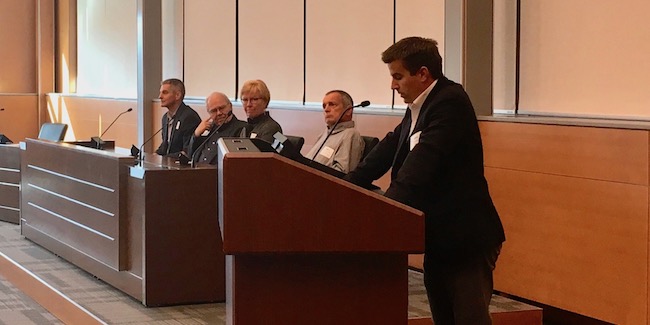
On October 26, FAUW held a 60th anniversary discussion exploring the unique relationship between faculty and the administration at Waterloo, and presented our first Awards of Appreciation to honour members of the University community who have made real differences in the lives of faculty members.

Left to right: David DeVidi, Roman Dubinski, Lynne Taylor, Ian Goulden, Bryan Tolson (FAUW president).

Panelists Roman Dubinski (FAUW president 1970–71), David DeVidi (FAUW president 2007–09), Lynne Taylor (chief negotiator and board member 2014–16), and Ian Goulden (dean of mathematics 2010–15) described the evolution of faculty representation at Waterloo, from the early relationship characterized by the University’s “benign paternalism” (in Dubinski’s words), through three attempts to unionize in the 1970s, ’80s, and ’90s, to the “honest conversation” of the current arrangement.

Continue reading “FAUW Celebrates Three Campus Champions and Six Decades of Collegial Governance”

How to Get a More Memorable UW Email Address

What is a “friendly” email address?

A so-called “friendly” email address is one that uses your actual name instead of your userID. Like zhang.san@uwaterloo.ca instead of z4san@uwaterloo.ca.*

Why would you want one?

Why wouldn’t you? It’s more professional-looking and easier for people to remember – and it makes it easier for people to be sure they’re emailing the right person!

What if you don’t go by the “first name” on record?

If, for example, your name is Rajwinder but you go by Raj, or your colleagues know you by a nickname or a middle name, you can specify that! See steps 3–5 below to update your “Familiar Name.”

What happens to your userID email address?

It will still work. The friendly email address is an alias, and the two addresses are interchangeable.

How do you get one?

  1. Sign in to WatIAM
  2. Select “Update Profile.” 
  3. If you need to update your Familiar Name, enter it here. If not, skip to step 6. 
  4. Select “Save” to save your Familiar Name. 
  5. Select “Update Profile” again. 
  6. Select the “Email Configuration” tab. 
  7. Select the friendly email address option you want to use. 
  8. Click the “Save” button.

Don’t like the options you’re provided?

Make sure you’ve updated your Familiar Name first (steps 3–5 above). IST says: “In exceptional circumstances, if the email choices are not appropriate, please contact helpdesk@uwaterloo.ca to assist with an appropriate address which meets University guidelines.”

More information is available on the IST website, including screenshots.

*This is not a real user ID at Waterloo. We checked.

8 Lessons from our ‘Making the Most of your Mid-career Years’ workshop

Here are some of the key lessons shared by experienced faculty members at our recent workshop for newly tenured/continuing faculty. Workshop slides, notes, and background reading are available on our website.

  1. The post-tenure slump is real. You need to plan how you’ll avoid it. Set goals; have a vision of what you want your career to look like in the end, and do things that move you toward that.
  2. Service work is not the dark side. Participating in collegial governance is “superb but challenging,” and it can be extremely rewarding to make a difference in your colleagues’ work lives. It’s also necessary: If we want the University to continue being run by academics (versus giving control over to administrators), we all need to take a turn. 
  3. You can still learn new things about teaching. Don’t be afraid of new technologies. 
  4. A scholarship slump is common. Imposter syndrome often kicks in hard now. Do what you can to stay active in scholarship in any way. Do something small. Learn new methodologies that allow you to start a project you’re excited about. Make use of the resources available (talk to the Office of Research!) to figure out how to keep doing research, whatever your specific situation. 
  5. Take chances and try new things. Lecturers, remember that you’ve gotten to this point because your chair/director has confidence in you. Don’t worry about the new things you’re trying until your chair/director complains. 
  6. Lecturers: Ask for the things you need. Chairs and directors are still getting used to the different needs of lecturers. If you have a project you want to do, figure out how to make it count as a teaching task. Explain how it adds value and renews your skills. 
  7. Be a complete colleague. Contribute and participate in all areas of your professional life.
  8. If things don’t go well, get help from FAUW

News From Your Board – September 28 Meeting

—Sally Gunz, past president

Peter Johnson and I agreed to take turns writing recaps of FAUW board meetings. We’ll focus on the main items and try to avoid the chit-chat that make all board meetings memorable events. For a fee, we will provide the chit-chat separately!

One of the lingering issues from the recent Memorandum of Agreement (MoA) revisions is that of histograms (13.5.11). This has proven to be technically challenging and a sub-group of the Faculty Relations Committee has been working on revisions for some time. The sub-group continues to work on this and will be providing recommendations soon.

FAUW senators summarized the debate on the CEPT report at Senate. A motion will be moved at the next senate meeting to create a new working group that will develop appropriate methodology to assess teaching per se (and not student perceptions of teaching, which is the focus of the current evaluations). You can read more about this motion on the FAUW website.

Bryan Tolson brought the board up to speed on recent changes to the Office of General Counsel and there was general agreement that these were positive for our membership. We also conducted a sound debrief of our new faculty events.

We discussed the impact of Unit4 on research accounts and the difficulty in gathering information. Peter Johnson indicated that as a stopgap measure, IST developed a tool to query and export salary reports from Unit4. This tool is generally easy to use and would be a significant advantage if it were extended to all areas of research grant reporting. Ultimately, while Unit4 may meet the needs of Finance as-is, it does not meet the needs of admin or faculty. This alternate tool developed in-house and ably supported by IST has the ability to do so. Discussions at UCIST (University Committee on Information Systems and Technology) to this effect will continue.

Live-tweet thread from the Senate discussion on CEPT

The Course Evaluation Project Team (CEPT) report was discussed (and, ultimately, endorsed) at Senate on September 18, 2017.

FAUW Board member and University of Waterloo senator Shannon Dea live-tweeted the discussion, and we’ve compiled her tweets here, with a bit of editing for readability.

UW Senate now in session. Looking forward to a lively debate on student course perception surveys starting at 4:20.

Pres. Hamullahpur reports to Senate that Pitchfork ranks UW as top university for unicorns. (It’s not as exciting as you might think.)

The President’s report is still happening. Student course perception survey discussion delayed a bit.

Ok. Here we go. Time to discuss the course evaluation project (CEPT). Here’s some background from @FAUWaterloo: [ https://twitter.com/FAUWaterloo/status/909844402142621702]

[Associate Vice-President, Academic] Mario Coniglio now giving the background on CEPT.

Coniglio describes “equity and bias [as] top of mind issues” in framing the CEPT project.

CEPT leader Mark Seasons now presenting, and again highlights negative impacts of bias on course evaluations. Says CEPT addresses this.

Seasons thanks community members, especially “three year club”, for their work on the CEPT project. Seasons reports that currently course eval practices at Waterloo vary widely across campus; some systems really outdated. Seasons provides overview of the many changes CEPT is recommending to the current system. It will evolve, the community will be updated.

George Dixon now moving endorsement of report and of Phase 2. Motion is seconded. Floor open for questions.

An amendment proposed: that the university provided sufficient resources to pilot in Fall 2017. Dixon: I haven’t seen a budget request yet.

Prez: can we come back to the amendment later? (No seconder yet.) Amendment not yet technically on the floor, but coming back.

FEDS Andrew Clubine: thanks to team. In favour of motion. Report affirms value of quality teaching esp. undergraduate. CEPT a step in the right direction, but work still to be done. An overdue improvement, but still need to address concerns, bias too. Improved data collection will help mitigate bias. Student senators will vote for motion.

FEDs prez: two key points quality teaching important and SCPs support that, but we must take concerns of bias seriously. Not a zero-sum game.

.@DavidDeVidi gives some history: FAUW members have long been concerned about annual review process. Much consultation about same. Research at UW (c. 2009) showed that good/bad teachers got same scores; that teaching evals overused in annual review. CEPT report addresses many of concerns raised in 2009. A good sign. He has received many concerned calls from faculty members about CEPT and today’s vote.

Seasons: we’ll get experts to design the tool, and then test for bias.

Bruce Richter: many senators received email from Psychology. Striking that the experts have come to a different conclusion than CEPT. Colleagues in Psych not optimistic that we’ll be able to fix bias problem. Teaching evals useful formatively to improve teaching; very different thing to affect faculty pay. Fundamentally incompatible. Tying pay to course evals at odds with supporting good teaching. Can lead profs to aim for high scores through shortcuts.

Seasons: we can’t control every aspect of bias. We’ll do the best we can. We recommended a multi-pronged approach to evaluations of teaching

Tara Collington: she and Fraser Easton received feedback from >30 Arts colleagues, prepared joint summary. Here we go: Fac members concerned about bias, unconvinced report adequately addresses concerns, concrete means for addressing bias not addressed. SWEC concerns not adequately addressed by CEPT. Validity of SCPs not adequately raised in report, discuss feedback from campus stakeholders

TC: CAUT released two recent policy statements cautioning against use of SCPs summatively. OCUFA too: SCPs should be used formatively.

TC: Collection and distribution –2 concerns. Value of data, implications of dissemination. Formative use doesn’t justify wide dissemination

Seasons: we’re aware of all of these issues. Big challenge working in multi stakeholder environment.

[Still a long speakers list. Buckle up…]

Seasons: we didn’t ignore any perspectives, but there was lots of disagreement, and we learned a lot from other universities.

Alexander Wray: students v.much in support of CEPT. Need an outlet somewhere. Otherwise, where do we go? Anecdotes of bad teaching @ Senate? What is teaching? [Time for some philosophizing… aided by some Webster’s definitions… Uh oh, and now we turn to the strat plan]

Wray: as partners, students ought to be evaluators, and ought to be participants. [whoa. Now a story from Mt. Olympus. Cautionary tale of Momus, plus some Game of Thrones. Huh]

Wray: mandate doc didn’t mention bias/equity. W2G Seasons for addressing bias. Wray: to faculty WTF guys — debate your employment conditions with your employer; don’t bother Senate with that noise.

Feridun: I’ve never seen GoT.

Gord Stubley: helped >50 faculty members read course evals, some bad comments, but also those of frustrated students trying 2b constructive. Course evals outdated and inconsistent. And our teaching has really evolved over the years. A lot! I strongly support this motion. It is an important step on the way.

[OMG too many Brians/Bryans on the speakers list. Hard to chair.] Here’s Brian/Bryan #1 [probably Brian Cepuran, alumni]: is uw prepared to invest enough to keep eValuate system running and keep the data safe?

Seasons: Yes! V. important.

Jennifer Clapp: much of what I was going to say has already been said. In answer to Wray’s question, we can’t separate tool from its purpose. Formative versus summative uses! Did CEPT discuss summative uses of the tool? Psych colleagues raised empirical concerns about this. Evidence suggests tying pay to course evals incentivizes grade inflation. Doesn’t serve faculty or students well.

GSA Prez: Robert Bruce. I’ll keep it short. Thanks for the hard work.

Bryan Tolson, @FAUWaterloo prez: thanks committee, but won’t support motion. Big concerns: biases, summative use of SCPs. What is the evidence that having a data set helps to address biases. Voting no on @FAUWaterloo board’s instructions.

[Oh, jeez. Zoned out for a minute and forgot I was live-tweeting. Ok, back now. ]

Dan O’Connor: sketches the many improvements CEPT made, endorses increasing use of other markers of teaching quality for summative purposes.

Prez: It’s getting late. Let’s keep it moving. No more long speeches. No more speakers on the list.

Mario: this initiative intended to improve teaching and learning culture on campus. Unfortunate that pol. 77 connects course evals to pay. The discussion should be around revising policy 77.

James Skidmore: lots of improvements here. We’ve long used course evals without any awareness of these issues.

Fraser Easton: thanks Seasons and team. To students: we take seriously being accountable to you. But systemic bias concern is l
egit. [Quotes colleagues seriously affected by racist/sexist comments.] Can’t continue to write a blank cheque to bias.

FEDs Hannah Beckett: formative role important. I don’t support system that reinforces bias. But we must continue to improve teaching. .

@DavidDeVidi: (1) take CAUT with a grain of salt. (2) bias also appears in research scores. Women get cited less, e.g.

And then I [@shannondea1] said: faculty can’t write CEPT a blank cheque because pol. 77 has been abused for years.

Seasons: thanks all for a lively discussion.

Motion passes. But the vote divided.

Wray is now chastizing @Fauwwaterloo and faculty again. “Talk to your employer!” he says.

New motion: to implement pilot F17, full implementation W18.

Kofi [Campbell, Renison Academic Dean]: this proposed timeline terrifies me on behalf of faculty members of colour. Change doesn’t come quickly. Let’s not rush it and botch the job. If it takes another three years to get it right, so be it.

Rob Gorbet: the process we’ve just heard about will take longer than a winter implementation.

Stubley: sympathetic to urge for a quick timeline, but cannot imagine meeting the proposed timeline.

.@JamesMSkidmore : asks Coniglio whether UW is committed to putting the resources into the project necessary to make it happen.

Coniglio: Too important to rush.

VPAP G. Dixon: We’ve taken 3 years, now have a path forward. Initiative will be adequately resourced. No need to impose artificial timelines

Motion (for Sept. timeline) soundly defeated.

Feridun: time to move forward and improve.

George Dixon: thanks Senate for fulsome discussion addressing longstanding issues.

I [@shannondea1] just moved To strike a working group to research and develop methods of assessing teaching and learning complementary to SCPs. Seconded by FEDs’ Andrew Clubine.
Chair requests tabling to next meeting. Dea and Clubine agree.

And thus ends the CEPT live-tweet. See you in the funny pages, peeps!

News From Your Board – September 14 Meeting

Welcome to a new series of FAUW blogs, “News From Your Board”. To increase the transparency of board activities and keep members up-to-date, we’ll be sharing some of the non-confidential discussion from our biweekly Board meetings.

The first highlight from the September 14 meeting was welcoming Bryan Tolson to his first board meeting as President. Bryan began with the always-aspirational goal to end the meeting on time!

We revisited ideas and plans for the year from our day-long retreat at the start of September:

  • better defining our membership
  • further communications improvements (like this series)
  • continued aspirations for a more robust teaching evaluation system to complement student surveys
  • how we can contribute to Indigenization efforts across campus

A regular part of each Board meeting is reports from FAUW committees and constituent positions, including updates from the Faculty Relations Committee (FRC). FRC is the main venue through which FAUW and the administration work together on collegial governance of the University. We also hear from representatives of the Lecturers, Academic Freedom & Tenure (AF&T), Status of Women & Equity, and Pension and Benefits committees.

The last agenda item was the slate of upcoming FAUW events. Our packed Fall schedule includes the New Faculty & Family Welcome Dinner on September 22, a workshop for mid-career faculty on September 29, FAUW’s 60th anniversary party on October 26, a Council of Representatives meeting on November 14, and the Fall General Meeting on December 6.

And with that, Bryan managed to squeeze one of the most ambitious September agendas in recent FAUW memory into the actual scheduled time! Congrats Bryan! Looking forward to the next meeting in two weeks!

—Peter Johnson, communications lead, FAUW Board of Directors

Welcome back message from the FAUW president

Bryan Tolson, FAUW president

Greetings members of FAUW!

I trust your fall term is moving forward smoothly. I’m excited about my new role as your FAUW president, and I thank our new past president Sally Gunz for helping make the abrupt September 1 transition from my sabbatical to this role go as well as possible. I’d also like to thank her on behalf of all members for her incredible dedication over the past two years as FAUW president.

One of my first tasks as president was to participate in a very nice new faculty welcome event. I tried to impart some wise suggestions on our eager new colleagues. But since welcoming new faculty properly is really a continual process, I ask all of you who are not new faculty to reach out to new colleagues in your department/school: Drop by their office or take them for a coffee and ask them what they need help or advice on.

For new faculty engaged in research, help jump-start their research by considering whether you could benefit by having a new colleague co-supervise one of your graduate students or maybe find a way to share lab space and equipment with them. I’m sure new faculty would appreciate any gesture you make, so give it a go!

Crowdmark

Now that I’ve asked you to do something, let me return the favour by sharing something to make your teaching easier. Ever heard of Crowdmark? I know you probably have if you’re in Math. I get the sense other parts of campus don’t know what Crowdmark is and I expect many of you failed to parse or read the somewhat cryptic email sent to all instructors last week. So let me try and fill you in a bit. Here’s the sales pitch:

  • Are you tired of the slow, serial process of having to pass boxes of midterms or final exams between you and your TAs for grading?
  • Do you find it difficult to organize marathon group grading sessions so that all marking can occur within a day or so of the exam? 
  • Do you wish you could grade exams while travelling without having to cart around the paper copies?
  • Would you prefer distributing graded exams back to your entire class with the click of a button?

If you answered yes to any of the above questions, then you really need to have a look at Crowdmark. It digitizes the grading process (with the help of Media Services) so that you can share the digitized documents online with your graders. Interested? Learn more about Crowdmark and how to use it at UW.

Back to FAUW

I’ll avoid a long list of all the issues and initiatives FAUW is currently working on. I’ll save that for our General Meeting in December and my winter term update in January. And this year we plan to release high-level summaries of our biweekly Board meetings on our blog. You can get these by signing up for automatic blog updates.

In closing, let me say that I’d be happy to hear from you and I know other FAUW Board members would be as well. So check out who your Board members are and who your department/school FAUW rep is. Feel free to chat with them or bring an issue, suggestion, or feedback directly to me.

Email (btolson@uwaterloo.ca) is probably most effective but in an effort to be regularly approachable, I will hold FAUW office hours on Mondays from 2:00 to 3:00 p.m. in room MC 4001. Check our website on Mondays to confirm that I am actually there if you plan to drop by. 
Of course, I’m just as happy to chat at other times and you can drop by my main office as well in E2-2316 to see if I am free. Another fine location would of course be a pre-arranged Grad House chat.

Thanks for making it all the way though my welcome message – all the best in the fall term!

Bryan

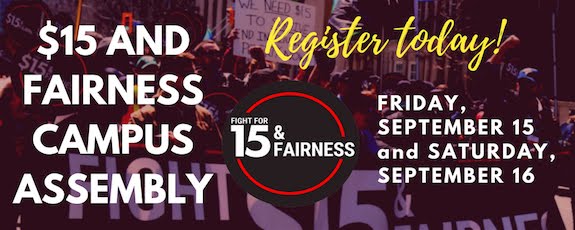
Join OCUFA at the $15 & Fairness Campus Assembly on September 15 and 16

Reposted from OCUFA, the Ontario Confederation of University Faculty Associations, of which FAUW is a member.

OCUFA is part of the Fight for $15 & Fairness, a broad group that is advocating for better labour laws and a $15 minimum wage across Ontario. On September 15 and 16, the first ever $15 & Fairness Provincial Campus Assembly will take place at the University of Toronto. Faculty from universities across the province are invited to attend, and you can register here.

The assembly comes at a crucial time because Bill 148 will be considered in the legislature this fall. There will be discussions and workshops about how to win the strongest possible labour legislation, as well as how to advance the $15 and Fairness agenda on campus through collective bargaining and by uniting students, staff, and faculty. Achieving fairness for contract faculty will be a key focus throughout the agenda.

We hope you can join us! Register today. If you have any questions, or would like more information, please contact Brynne at bsinclair-waters@ocufa.on.ca or 647.226.7184.

President’s Report

Sally Gunz, FAUW President

This is my last report as president of FAUW. Tomorrow, Bryan Tolson will return from his sabbatical and assume his rightful position in my stead. Bryan is an associate professor in Civil and Environmental Engineering. He has represented FAUW in many roles, and for the past two years has been its vice president. The membership made a fine selection. Bryan cares deeply for FAUW and its members, and I have no doubt he will bring a whole new level of positive energy to this position.

How do I feel at this stage? Of course there is inevitably a real sense of relief. This is, to all intents and purposes, a full-time job that brings with it a tremendous sense of responsibility to make decisions, offer opinions, and take initiatives that are in the best interests of the membership. Fortunately, the FAUW board of directors comprises a strong set of people with a vast array of experience, and we have many people on campus whose past experience with FAUW can be very useful. Issues are seldom new, even if they are new to me. Thoughtful people have always been there to offer advice and support and I thank them.

Further, FAUW has recently built up a team of permanent staff members who are highly skilled, tactful and always generous with their time. Volunteers will come and go with FAUW but our staff provide our memory and our continuity. We are most fortunate that all three of our staff are not only excellent at what they do, but are genuinely decent and caring people. Those of you who come by our offices in MC will know the value of the warmth and friendliness with which we are always greeted.

My goal coming into this position was to ensure that I left it with a strong organizational structure, sound staffing, a talented successor, and a strong board and, while any achievements are hardly my doing alone, I can say that as a group we have met all these expectations. FAUW is in very good hands. Here are some further observations, particularly relating to the months since I last reported.

New faculty

Summer is one of the really enjoyable times of year when we greet new faculty members. I gather we have approximately 40 new members of our academic community. In July and August, we held informal get-togethers for those who had just joined the University and these were fun. The newcomers are filled with enthusiasm and the pleasure they take in joining this university is infectious. We look forward to many more gatherings like this as the new academic year begins.

New administrators

The past months have once again seen major changes at the senior administrative levels of the University. Provost Ian Orchard’s retirement was not the best news, but, fortunately, George Dixon is well known to us all, and of course he knows the university through and through. It is good to have a University Secretary once more, especially as Karen Jack already has a sound understanding of the operations of the university. We also welcome Cathy Newell Kelly in her new role as Registrar and Beth Sandore Namachchivaya as University Librarian. But we remain engaged in hiring for top level administrators and there will be the obvious next transitions and adjustments.

Upcoming events

There are many issues FAUW will continue to work on over the next year. For now, I will let you know of the new events we have planned:

Workshop for mid-career faculty – September 29

This is for all of you who have become a continuing lecturer or acquired tenure in the recent past. You are officially “mid-career.” The workshop is offered in recognition of the relatively poor job we do of introducing faculty to the full range of options available in an academic career (as all universities do). We are often asked how people become administrators, journal editors, policy advisors, etc. Often it is a matter of being in the right place at the right time, which is obviously not good enough. Acquiring career security marks a significant transition in your life as an academic and this half-day workshop will introduce you to many of the options now open to you. Shannon Dea will lead the event and has brought in others with really solid experience at this university and others in a range of capacities. Please register in advance.

Celebrating our birthday – October 26

Yes FAUW too is celebrating its 60th anniversary this year. We understand we are competing with many special events, but we believe ours will be the best. Please mark your calendar for October 26th, when we will have an afternoon panel session followed by a reception. We will be providing more information soon.

FAUW service awards – October 26

At our 60th anniversary event, FAUW will present its inaugural service awards. These will be given on an annual basis to members of the university community who genuinely have made significant and lasting contributions to the well-being of FAUW members.

Mental health workshop

We are currently exploring an event that would help faculty better understand mental health concerns in academe to complement other, more student-focused initiatives on campus. Stay tuned for more information.

Thank you

Thanks all of you for the support over the last two years. FAUW belongs to its members. It is an inclusive and transparent organization. We welcome all of you who wish to work with us on any of the important issues that arise in our academic community.