Did you know…about UW’s large payouts to Administrators?

 
Western University has taken a lot of flak for trying to provide a large administrative payout to its president (which he has now promised to return). In contrast, the University of Waterloo executed large administrative payouts between 2009 and 2011 that have gone relatively unnoticed. The 2010, 2011and 2012 Ontario Sunshine lists show that:
In 2009, the vice president, academic & provost was paid:
                              $737,000 from UW (at UW January – June)
                            +$220,000 from Western (July – December)
 
In 2010, the same person was paid:
                              $500,000 from UW (as “professor, adjunct”)
                            +$440,000 from Western
In 2010, the president & vice chancellor was paid:
                        $1,041,000 from UW (at UW January – October)
 
In 2011, the same person was paid:
                         $610,000 from UW (as president)
It is noteworthy that the presidency at UW changed in October 2010 and as such the incoming president was also paid $309,000 in 2010 (for 9 months service as provost and 3 months as president) and $486,000 in 2011 as president.
Confused? Consider the faculty/staff salary scale increases in the 2009-2011 period. They are much simpler:
 
Year
Faculty/Staff Scale Increase
2009
3%
2010
0%
2011
0%


Note that the UW Board of Governors Governance Committee is responsible for reviewing senior UW administrator contracts.
The Faculty Association would like to know:


Does the UW community wish to set parameters/limits/procedures that the Administration and Governance Committee must work within when negotiating and approving contracts? What should these be?

FAUW Scheduling Survey Results

by: Bryan Tolson, FAUW Vice President 

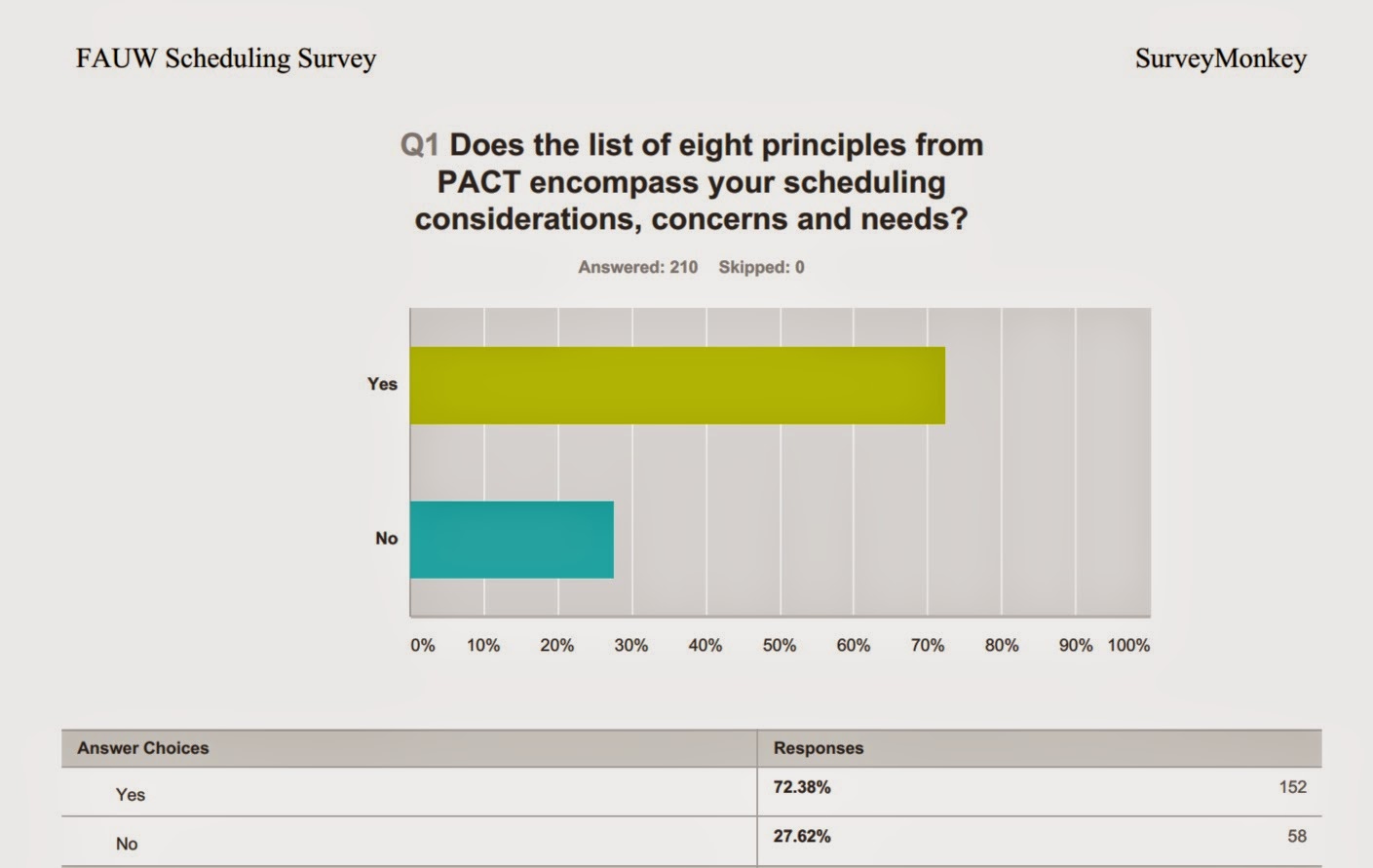
The Provost’s Advisory Committee on Timetabling is considering a list of principles that will govern the functioning of the new scheduling system going forward. FAUW recently conducted a survey on timetabling and more than 200 members responded!  Here are the overall results: 

Question 1:


Question 2:
  • For Q2, we had 57 responses suggesting concerns missing in the principles.


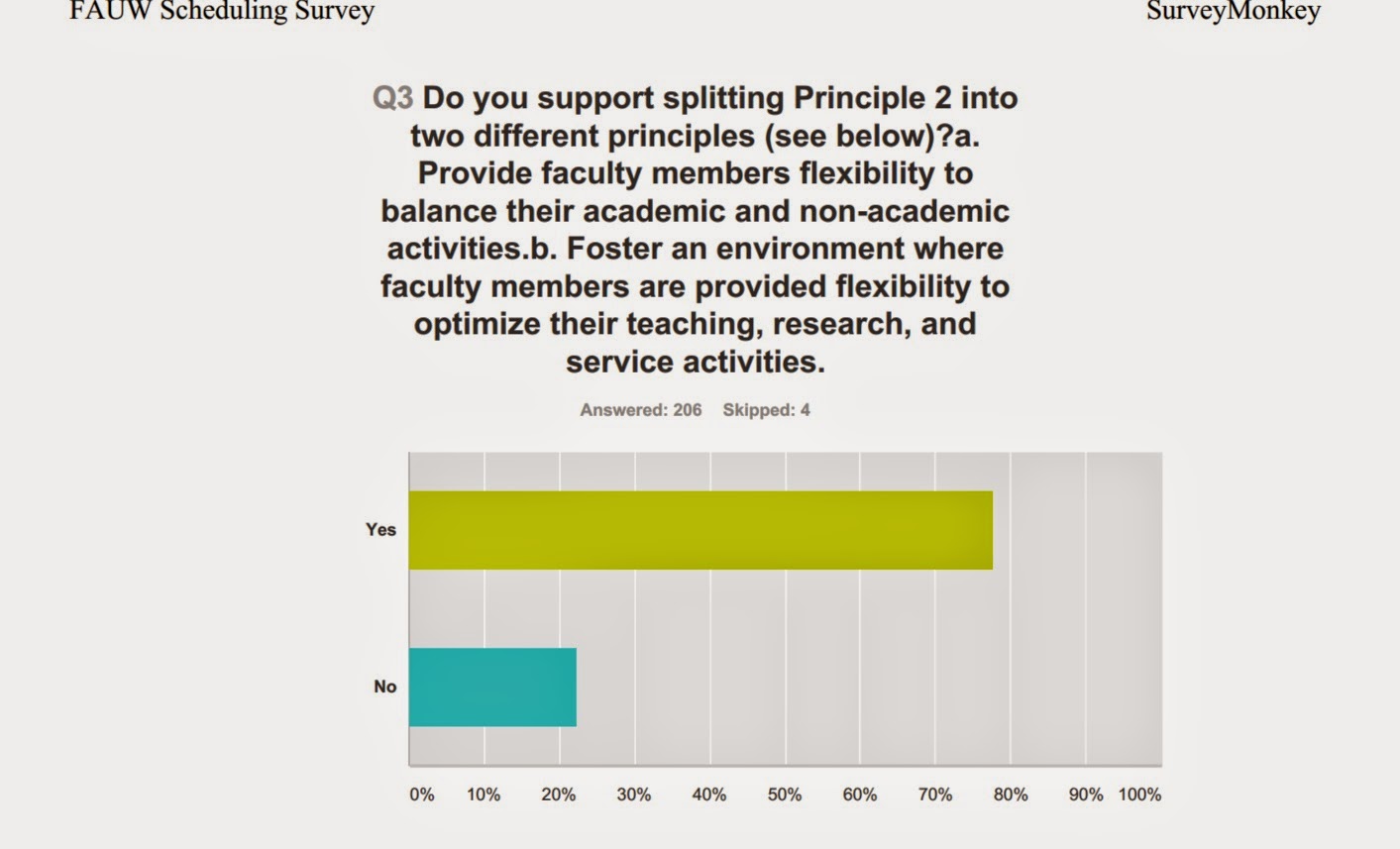
Question 3:


Note: PACT Principle 2 wording is currently as follows:
“Foster an environment where faculty members can harmonize their teaching, research, service, and non-university activities”. 

Scheduling Systems: Same Old Tune

by: David Porreca, FAUW President
This blog post represents a synthesis of my own experience with scheduling systems over my 22 years of involvement with the University of Waterloo, along with the sharp observations of a more senior colleague. (h/t to BC)
Over my time at Waterloo, I reckon I’ve been through at least three (if not four) changes in timetabling systems, and all have followed a recognizable and consistent pattern in their deployment:
1- Disaster is widely predicted.
2- Disaster does not occur but there are numerous problems.
3- People responsible for the new system deny that any problems are real: they will disappear when the system is fully implemented.
4- Departmental administrators gradually discover the levers that control the system and devise workarounds and local optimizations that mitigate the problems.
5- Four or five years later the system has returned to what it was before the change, in terms of functionality.
6- The Registrar discovers that they still have the same problems they had before the change.
7- Acquiring a new system commences.
The current iteration of the scheduling cycle is sitting somewhere between points 2 and 4, with some units working with the system, and others working the system to their advantage – and it’s unclear whether the latter represents a disadvantage to other units.  Any complex system can be gamed to the advantage of certain participants, but not all such systems are zero-sum games. 
The extent to which the InfoSilem system and its attendant procedures amount to zero-sum is still unclear to me.  The number of potentially competing factors is substantial: does one prioritize student completion times, student conflict-free schedules, room usage, professors’ optimal performance in the classroom, efficiency of the process of timetabling itself, pedagogical considerations for individual courses and for programs, or any number of other factors that one could devise?

The issue is as confounding as it is important to our working lives as faculty members.  According to the scheme outlined above, we still have a couple of years to go before the current system is made to work well.  Will it work well enough to (gasp!) break the cycle?  
To include your input on the issue, take part in the FAUW scheduling survey before Friday, March 13. 

2015 FAUW Board of Directors Elections

by: the FAUW Board

It’s that time of year again. The Faculty Association of the University of Waterloo is putting out their 2015 Call for Nominations.
The Faculty Association invites nominations for:
President: term 1 July 2015 to 30 June 2016
Director (5): term 1 July 2015 to 30 June 2017
Who is eligible?
All faculty members and librarians who have opted to join the Association as official members are eligible. If you are not yet a member and would like to become one, all you have to do is submit a form.
What is the time commitment?
The Board of Directors meets bi-weekly on Thursday afternoons from 2:30-4:30pm, September through June.
Where are nomination forms?
You can download a nomination form by visiting FAUW newsor by selecting 2015 Call for Nominations.
When are nomination forms due?
Nomination forms are due Tuesday, March 10, 2014by 4:30pm and are to be submitted to Erin Windibank, FAUW Executive Manager in MC 4002.
Why participate?
Do you have a voice that wants to be heard? This is your chance. Sit on the Board of Directors and discuss issues you want resolved, be part of the Faculty Relations Committee, and help make your workplace a better community. Service to FAUW is considered service to the University of Waterloo.
Any further questions can be directed to the Faculty Association

Sort of Snow Day

by: The FAUW Board

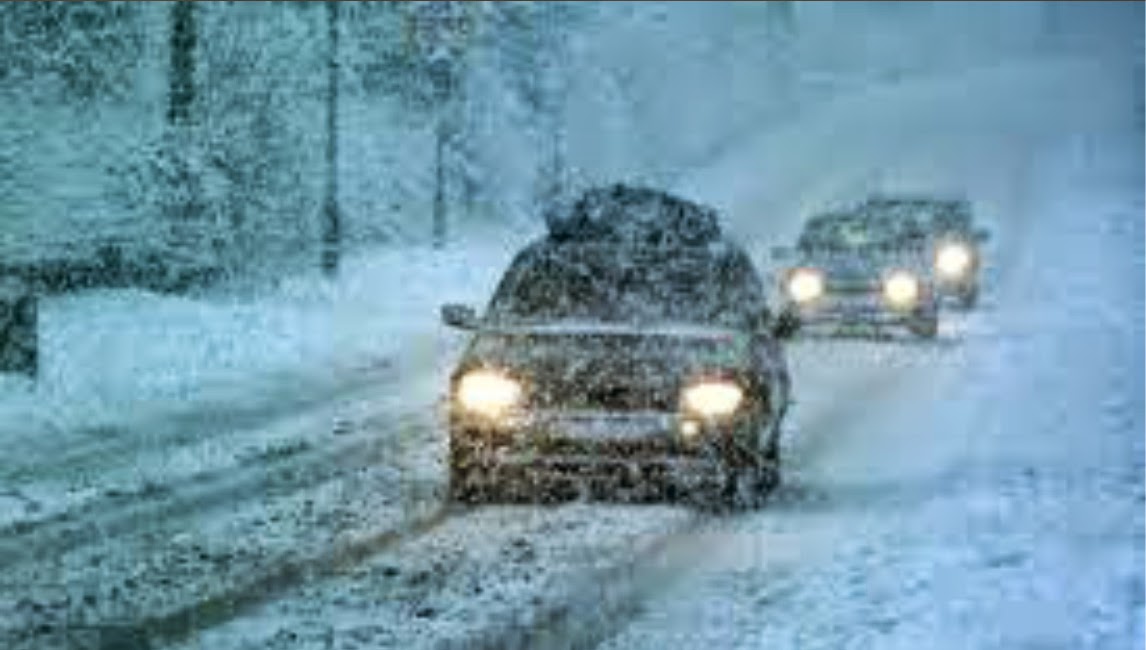
Deciding whether or not to close UW due to harsh weather conditions is a big decision and is not an easy call to make.  However, leaving UW open when the rest of the region is closed for business (all elementary and post-secondary schools, some businesses) during the obviously terrible conditions last Monday morning (February 2) would suggest the possibility that the bar for closure at UW has risen significantly higher than it has been in the past. 
During the inevitable and hopefully multi-stakeholder discussions on this topic, FAUW hopes to see the following questions/issues addressed:

  1. What decision-making body should be responsible for approving the university’s closing procedures?  According to the UW Weather-Emergency Closing Guidelines, this is Executive Council since they approved the current closing guidelines.  Shouldn’t the guidelines be debated and approved by UW Senate? Senate currently approves the schedule each year including closure of UW over the Christmas holidays.
  2. What precisely are the consequences of closing campus?  Asking faculty, staff and students to bear additional risks by travelling to campus during extraordinary weather conditions implies the additional risks are worth taking to avoid the closure consequences.  Note that UW Weather-Emergency Closing Guidelines indicate there is no requirement to reschedule cancelled classes.
  3. What extra resources and preparations (i.e., dollars), beyond a normal weather day, did UW allocate on the morning of February 2nd to safely prepare to have 20,000+ people come to campus?
  4. Why was the announcement confirming the opening campus delayed until after 7:00 am?  What was known at 7:00 am that was not known at 6:00 am?  Should the decision be made (yea or nay) and announced at 6:00 am when there is a severe storm warning?
  5. Is leaving the decision to reschedule a class in response to a UW closure at the discretion of each course instructor (see link above to guidelines) appropriate?  Why not mandate the first lost teaching day to be made up on the first weekday in the period between the last day of classes and the start of examinations?
  6.  Is it a good or bad thing that UW staying open February 2 made the national and international news and lit up social media (UW was trending 3rd in North America on social media on Monday)?

Addressing the above questions directly, among others, will  better prepare UW to repspond to future inclement weather. 


Leave a comment and let us know what you think along with other stories about February 2nd. 

A Fall Break at UW?

by: Bryan Tolson, FAUW Vice President

“Should classes start on the first Thursday after Labour Day to allow for two additional days off in the fall term?”
Our undergraduates said yes in their November referendum (74% of roughly 20% of eligible voters according to the Daily Bulletin).
My answer to the question above is no.  Starting the term earlier negatively impacts my mental health and my work-life balance. I’m not saying I don’t care about student mental health and well-being.  I certainly do and I think there are means to improve these things for students (see a few paragraphs below). My point is that we need to start this Fall Break discussion by realizing that UW has to balance the perceived improvement to undergraduate student mental health and well-being with the perceived degradation of mental health and well-being to other UW community members such as faculty, staff and graduate students.
The reason UW does not currently have a Fall Break, and would be justified in continuing with this approach, is very simple: Co-op. UW flexibility to accommodate a Fall Break is incredibly constrained, unlike any of the 14 Ontario universities that currently have a Fall Break, by our massive Co-op program, which involves more than half our full-time undergraduates (>60%) and thus has our campus buzzing over the summer.  Providing the co-op program means that a large proportion of faculty members, staff and graduate student TAs are committed to lectures, tutorials, labs and proctoring and then grading exams May through mid-August.  
Based on my personal experience of teaching in almost every spring term since I have been at UW, I can tell you that it is quite limiting to have to plan a family vacation for the final two weeks of August or the first week of September. This is even more frustrating when holiday plans sometimes need to wait until the spring final exam schedule is released in mid-June. 

However, I don’t have it as bad as lecturers who typically teach all three terms in a calendar year. Their only current dependable opportunity to take a two week or longer holiday not over Christmas (they have 4 weeks of holidays to take) is the period between spring exams ending and the start of the fall term. There are also UW staff and faculty who choose to take family holidays during orientation week (week of Labour Day) with the rationale that this is the only dependable non-teaching week outside of December when their family can take a week long holiday that only requires four days of vacation time.  

Perhaps more UW staff and faculty with children at home use the week of Labour Day to deal with the stress of transitioning the family into new routines for the new school year as that is the week their kids return to school.  Adding the work stress of the start of term at UW to that of an already stressful week at home is not very attractive.  For all these reasons, it is not acceptable in my mind to further reduce the potential vacation period at the end of the summer by starting the fall term on Thursday after Labour Day.   
After ruling out an earlier start to the fall term, perhaps the next option the campus would consider is Sunday exams.  Students didn’t answer to this option/question but my answer is again no.  This is not for religious reasons.  Sunday happens to be the only day of the week that I can currently count on having no mandated commitments and thus plan family gatherings for the Christmas season in advance.  Faculty and graduate student TAs all deserve to count on having one such commitment free day a week in December. Faculty and graduate student TAs are already required to work a few Saturdays a year without overtime and I personally think that is fine.     
As I mentioned earlier, I do care about student mental health and well-being and so we should talk about ways to improve this. Here are two approaches that do not require a Fall Break
  1. Follow the advice of a wise student-senator who suggested we just have a 24-48 hr moratorium on deliverables and exams immediately after the Thanksgiving long-weekend.  This is easy in my view and makes complete sense.  We should let the students decompress and not have to work over that weekend.
  2. Use the new campus scheduling software to maximize efficiency of final exam scheduling and constrain the system so that students never write two exams in one day.  While it is entirely plausible that this is not feasible, our campus won’t know for sure until this is tested.  We could even consider melting one of the Columbia Ice sheets to make available more large scale final exam writing space. 

      If the above improvements are not enough and a Fall Break must happen then how about having the break only when the scheduling of Statutory Holidays during the September-December are favourable? Why not just change UW guidelines on the pre-exam study days to say only that there must be a two day break (weekend or weekday, but not statutory holiday) between last day of classes and first day of final exams [actually I think this just partially happened at Nov. Senate meeting – see the minutes, pg 27]? This is arguably better than the current guidelines, which can sometimes yield only a 48 hour study period like this term while in other terms students have 96 hours to study before their first final.


      What about squeezing the final exam period into a 12-day instead of 14-day stretch?  Note that both of these stretches will usually cover two non-exam writing Sundays and so students with perfectly spaced exams would on average go from writing an exam every 2.8 days to every 2.4 days (see #2 above for feasibility assessment of perfectly spaced exams). 

      In fact, the spring term exam period is only 11 days of exams while the other terms have 12 days of
      exams. If the exam scheduling could be made to work over 11 days, why not move to 11 days of exam writing in all terms? One way to squeeze the exam period without having to rely on the scheduling system software would be to increase the number of exam time slots from four to five per day. This is achievable by changing the first exam time to start at 8 am, moving to only 30 minutes in between exam times and then finishing the last exam at 10:30 pm.
      I believe UW can find the right balance on this issue but it will not be achieved by implementing a Fall Break in the way the students voted for. I’d like to think that a faculty referendum on this issue is not necessary. But if it is, perhaps this question is appropriate:
      “Should classes start on the first Thursday after Labour Day thus, shortening the period between the end of the spring term exam period and the start of the fall term by two working days?”

      Take Back the Night: Point & Rebuttal

      Take Back the Night: Point

       by: Sheila Ager, Department of Classical Studies

      I have always had very strong objections to the Take Back The Night policy that bars men from participating in the march.

      I would consider myself quite a committed feminist, and I am familiar with all the reasons that have been put forth in support of this policy. Nevertheless, I find it both short-sighted and inconsistent with the premises of human rights. The latter objection should be pretty clear: men should not be excluded from the opportunity to participate in an activity on the basis of their sex, when that activity is not such as to necessitate a gender division. The implicit message is that all men are sexually abusive or otherwise violent (and conversely, that all women and all trans* people are not). The policy also sends a message that men who have themselves been victims of sexual violence and abuse do not rate the same consideration as women, children, and trans* people.

      On a more pragmatic front, I think this policy is seriously short-sighted. It once again implies that this is a “women’s issue”, instead of a grave social issue that concerns society as a whole. Men should be encouraged to adopt values and take actions that are conventionally labeled as “feminist” but this policy does the reverse, in spite of the invitation that men line the route of the march and so on. In my view, society will move forward more quickly and effectively towards desirable social goals of the type that Take Back the Night stands for if men are encouraged to partner with women in achieving those goals. Activities and rhetoric that discourage men from doing so are counter-productive, however well-meaning they may be. If anything, I think our society needs to take a much stronger stance, through education and other means, in getting men to actively espouse such goals.

      Barring men from the actual march may be a “tradition”, as the message states, but I really think it is a tradition that needs to change.

      Take Back the Night: Rebuttal

       by: Diana Parry, Recreation and Leisure Studies

      Take Back the Night (TBTN) is an annual event that sparks critical public discourse and action to stop violence against women, children, and trans* people. Historically, TBTN marches are rooted in 1970’s England, when, in response to murders by the “Yorkshire Ripper,” police put women under informal curfew, urging them not to be out on streets after 10 PM without male accompaniment. Outraged women took to the streets and marched to reclaim their right to walk in public without male accompaniment.

      Waterloo TBTN consciously honours both this history and its core symbolic gesture: women, children and trans* people walking at night unescorted by men. This symbolism powerfully conveys that women, children and trans* people should not have to be escorted by men to exercise their right to move about in public space without fear of violence (sexual, physical or otherwise). Indeed, for many who march, violence has intimately touched their lives, and the act of uniting in solidarity with others offers the opportunity to reclaim some of the power, and potentially the voice, that such violence may have eroded. 

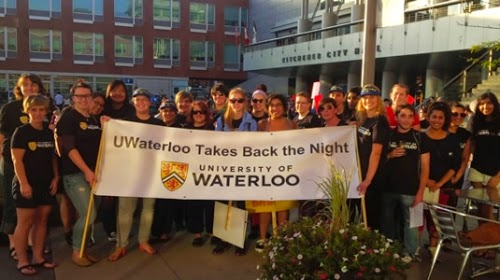
      Far from being excluded, men help to organize TBTN, they volunteer at the event, and they attend the opening rally and the post-march reception. Organizers also ask men who wish to show their support for women’s, children’s and trans* people’s right to walk at night unescorted to do so by flanking the streets and shouting words of encouragement.  This year, as the marchers filed into City Hall after the march, we were greeted by a sizeable group of men smiling and clapping. Many of my fellow marchers voiced their appreciation for the support they felt from these male allies.

      TBTN events have certainly never endeavoured to suggest that all men are perpetrators of violence, nor that men are incapable of being victims of sexual or intimate partner violence themselves.   Organizers are well aware of research such as a 2005 Statistics Canada study that suggested nearly 7% of men in intimate relationships have reported being slapped, kicked, bitten, or hit by their female partners (http://www.statcan.gc.ca/daily-quotidien/050714/dq050714a-eng.htm). 

      This same study, however, demonstrated that when women are victimized, the level of violence is often much more severe than that experienced by men.  Women were found to more likely to be beaten, choked, sexually assaulted, and threatened with a weapon by their partner than men were.  Women were also more likely to be injured through such violence and were three times more likely to fear for their lives than male victims. Within the Waterloo region alone, 14 women experience some form of sexual assault every single day (https://www.facebook.com/events/1484815838430775/permalink/1513855365526822/). Clearly, sexual and intimate partner violence represents a major social problem in Canadian society and one that can affect anyone, regardless of gender. TBTN draws attention to these social issues and serve as a call to action to end gendered violence.


      Are lecturers at Waterloo professors?

      by Bryan Tolson, FAUW Vice President

      As FAUW’s new vice-president this year, I have volunteered to advocate for Lecturers on our campus. I recognize the inherent difficulty associated with FAUW representing both tenure/tenure-track faculty members and lecturers, as the interests of both groups are not always the same.  I plan to write about this issue more in a future blog.  Today’s blog is about the titles we give (or should be giving) to those who are currently lecturers on campus. 

      Regular tenure/tenure-track faculty members typically have a 40/40/20 job responsibility split among the research, teaching and service components of their job.  Policy 76 suggests that the faculty appointment rank can include the word “professor” for faculty hired as research professors who are focused only on research (“Duties will be primarily research-oriented, but in some cases may include some service, teaching and/or student supervision”).  Note that research is only 40% of what most tenure/tenure-track faculty do.  On the other hand, according to Policy 76, the suggestion is that lecturers’ “duties are primarily limited to teaching and service”, which is 60% of what most tenure/tenure-track faculty do.  Further, consider that our Memorandum of Agreement (Article13, part 13.5.5b) allows tenure/tenure-track faculty to reduce their research component to only 20% of their duties.  This means that lecturers could have an 80% overlap of duties with some tenure/tenure-track faculty.  Based on the above policy interpretation, the argument to designate lecturers as professors clearly has some merit.

      Looking for further rationale, let’s consider what it means, according to UW policy, to be a professor.  Whether one has a research appointment or a regular appointment in the professorial ranks (and thus is designated as a professor), the only common thread I see in Policy 76 is that such a person “normally has a doctorate or terminal professional degree, as well as experience or strong potential in teaching and scholarship”.  How many of our lecturers on campus meet these criteria?  I am confident this number is significantly larger than zero.  For such individuals, what other reason is there to suggest that they are not worthy of using the word “professor” in their title?

      Beyond policy interpretations, I tend to think of professors as having, or working towards, some form of robust job security.  In contrast, research professors have no form of job security and are limited to definite-term appointment types.  So it seems odd to me that some colleagues with no prospect of job security get to use the word “professor” in their title while others who actually have job security (Continuing Lecturers) do not. 

      At the end of the day, I believe that any colleague of mine that has the same terminal degree as I do, has effectively the same level of job security as I do, and can do 60% of my job (often much better than me) deserves to have a title that includes the word “professor”.  The biggest question I see moving forward with such a change is the word “scholarship” in the Policy 76 statement.  For lecturers, what is it precisely and is it fundamentally required?

      Do you think this campus should move forward and give some or all lecturers titles that include the word “professor”?  Please do comment below.

      FAUW Updates – Part 2 of 2

      David Porreca, FAUW President

      This is a continuation from Part 1 posted last week.

      6. Pharmacy building

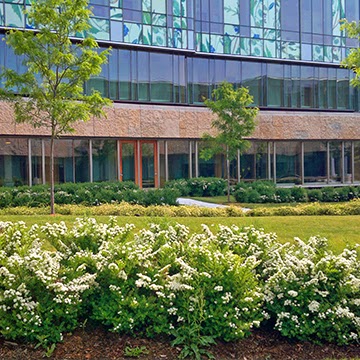
      East side of the pharmacy building showing flower garden

      Photo by George Freeman

      FAUW has received reports that certain peculiarities of the newish Pharmacy building on the corner of King & Victoria in Kitchener have been generating substantial environmental problems for the users of the building.  In particular, large teaching laboratories on the King Street side of the building have been experiencing high temperature and humidity levels on hot summer days.

      Their large windows face roughly north east and would get direct sun in the early morning, especially around the summer solstice.  Users of the lab need the full protective gear of safety glasses, long-sleeved lab coats, etc., along with giant fume hoods to whisk away any hazardous vapours. It is possible the HVAC equipment in that part of the building is not sufficient to its task or needs adjustment in view of the exhaust force of the fume hoods.  FAUW and colleagues working in the Pharmacy building are working with Plant Ops to find a solution.

      7. Fall break?

      Sign post labelled October pointing to the right

      © Filipe Frazao / Dollar Photo Club

      The Federation of Students has expressed an interest in running a referendum on whether or not to call upon the university to establish a Fall Break, similar to the winter-term Reading Week.  Currently, 14 Ontario universities have such a break, leaving only 8 without one (UW included).  A Task Force has just produced a report for the Provost detailing the various trade-offs that would be needed for such a break to be established (e.g., some combination of shortening Orientation, allowing exams on December 23, Sunday exams, and other options).

      The mandate of the task force was simply to gather information about these trade-offs, and to comment on their relative feasibility, rather to make any decisions or formal recommendations about whether or not to go ahead with this idea. The Task Force had good representation from all relevant stakeholder groups, and any moves toward a Fall Break would certainly involve much more extensive consultation of all the relevant parties. Any changes would require formal approval by Senate.

      8. FAUW staffing

      Just as the university itself is facing a crisis of continuity, the Faculty Association is also in a similar bind with respect to our staff. We have already bid farewell in early July to Jim Tigwell, our Communications Coordinator and Administrative Assistant, as well as to Carrie Hunting in mid-August, who was our Academic Freedom and Tenure and Policy Officer. Job postings forthcoming.

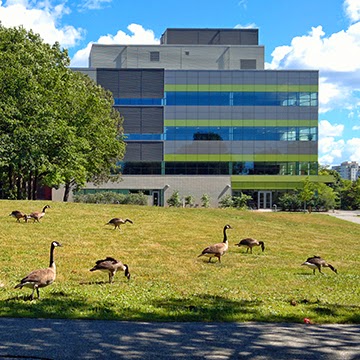
      Geese graxing on the lawn beside the ENV3 building

      Photo by George Freeman

      9. Revamped course evaluations

      Another Task Force, chaired by Mark Seasons (School of Planning) has been working on revising how UW conducts its in-class instructor evaluations by students. The faculty of mathematics and the faculty of science have been doing some pilot testing of all-electronic course evaluations using a very promising in-house electronic system. FAUW will be paying close attention to who has access to the completed evaluations, their format and content as well as to how they end up being used.

      10. FAUW retreat and priorities for 2014-15

      In July, the FAUW Board of Directors held its first-in-a-long-time strategic retreat to discuss large-scale issues facing us over the next year. During this retreat, we established a list of items that we hope to devote time and effort to over the course of the year. Some have already been discussed above, others are listed briefly here:

      a – Surveys: the FAUW Communications Sub-Committee intends to do more intensive polling of our membership on assorted questions of concern during this year.

      b – Revisions to Policy 33 (Ethical Behaviour)

      c – ADDS status: the revised ADDS regulations are winding their way through various Faculty Councils before going for approval at Senate. Revisions to the draft FAUW negotiated with grad students and the administration last year is likely to undergo revisions as a result of this process. More as it arises.

      d – Performance evaluations: The idea of shifting tenured faculty members to a biennial performance evaluation scheme will be considered once again over the course of the year.

      e – Arts 1.25 for service: This refers to the manner in which standards were set and communicated for assessments on the faculty annual performance (merit) evaluation.  It remains unresolved from last year.

      f – Best practices in graduate supervision: In collaboration with FAUW and the GSO, the Graduate Students’ Association is planning to develop a document setting out best practices in graduate supervision.

      g – Athletics: We will continue to explore ways of improving our health and wellness facilities on campus in collaboration with the student and staff associations.