How’s the Weather at UW? The Art and Duty of Accepting Limits

David Porreca, FAUW President

In this week’s blog post, I shall address the pros and cons of UW’s Weather Closing policy. Last week’s decision by the University not to close during the severe weather conditions provoked widespread befuddlement and outrage campus-wide.  Notes posted to UW’s main web page reassured students that they would not be penalized for not attending on account of the weather. This provision was particularly salient because of the importance of claiming seats in classes during the very first week of term.

Subsequently, a memo dated 9 January 2014 from the Provost was circulated to the campus community indicating that “snow and ice accumulation on local traffic routes is the central factor in the decision-making process” in determining whether to close our campus’ operations due to the weather.  This particular factor is mentioned nowhere in the university’s published guidelines, and is revealing in terms of its emphasis on infrastructure rather than people.  The same memo indicates that the Provost is assembling a group to “consider implementing a broader approach in future.”  Faculty representation on this working group is essential, and it is a key request that FAUW will be making when the matter is discussed at this week’s Faculty Relations Committee meeting.

There are three main concerns at work here:

“When half the students come and half don’t, when some colleagues cancel and some don’t, it’s actually worse than when the central administration makes a decision to close campus for a snow day.”
  1. The work-life balance issue of having local schools and childcare facilities close, including UW’s own daycare facility, no less – while our campus remains open.  All members of the campus community who have children – faculty, staff and students – either have to make special childcare arrangements (often expensive or difficult to find) or bring their kids to campus, which is not likely to boost productivity, nor is it much fun for anyone involved.
  2. There is also the safety issue unrelated to roads: is there a health warning associated with the weather?
  3. Finally, there are the logistical consequences of leaving the decision up to the good judgement of each individual (the guidelines linked above says that “faculty, staff and students are reminded that they are responsible for determining when weather conditions make their travel unsafe”: is everyone likely to be very late? When half the students come and half don’t, when some colleagues cancel and some don’t, it’s actually worse than when the central administration makes a decision to close campus for a snow day.

Now, I realise the expense and difficulties involved in declaring a closure when that teaching time must be made up elsewhere in the term.  Also, there is always the risk of declaring closure due to forecasts predicting imminent tempests that don’t manifest.  Considering the three main concerns mentioned above, would not a judicious application of the precautionary principle be advisable?  If work-life balance, the mental health and physical health of our campus community are true priorities at UW, human factors such as personal safety, the cancellation of school buses and the closure of local school boards should be part of the decision-making process, not just the measurable quantity of snow on the roads.  Here is yet another example of something that has value (mental & physical health), yet because it is more difficult to measure than the quantity of snow on the ground, only the latter gets attention and prioritization.

UW may wish to portray itself as invincible in the face of any and all adversity, but such an attitude betrays a lack of acknowledgement of the limits, human and logistical, experienced by the people directly involved.  FAUW looks forward to assisting in the drafting of a new, more humane closure policy.

For more on this topic, please see the blog entry by former FAUW Vice-President, Aimée Morrison at Hook & Eye.

Welcome Back!

David Porreca, FAUW President
Happy New Year to All!
This blog post marks the first anniversary of the FAUW Blog!  Two red-hot items for everyone’s consideration: the Strategic Mandate Agreement & Scheduling Feedback

Special Meeting of Senate re: Strategic Mandate Agreement (SMA)

14:30 TODAY
The Ministry of Training, Colleges and Universities (MTCU) has requested that all Ontario universities update and re-submit their Strategic Mandate Agreement. For reference, the original 2012 draft (PDF) and the current draft (PDF).
The deadlines imposed by the MTCU have left only just enough time for consultation with faculty members, with the latest draft of UW’s SMA submission being discussed at a special meeting of UW’s Senate this afternoon. 
Although at times jargon-heavy – “intrapreneurship” left this francophone and latinist baffled and scurrying for an etymological dictionary – the draft does a good job of selling UW’s strengths, borrowing heavily from the recent Strategic Plan.   In this context, I note in particular the wording “including, but not limited to, quantum science, water and aging” (emphasis mine) in a crucial passage under the heading “Transformational Research”.  This welcome modification to the controversial original formulation brings the document closer to embracing the full variety of research that is done on our campus, but members in certain disciplines will still find themselves searching for their proper place within the vision of UW described in this SMA. 
Finally, the MTCU imposed strict length limits on these SMAs, which limits the depth of the proposals.  With one’s expectations adjusted accordingly, it represents a palatable and at times even eloquent expression of what makes UW different, clearly destined for a political audience.

Scheduling Feedback

Please send your feedback to the Registrar’s Office on the simulated schedule that was distributed via e-mail in the waning days of last term.  You may do this in three principal ways:

  1. Fill in the survey that was distributed along with the simulated schedule materials.
  2. Send an e-mail directly to the Registrar’s Office regarding the simulation: regstep@uwaterloo.ca
  3. Contact the scheduling representative of your department.
The new extended deadline for feedback is 13 January. 
That’s all for now!  In the upcoming weeks, we will feature more fulsome assessments of the new scheduling system, the results of the Digital Privacy Colloquium held on 4 December, and other news, as it always arises.
With best wishes for happiness and productivity for 2014!

See you next week!

Fall General Meeting

The Faculty Association will be hosting our Fall General Meeting from 11:00 – 13:00 on 9 December in MC 4041 (light lunch and beverages provided). Some hot-button items for discussion:

  • Infosilem scheduling system
  • Online expense claims and digital privacy
  • University governance: Senate bylaw revisions, policy revisions, strategic planning and Senate
  • Athletics access and facilities
  • Course evaluations
  • Status of Lecturers and contract academic staff
  • Approved Doctoral Dissertation Supervisor status

We hope to see you there!

Senate Strategic Planning Update

David Porreca, FAUW President

This week’s post addresses issues and concerns relating to the November Senate meeting, when UW’s Strategic Plan was voted upon and approved. The UW Imprint and Daily Bulletin have already published news items relating to these events.

The discussion of the strategic plan generated a lively and vibrant debate, one which demonstrated Senate not to be a sleepy rubber-stamping body.  That said, there is some sense of disappointment in the end results. Let me explain.

The vote

Senate actually got to vote on the final version of the wording of the Strategic Plan, which had been called for at the October meeting of Senate.

Fears

  1. The fact that the Strategic Plan was printed, published and released as a public document prior to final Senate approval is, to me, the most unsettling portion of the events relating to this topic.
  2. The impact of emphasizing three specific research areas above others in the Strategic Plan is bound to colour perceptions of what research gets done at UW, including what donors see as our principal activities (e.g., will someone wanting to endow a research chair in a non-identified research area still want to send their monies to UW?)

Compromise

Concerns concentrated around the changes in wording of the Strategic Plan (detailed in our November 4 and November 11 posts) between the version Senate had approved by electronic vote in May and the one that was actually put forward at this November meeting. A friendly amendment was added to the motion to approve the Strategic Plan directing the team in charge of the implementation of the “Transformational Research” portion to refer to and take into account the university’s Strategic Research Plan, which is a much more inclusive document in terms of recognizing the broad range of research that happens on our campus. Hopefully this amendment functions to ensure the multi-million dollar internal CFI grant competition decisions are not influenced solely by the Strategic Plan statement.

Consequences

Water Institute Newsletter
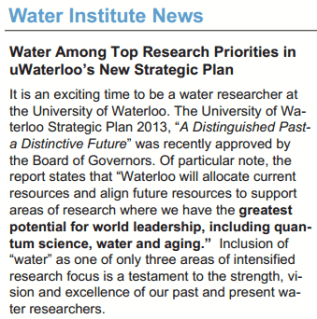
Water Institute Newsletter, v. 4 issue 1, p. 5
  1. It has not taken long for evidence to arise that confirms some of our fears in relation to identifying these three research areas.  See page 5 of the Water Institute’s Fall 2013 Newsletter (pdf).
  2. After the vote was completed on the Strategic Plan itself, a motion was put forward by a colleague aiming to proclaim Senate’s own authority to govern the academic aspects of any future strategic planning at UW.  Here is the language of the motion, with amendments noted (deletions that passed during debate are struck through):

    Motion:

    Whereas the University of Waterloo Act 1972 grants the Board of Governors the power to conduct the university’s business and affairs “… save with respect to such matters as are assigned by this Act to the Senate, …”, and

    Whereas the same Act, in section 18, states that “The Senate has the power to establish the educational policies of the University … this includes the power … j. to undertake, consider and co-ordinate long-range academic planning”, and

    Whereas research and teaching are both fundamental components of the educational and academic functions of the University, and

    Whereas any strategic plan for the University will address the strategies and approaches to be taken to further education and research at the University, and will identify potential areas of opportunity or importance,

    Be it resolved that

    a. Senate asserts the powers granted to it under the Act which give Senate the final authority over all academic aspects of any Strategic Plan, including those to do with research and education.
    b. No Strategic Plan for the University shall be regarded as being in effect until an explicit motion to that effect is discussed and approved by Senate.

Debate revolved around the specifics of the wording of the motion, to the point that the eventual vote went (quite surprisingly, in my humble opinion) against the motion 30-28, with votes going along non-partisan lines. Of course, Senate does not have the authority to vote away its own authority over academic matters, which is enshrined in the UW Act. Plans are afoot with student Senators to craft a more acceptably worded motion for the January meeting of Senate to address the concerns of Senate’s role in governing the academic aspects of any future strategic planning that happens at our university.

Open Access

Christine Jewell, University of Waterloo Library

Do you follow developments in the Open Access (OA) movement? If so, you’ll have heard the exciting news on the Canadian front.  This past October, the Canadian Institutes of Health Research (CIHR), the Social Sciences and Humanities Research Council of Canada (SSHRC), and the Natural Sciences and Engineering Research Council of Canada (NSERC) together launched a consultation on a harmonized open access policy.

The agencies are aiming for a policy that is in tune with global trends toward open access of scholarly literature, specifically, peer-reviewed journal publications arising from publicly funded research. The consultation document, entitled the Draft Tri-Agency Open Access Policy, is modeled after the CIHR Open Access Policy that has been in place since 2008.  The CIHR policy states that peer-reviewed journal articles must be freely accessible within 12 months of publication. The CIHR policy remains in effect throughout the consultation process. The proposed policy would apply to CIHR grants as well as SSHRC and NSERC grants awarded after September 1, 2014. More information and answers to frequently asked questions are posted on the NSERC website.

The consultation stage of the proposal will end on December 13th.  NSERCC and SSHRC are calling for individual as well as collective responses to be sent to openaccess@nserc-crsng.gc.ca.

Continue reading “Open Access”

The Quebec Charter of Values

Dan Brown, Status of Women & Equity Committee

It is a bit dismaying how little discussion there has been of the academic freedom implications of the proposed Quebec Charter of Values. Neither the Canadian Association of University Teachers nor the Association of Universities and Colleges of Canada has been willing to go on the record publicly about concerns with the Charter, and inside Quebec, the only university to publicly state its opposition has been McGill, whose new Principal, Suzanne Fortier, did publicly oppose the Charter.
In October, SWEC approved this letter.


The Status of Women and Equity Committee of the Faculty Association of the University of Waterloo disagrees strongly with the proposed Charter of Québec Values.

These proposals forbid civil servants from wearing “conspicuous” religious symbols, such as hijabs, turbans, and kippot, while allowing for “non-ostentatious” small jewellery. 

“This proposed charter would unacceptably enshrine religious discrimination and restrict the academic freedom of faculty and staff at universities across Québec.”

This proposed charter would unacceptably enshrine religious discrimination and restrict the academic freedom of faculty and staff at universities across Québec.  A pluralistic society will include members who express their personal beliefs by diverse choices of attire, and this diversity does not reduce the religious neutrality of the state.  We reject the claim that leaders of public institutions will proselytize by their choice of dress.

We strongly support the rights of women and equity for all members of society.  The proposed Charter does not enable women’s equality, and, by forcing some women to choose between their profession and their religion, violates their freedom of religion and freedom to practice their profession.

Finally, the Charter will reduce the quality of research and education in Québec.  Leaders at universities in Québec are already expressing concern about recruiting excellent faculty if the Charter were to be enacted.  At the University of Waterloo, we know that a diverse faculty is essential to educate our students and spark innovation, and we will regret the unnecessary loss to the research community that will come from silencing so many scholars.

We call on the Québec government to cancel the introduction of this unnecessary and divisive Charter.

In Support of the Strategic Plan

George Freeman, FAUW Past President

Since I am on both Senate and Board of Governors and have been involved in discussions of Ontario university politics for five years, I do support the strategic plan in its present form and suggest another approach for Senate and individuals who don’t like the wording of the ‘over the next five years’ paragraph in the ‘transformational research’ section of the plan.

George Freeman
George Freeman

My understanding of history would be that top-down direction of research (not development) has ultimately failed every time it has been tried (excluding some serendipitous fall-out which can come from any research activity). Having not seen much inclination from Waterloo administration to make that mistake, I wouldn’t worry that the strategic plan is a surreptitious move in that direction. I have been around Waterloo for a long time. I was at one of the first meetings, perhaps fifteen years ago, of the thing which ultimately became the nanotechnology piece of what is called quantum science in the plan. I participated in research discussions with the Research Institute on Aging back in 2006. I feel like water research has been amorphously congealing at Waterloo since my time as an undergraduate student in the 1970s (perhaps deriving from the puddles of 1957). My point is that these research areas became strengths from the ground up – because of Waterloo faculty interests and abilities and pursuits. It would be a fool’s game to strategically move into a research area without significant prior faculty buy-in and engagement and expertise. Thus, I would say the ‘transformational research’ section of the strategic plan, where it mentions specific research, is highlighting and celebrating a few current strengths from the thousands of research agendas we follow. In a time frame as short as five years, significant resources already have been, or are being, directed to those areas, plan or no plan. Everything else in that section is about supporting research generally and came from consultations with all stakeholders at a scale I would say has never before been seen on this campus. Fifteen years from now, I believe the highlighted research will look quite different.

My understanding of publicity would be that the plan is out there, has made its primary impact, and is now yesterday’s news as far as the public is concerned. If Senate wants to change the word ‘including’ to ‘including, but not limited to’ or some longer version of that – or to delete the paragraph – the only public news is the conflict between our Senate and our Board. That kind of exposure will not help us as faculty in anything we wish to accomplish and I would go so far as to call it a conflict based more on circumstances than overt actions.

Nothing is perfect. Waterloo is a big complex place in an environment of constant change trying to preserve proven academic principles which are under vicious attack in the public sphere. Meetings of Board and of Senate are costly, important events and people have other lives, especially in the summer. An administrative upheaval occurred, during the plan preparation, with the resignation of Sallie Keller, our previous Vice-President, Academic and Provost (VPAP). I believe Geoff McBoyle, our present VPAP, even put Waterloo ahead of his own well being (through lack of sleep) getting the plan out in time. If you want to understand the urgency, and the political risk, subscribe to the OCUFA news feed or spend some time reading the HEQCO website. If you have a particularly strong stomach, check out the Ontario government’s Productivity and Innovation Fund to which the university had to respond in September. The attacks and misunderstandings seem to come daily, some well planned and well funded, and some seeking essentially to dismantle the structures which make universities work to the benefit of society and change them to the benefit of other interests. I don’t think we have much political space for generic arguments. Had it been noticed in time, I’m convinced that the paragraph which bothers people would have been altered without a second thought by the Board or administration. The political goal, I think, is to look tremendously successful in things to which the public can easily relate and project our confidence that this will only get better in the future, ensuring their prosperity. Our story has to be as simple and immediately absorbable as the almost-completely-false but intuitively comfortable stories of some of the influential people attacking us.

Anything said in the document can, of course, be picked up by someone with an intent to push their own interests over yours. This happens sometimes with the faculty-level strategic plan in my faculty, for example. That’s where our full participation as faculty members in collegial governance comes in. FAUW has worked with the administration to become a permanent part of the Senate Long-range Planning Committee. Keeping that committee active is a good place to be involved in actual strategy.

“Get involved with FAUW activities. If someone in the public misinterprets the plan, set them straight or direct them to someone who can.”

Speak up in your department, faculty, or university committees. Regardless of what any plan says, most resultant actions need approvals before they can happen. Get involved with FAUW activities. If someone in the public misinterprets the plan, set them straight or direct them to someone who can. Most of what happens at Waterloo passes through public meetings in open session (or should). You could have attended, for example, every significant discussion of the strategic plan by the Board and heard first hand what each governor said (nothing about specific research directions in my recollection). My advice for Senate on the plan would be that we come to a understanding (recorded in the minutes) with the administration about the meaning of the one controversial paragraph. As a senator, I can be rightly upset about how the plan traversed its Senate approvals, but at some point I believe I have to look for the best solution in the context of what actually happened rather than a worst-case interpretation or an idealistic stance for its own sake.

As a public document, I believe the plan serves us well in this time and place. It makes us unique to the point of being anomalous in Ontario (on yet another front for Waterloo). As an internal document, it captures what people said they wanted, plus or minus. Internally, I consider the planning process much more important than the resultant plan.  How about externally?  What I believe we want to do, ideally, is load up our external Board members and other supporters with enough ammunition on Waterloo’s beliefs, and accomplishments under those beliefs, that they can sell our case in the corridors of power and money where they operate. If they are successful, this aids the case that Waterloo is a worthwhile investment and that it is not a target needing political meddling. When we go asking for support, it won’t matter so much that
they remember how successful we are in water, quantum science, or aging – it will only matter that they remember we are successful on a certain scale.  I believe this is the ‘branding’ for Waterloo which people are seeking.  It’s hard to make such an impact on outsiders without specific good examples.

The Senate needs to worry mostly about academic credibility, academic planning, and the motivations of faculty and students.

As always, I think the Board and Senate are voting on somewhat different things. The Board needs to worry mostly about risks of various kinds and about garnering support for the university. This is a high-level oversight role, not day-to-day management.  The Senate needs to worry mostly about academic credibility, academic planning, and the motivations of faculty and students. When a big resource movement is contemplated, these worlds mix a bit but mostly they seem to move along somewhat separately at the university level (unless you are a president or other high-level administrator). Where you really want a sharp eye out, I think, is your department and faculty and how the plan is interpreted into specific actions.

There’s also a bit of talking past each other going on between the Board of Governors and the Senate, I believe.  When the Board talks about a strategic focus on three areas, it is talking about the first three sections of the plan, namely ‘experiential education for all,’ ‘a uniquely entrepreneurial university,’ and ‘transformational research.’  These are the areas where Waterloo stands out on the Ontario and international stages.  The other five are in great shape at Waterloo but don’t represent as much of a competitive advantage in promoting this university. The government is serious about universities needing to understand and promote their strengths (differentiation), although we don’t know as yet exactly how that translates into funding decisions. Nevertheless, I think it is prudent for Waterloo to be in the game and ready.

I just got back from a meeting of Ontario members of boards of governors of universities, on the topic of what universities will look like in ten years, at which we heard from the Governor General of Canada, the Ministry of Training, Colleges, and Universities (both the Minister and Deputy Minister, separately), and several speakers and panels comprised of people experienced as university presidents, university board chairs, employers of university graduates, students, and education trend watchers or reporters. I would call it the most intense discussion of Ontario universities that I have ever participated in outside of a conflict environment. Based on my understanding of what was said, what is misunderstood, and what needs to be done, Waterloo’s strategic plan positions us extremely well (in fact, all three of Waterloo’s targeted areas, namely experiential education, entrepreneurial focus, and truly transformational research, were specifically mentioned as urgent priorities by many participants). There are real changes afoot and Waterloo looks well placed to be agile.

Bottom line is that I support the plan and urge Senate to take a non-confrontational route to reaching an understanding of its meaning.

Changes to UW’s Strategic Plan: Up for Approval at Senate

David Porreca, FAUW president

This week’s blog post outlines a series of serious concerns a number of Senators have expressed concerning the version of UW’s Strategic Plan that is intended to be discussed for approval at the next UW Senate meeting on November 18.

University of Waterloo Strategic Plan Header

First, it is important to outline the principal differences between the latter and the version of the Strategic Plan that Senate voted on electronically in the wake of the 21 May 2013 meeting of Senate. The two versions are set out in the table below, both taken from the “Research” section of the Plan [changes are boldfaced]:

21 May Strategic Plan language 18 November Strategic Plan language
Goal:
Increase the worldwide impact and recognition of University of Waterloo research

Objectives:

  • Enable conditions which support research excellence and impact
  • Identify and seize opportunities to lead in new/emerging areas
  • Increase interdisciplinary and transdisciplinary research at the global, national and local scale
  • Strengthen the relationship between research and teaching at the undergraduate level
  • Build wider awareness and understanding of Waterloo’s research productivity and impact
Goal:
Increase the worldwide impact and recognition of University of Waterloo research

Over the next five years:
Waterloo will allocate current resources and align future resources to support areas of research where we have the greatest potential for world leadership, including quantum science, water and aging.

Primary Objectives:

  • Be recognized internationally for excellence and innovation in education, research and scholarship
  • Enable conditions which support research excellence and impact
  • Identify and seize opportunities to lead in new/emerging areas
  • Increase interdisciplinary and transdisciplinary research at the global, national and local scale
  • Strengthen the relationship between research and teaching at the undergraduate level
  • Build wider awareness and understanding of Waterloo’s research productivity and impact
  • Seek global awareness of Waterloo’s research and teaching expertise

The motion that was voted on electronically by senators after the 21 May meeting reads as follows:

“You will be asked to vote on the following motion:
Resolved that Senate support the adoption of the strategic plan in the version posted at the following link [link to 21 May version no longer functions], and that Senate recommend to the Board of Governors that it adopt the strategic plan in that version.
Do you support this motion? Choose yes or no. “

Would the latter version have been resisted strongly at the electronic vote had it been included in the original?  It would seem so, considering how much reaction the new version is getting now that attention has been drawn to it, and Senators are becoming alert to the implications of the new language on several levels:

  1. The quoted passage from the new plan is not harmless language, where the key word is “including.”  Here are a couple of passages from the KW Record article “UW to focus on research as it strives for international recognition”

    “Hamdullahpur said there are many researchers at Waterloo whose work does not fall into the three research areas of special focus: quantum science, aging and water. There won’t be any threat of taking resources away from one scientist to give to another, he said. Rather, projects that fall within the priority areas will get preferential treatment with any new money that is raised.”  [emphasis added]

    “A new strategic plan for the university calls for it to develop internationally renowned and “world-changing” research, with special focus on the three key areas of quantum science, aging and water.”

    Conclusion: the suggestion heard at Senate that these three areas are only “examples chosen from many” is not consistent with the statements attributed to UW’s President in these press reports. So, is the intention to pour resources into these three areas at the expense of other world-class research on campus, was the President misquoted, or was a false impression given to Senate?

  2. The implication of  “world leadership” in the new version is itself troubling on at least two levels:

    a) The simple fact of singling out three areas in particular inevitably invites the reaction that “there are other, lesser fields.”  Anyone with links to a not-named field may feel that UW is not interested in what they do.  This has an effect not only on the morale of researchers, but also on potential donors interested in contributing to the not-named fields: would they still choose to support UW’s endeavours?

    b) There are numerous fields of extremely worthwhile inquiry to which “world leadership” cannot logically apply.  Examples include local history, the study of local ecosystems, the safety of local water supplies and local climatic conditions. The best possible research in these fields cannot conceivably be supported by the new language in the Strategic Plan.  Will scholars in these fields find themselves at a disadvantage in the resource allocation game as a result of the new version of the Strategic Plan?

  3. Focusing on a small number of things that one does well may well work in other realms of human endeavour (e.g., running a business, or playing a musical instrument), but it is a recipe for significant harm to an institution whose very name – a university – implies that it studies “the sum of all things,” or the “whole community”.

Therefore, it would behoove Senators to take their jobs seriously as guardians of the academic integrity of our institution.  If harmful ideas at the strategic planning stage are not resisted, how will we be in a position to stand up against them when the time comes for implementation?  The only reason that Senators are getting to vote on this new version of the Strategic Plan is thanks to the diligent attention – and serious concern – of a number of faculty and student Senators.  Otherwise, UW would be saddled with a plan that was modified at the urging of the Board of Governors, without the rest of our academic community’s knowledge or consent.

Consequently, an amendment to the motion for approval of the Strategic Plan will be put forward at the next Senate meeting to change significantly or delete entirely the paragraph beginning “Over the next five years…”, and Senators are invited to consider their votes carefully.

Unless, of course, the Strategic Plan is a document not to be taken too seriously at the day-to-day operations level….

FAUW Issues Update

David Porreca, FAUW president

It has been an extremely busy start to the Fall term.  Now that we are at the mid-way point, it is time to provide you, dear reader, with an update as to what has been keeping us at FAUW on our toes over the past several weeks.

ADDS status

The task force on the Approved Doctoral Dissertation Supervisor status regulations is pursuing its work with a view to reporting to the Faculty Relations Committee and the Graduate Student Relations Committee in November.  We are looking at solutions to ensure good graduate supervision that meets students’ needs while addressing the manifold concerns with how the current ADDS policy is communicated, applied and enforced.  At FAUW’s request, the Provost’s Office has written to each individual faculty member who has been hired in the past 6 years to inform them of the current policy, and equivalent language has been included in employment letters for those colleagues hired this past year.

Since doctoral dissertation supervisors can belong to a number of different categories of faculty members (e.g., visiting, clinical, tenure-track, tenured at UW, hired with tenure from elsewhere), the eventual policy would need to be formulated in such a way as to address the issues relating specifically to each one.

New AF&T chair

I am very pleased to announce that our colleague Christopher Small from Statistics and Actuarial Science had kindly agreed to replace Peter Van Beek as the Chair of FAUW’s Academic Freedom and Tenure Committee when the latter ends his term of office at the end of August 2014.  The AF&T Chair is a challenging position that can have an enormously positive impact on the careers of our members, and we at FAUW are very pleased that Christopher has expressed such keenness to take on the role.

Athletics

Our blog post from September 9 highlighted some of the issues relating to athletics that affect faculty members’ working environment.  New concerns have come to light in the meantime:

    University of Waterloo Physical Activities Complex

  1. There is no controlled access to the change rooms (e.g., turnstiles), which is commonplace in most reputable athletics facilities.
  2. All staff members who dispense towels and oversee the (otherwise) uncontrolled access to the change rooms must walk through the men’s change room area in order to gain access to their office space.
  3. Upon examination of the floor plan of the PAC, it turns out that the female change room is about ½ the size of the men’s. Unless there is a demonstrable difference in usage rates between the two groups, this layout is evidently problematic from an equity perspective.
  4. A rough estimate sees 1/3 of the lockers in the men’s change room being broken and unusable, and another 1/3 being unused (those with the locks upside down). In other words, the space is under-used by a substantial margin. The lockers are in a deplorable condition, and we should all be grateful that campus ambassadors do not take visitors through the change rooms.

In light of the above, the Faculty Association is pushing for renovations to the PAC that would

  • Restore separate change rooms for faculty and staff
  • Replace the lockers with new equipment
  • Maintain safe access to the emergency exits
  • Ideally, address the concern over equity

If all groups of stakeholders – faculty (FAUW), staff (UWSA), graduate students (GSA), undergraduate students (Feds) and the university administration (via Athletics or the Provost’s Office) – could come together to fund such renovations, all the stated groups would benefit at a modest cost to each.

Also, feedback from female colleagues as to the state of the women’s change rooms at the PAC would be greatly appreciated.  Please comment below or e-mail the FAUW president at dporreca@uwaterloo.ca.

Best practices in hiring

FAUW’s Status of Women and Equity Committee (SWEC) produced a 6-page report on “Best Practices in Hiring” for faculty members. This document has received endorsement by Deans’ Council and will be presented to the Executive Council of the university in late November. Recognition of the need for such a document at those high levels of university administration is an encouraging sign to be sure, as long as we eventually see proportional corresponding action.

Grad House memberships

Some of you have been asking about how faculty memberships at the Grad House work. Henry Ensley, manager of the Grad House, has written a letter explaining how it all works.

Instructor evaluations

FAUW is being consulted on what shape we would like to see course evaluations take in the future. Discussions will include student representatives and qualified staff from CTE. If you have strong feelings or ideas you’re willing to share about course evaluations, please comment below or e-mail the FAUW president at dporreca@uwaterloo.ca.

OCUFA Queen’s Park Lobby Day

UW’s Kate Lawson (OCUFA President) and David Porreca (FAUW President) met with four local MPPs on Wednesday 23 October at Queen’s Park: Ted Arnott (PC – Wellington–Halton Hills); Catherine Fife (NDP – Kitchener–Waterloo); Rob Leone (Cambridge) and Hon. John Milloy (Kitchener Centre). We had four basic messages to deliver to our representatives:

  1. That the province needs to fund an independent study on the working conditions of contract academic staff across the province in order to help resolve long-standing concerns about their job precariousness, lack of real academic freedom and potential for exploitation.
  2. That the province needs to provide temporary solvency relief to university sector pension plans for those institutions that need it.  We had been asking for a 1-year extension of such relief in order to give enough time to OCUFA to complete its study on university-sector pension plans. Much to our relief, however, in the middle of our meeting sessions, news came out that the province had granted a 3-year window of solvency relief.
  3. That the province needs to restore funding to its faculties of education. This question did not concern UW as much, so I shall not belabour it here.
  4. That the province need not incentivize differentiation between universities in the province because institutions of higher education are already plenty differentiated as it is, from small liberal arts colleges to the University of Toronto, with UW standing out – among other things – for its long-standing commitment to the co-op stream and for having a full Faculty of Mathematics.

Our messages were well-received, in particular, the first point, with members from all three parties agreeing to request such a study from the Minister of Training, Colleges and Universities.

Scheduling

FAUW is anxiously awaiting the results of the latest simulation of the new scheduling system, as discussed in last week’s post by Bryan Tolson.

Senate bylaws

The Secretariat has announced plans to undertake a full-scale revision of the Senate bylaws. The first phase of this initiative is restricted to housekeeping changes, but revisions to Section 5 (selection of members of the Senate) are being left for last as they are more likely to be substantive. These revisions require great vigilance to ensure that nothing deleterious to our working lives as faculty members happens as a result of the proposed changes.  Faculty senators are encouraged to exercise active vigilance when these documents become available for consideration.

UW’s numbered policies

The Secretariat is also undertaking a full-scale multi-phased revision of all 69 of UW’s numbered policies (still listed as 1-77, with some gaps).  The first phase will involve housekeeping changes (e.g., regularizing and updating the names of buildings and offices that are mentioned in the policies), but later phases will also involve substantive changes.  Through the Faculty Relations Committee, the approval of the Faculty Association will be necessary for any changes that are to be made to Class F, FS and A policies.  FAUW plans to devote substantial time and energy to make sure that any changes are favourable to faculty members’ interests.  The numbered guidelines and procedures will also be subject of an eventual analogous revision.

Work-Life Balance Report update

The joint FAUW/Provost’s Office Work-Life Balance Report that was presented to Senate back in February 2013 is becoming integrated purposefully into the “Value System” focus area of UW’s newly released (but-not-yet-fully-Senate-approved) Strategic Plan.  FAUW’s Status of Women and Equity Committee produced a “Compassionate Care and Bereavement Leave” report that will be considered in conjunction with the WLB report at the same level.

Event reminders

Please mark your calendars for the following events:

Privacy Colloquium: Wednesday, December 4, 2 – 5 in M3 1006, with reception to follow.
Fall General Meeting: Monday, December 9, 11-1, Location TBA. Light lunch provided