Standing for academic freedom, equity, and collegial governance since 1957.
Author: fauwaterloo
FAUW is the official representative of faculty members at the University of Waterloo. We negotiate compensation and terms of employment, help develop university policies, advocate for collective rights and academic freedom, support individual members, and foster collegiality across the campus community.
A couple of months ago, FAUW hosted a panel on how faculty members can “unplug” when away from work. With reading week upon us, we thought we’d share some of the insights from that event.
These are not pie-in-the-sky ideas dreamed up by productivity bloggers or people who don’t sleep. These are real methods for protecting your time practiced by professors at UWaterloo who are approximately as busy as you are.
Every two weeks or so, we give you a run-down of the major non-confidential topics discussed at our Board of Directors meetings. Here are the latest items:
A new Board member. Patrick Lam (Electrical and Computer Engineering/Computer Science, Director-at-large elected in 2019) has stepped down and gone on sabbatical. Alfred Yu (also ECE) is stepping in until June 30. Nominations for this seat and the six Faculty-specific seats on the Board are open now and due in March.
Climate Justice Working Group. The Board approved a proposal from members to form a FAUW Climate Justice Working Group. Its objectives include building climate justice awareness on campus, creating a community of practice for faculty, and sharing climate justice research with the regional community. You’ll hear more about this new group soon!
Graduate Students Association unionization vote. The GSA Council (similar to our Council of Reps) has voted in favour of “the formation of a union of graduate TAs, RAs, and sessional instructors.” This is a green light for the GSA to explore the option of unionization. There is a detailed explanation on the GSA website. The Imprint has also published a statement from GSA VP David Billedeau.
Our teaching workload project. We’ve collected some information about teaching workload norms and practices from our Council of Representatives. Unsurprisingly, we found wide variation across campus. This is back on the agenda at the Council of Reps meeting on February 5 as we work on narrowing our focus and filling in gaps in the data.
Departmental addenda. Every Faculty has guidelines for performance reviews. Every department has (or is supposed to have) departmental addenda to those guidelines with department-specific criteria (teaching workload norms, for example). These are mandated by the Memorandum of Agreement and they’re important because they set out what the expectations are for your evaluation. We’ll be talking about what to include in these addenda—and why now is the time to update them—at the Council meeting on Wednesday.
Policy 33 – Ethical Behaviour. A subcommittee of the Faculty Relations and Staff Relations committees is reviewing the feedback from the Policy 33 consultations.
The FAUW Indigenization Reading Circle meets monthly to discuss readings relating to Indigenization and reconciliation in the university context.
“Two-Eyed Seeing” by Cheryl Bartlett, Murdena Marshall, and Albert Marshall* reports on a program developed at the University of Cape Breton to increase Indigenous enrollment in science. The article describes and reflects on a learning process that could be used to move post-secondary programs toward a recognition of the strengths of Indigenous knowledge and ways of knowing and those of “mainstream (Western) science.” One key challenge the authors identify is finding the humility to acknowledge the circumstantial relevance of different ways of knowing. Ensuring that the process respects distinct knowledge communities requires institutional participation by Indigenous elders to validate the path taken.
Participants in the reading circle were divided about the value of the “two-eyed seeing” framework. On the one hand, some regarded it as a conciliatory position that dodges more radical concerns about the violence of colonial ways of knowing. Some forms of academic knowledge are not benign ‘eyes to see by’ but reflect practices of dominance. Interpreting the framework closer to its intended STEM field of application, other participants could see two-eyed seeing as a promising generative framework. The co-learning journey described showed a process whereby new knowledge “tools” could be incorporated into a sovereign cultural setting.
Happy new year! Our big priority for this term is to keep moving forward on policy development and research professor representation. Here are some of the smaller (and not-so-small) things we talked about at the January 16 board meeting:
OCUFA’s court challenge. OCUFA has voted to join ten unions representing more than 250,000 Ontario workers to launch a coordinated Charter challenge against the Protecting a Sustainable Public Sector for Future Generations Act—formerly Bill 124—this is the legislation that forces our pay raises to be small for three years.
TheFAUWAppreciation Award. We’re starting to consider suggestions for this year’s recipient(s) of the FAUW Appreciation Award, which recognizes people from across the University who have gone above and beyond to improve the lives of faculty members.
Professional licensing fees. We’re doing an environmental scan about how professional licenses are handled across campus. Unsurprisingly, there is a lot of variation in terms of who needs to be licensed, how many people in a unit need to maintain their license, and who pays for it. For anyone who doesn’t know what we’re talking about, professional programs (e.g. planning, optometry, engineering) typically need a minimum number of faculty members to hold professional licenses in order to maintain the accreditation for their school/department/program.
The switch from Scantron to Akindi. You have at least three options for digital grading solutions, including Akindi, UW’s new go-to “multiple-choice exam processing service.” One of our board members recommends Crowdmark as a way to reduce your workload. We’re exploring the possibility of hosting a lunch & learn on digital grading systems—let us know in the comments if you’d be interested. Learn more and register for Akindi training on the IST website.
Our “People You Should Know” blog series interviews key people and offices at the University of Waterloo so you can make the most of their services.
Lauren Byl is the Copyright and Licensing Librarian at the University of Waterloo.
What does a copyright librarian do?
In my role, I answer copyright questions about use of materials in teaching, such as those related to the Fair Dealing Advisory, as well as provide guidance on copyright during the publication process. I’m also responsible for negotiating the Library’s licenses for electronic resources.
Why should faculty members know about your role?
Much of the work faculty do triggers copyright in some way—whether it’s their own rights as authors, asking permission to use other’s work, or what they can use in the classroom. Faculty should know about my role because I’m here to help make copyright easier to understand and provide guidance on University best practices.
“There’s no end to the ways that people consider using or adapting works.”
What are the most common questions you help faculty with?
On the publishing side, the most common question is “What can I do with work I’ve published?” Faculty usually sign over copyright to their publisher during the publishing process; the agreement states what an author can do with their own work.
Before everyone disappears for the holidays (who are we kidding, most of you won’t see this until January), here’s a quick re-cap of what we’ve been doing this term, including an update on our priorities for 2019–20.
How we’re doing on our 2019–20 goals so far
Policy development: We are in the midst of some big discussions about how to improve our policy development process as a whole. Policy 33 (ethical behaviour) is moving along—FRC is processing 100 pages of feedback from the University community and will give direction on changes in the new year. Bryan is still hoping to get this approved before his term is up! Policies 14 (parental leave), 57 (accommodations), and 76 (faculty appointments) are still in progress.
Conflict of interest guidelines: Faculty Relations Committee is finalizing these.
Workload: We distributed a questionnaire to our Council of Representatives and are finishing up gathering the last of those and starting to analyze the information. We will share the results with our members next term.
It’s that time of year—the time when faculty members at Waterloo start thinking about writing their annual performance review documents and putting together their files. In this spirit, the FAUW Equity Committee offers twelve tips to help you think about equity as an essential part of this process.
On the first day of performance review season, collaborate with members of your own department to demystify the review process, especially for new faculty members. All APRs are local; what someone does in another department is probably not the same in yours. Consider starting a sharing circle: pool APR reports, with or without the numbers attached, so that you can get a feel for the genre. Pay it forward. Mentor those junior to you.
On the second day of performance review season, focus on your teaching effectiveness in the full knowledge that student questionnaires correlate principally with non-instructional factors (scheduling, student interest in the topic, grade expectations, and the like).
The Ontario Confederation of University Faculty Associations (OCUFA) states unequivocally:
“Using SQCTs [student questionnaires on courses and teaching] for performance evaluation penalizes women, racialized and LGBTQ2S+ faculty, and faculty with disabilities. These faculty are also more likely to be the target of harassment in the anonymous comments sections of the questionnaires. Further, using SQCTs for performance evaluation risks undermining effective teaching and intellectual diversity.”
To cite this report in your own performance review documentation: Ontario Confederation of University Faculty Associations. “Report of the OCUFA Student Questionnaires on Courses and Teaching Working Group.” February 2019. https://ocufa.on.ca/assets/OCUFA-SQCT-Report.pdf
On the third day of performance review season, start a broader discussion at the department level. Every department has guiding documents that outline how to evaluate performance. Share the recent arbitration ruling at Ryerson University (Ryerson University v. The Ryerson Faculty Association, 2018) that student evaluations of teaching via course questionnaires are valuable instruments for “captur[ing] student experience” but cannot be “used to measure teaching effectiveness for promotion or tenure.”
Or talk about how the Department of Psychology at Waterloo decided not to use student evaluations of teaching in their review process, citing the bias inherent in these evaluations. This effort was rejected at the decanal level, but maybe we just need more departments to take a principled stand. Consider citing the OCUFA document (see: day two) in your department’s review documentation. Ask what other sources of bias might exist in your department’s process.
On the fourth day of performance review season, your department gets a special gift: a junior faculty member on the performance review committee! Rotating junior members of the department onto the committee is important because it will pull back the curtain for these colleagues, but also because it can be unfair to junior faculty members to be evaluated only by senior colleagues. The Memorandum of Agreement (MoA) between FAUW and the University delineates that there must be five members to assist the Chair on this committee (see section 13.5.6), but does not specify rank or other details about these members.
Our “Meet the Faculty” interviews provide a window into the work lives of faculty across the University of Waterloo. Faculty members talk about the day-to-day joys and struggles, and share tips for getting the work done and staying mentally and physically healthy in academia.
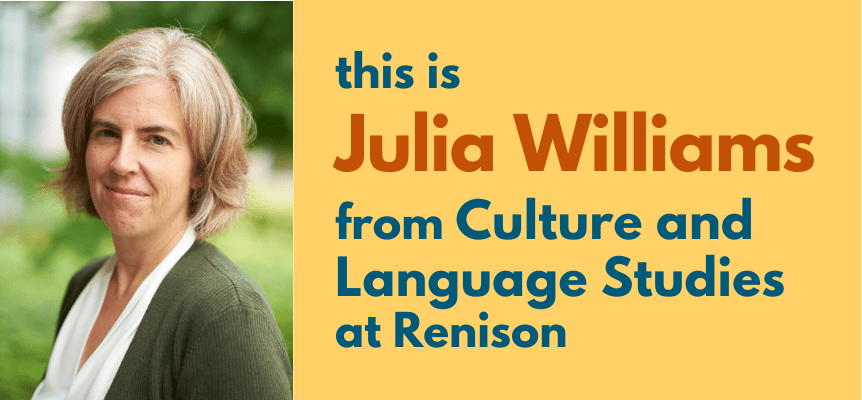
Julia Williams is director of the English Language Studies unit, co-ordinator of the Applied Language Studies plan, and a continuing lecturer in Culture and Language Studies at Renison University College.
What do you teach and research?
I teach English for Multilingual Speakers (EMLS) courses and Applied Language Studies (APPLS) courses. I also carry a substantial administrative workload. Although research is not part of a continuing lecturer’s official workload, like many CLs, I do engage in research. I have written several textbooks for EMLS courses and conducted collaborative research with colleagues in Economics, Optometry, and Earth Sciences. Currently, I am working, with a colleague, on a survey of units administering English language programs at post-secondary institutions across Canada.
You have a number of service roles, including directing the English Language Studies unit. What else is filling your days right now?
I’m fortunate to have a varied and stimulating workload. I’m teaching and in the midst of providing feedback on student assignments, I’m the chair of Renison’s Anti-Harassment and Discrimination Committee, and I’m a departmental representative on the College’s Academic Council and the Community and Professional Education (CAPE) Council. I’m also a reviewer for two disciplinary journals and am developing a presentation for a conference in early December. Outside of work, my family and I are becoming more involved in the Ride for Multiple Sclerosis.
The Renison Association of Academic Staff has demonstrated that faculty have shared interests and can work together for our shared benefit.
You work at Renison. How would you describe your relationship to the University of Waterloo?
We have strong ties to the University of Waterloo through a variety of connections. English Language Studies offers communication skills courses, and we are integral to the Math and ARTS First communication skills initiatives. We participate regularly in community of practice groups run by the Centre for Teaching Excellence and the Writing and Communications Centre, and we have links with the Centre for Extended Learning as well. We also develop and maintain strong ties to the larger university through our undergraduate and graduate students who come from faculties all across campus.
Our “Meet the Faculty” interviews provide a window into the work lives of faculty across the University of Waterloo. Faculty members talk about the day-to-day joys and struggles, and share tips for getting the work done and staying mentally and physically healthy in academia.
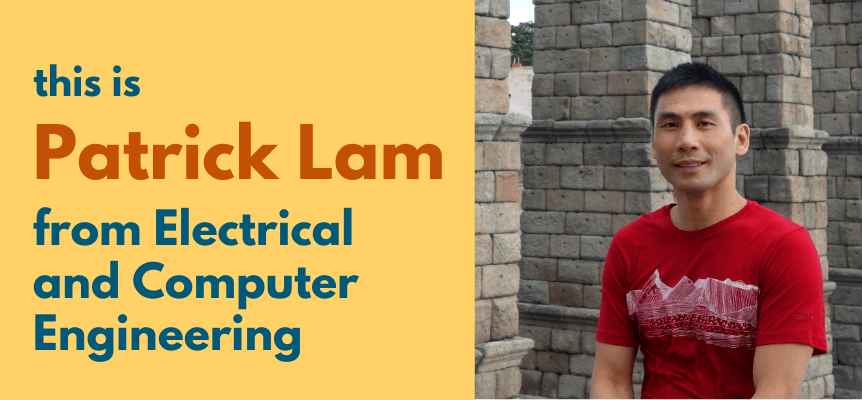
Patrick Lam is the soon-to-be-ex-director of UWaterloo’s Software Engineering program and an associate professor in the Department of Electrical and Computer Engineering. He’s also an at-large representative on the FAUW Board of Directors.
What do you teach and research, and what drew you to that work?
I am trained as a computer scientist and my subfield is programming languages and their applications to software engineering. When I came to Waterloo, I learned that Electrical and Computer Engineering departments tend to be quite scientifically diverse and include faculty from a wide range of disciplines, from physics to mechanical engineering, and fortunately passing through computer science as well.
Specifically, I develop techniques and tools which automatically understand what software developers are saying (and what they meant to say) when writing computer software. A common misconception that developing software is a solitary task where it’s just you telling the computer what to do. That’s totally not the case, especially today, and developers absolutely must communicate with their teammates (and others). My research aims to dig out some of the implicit communication developers are performing and make it explicit.
I believe that many of us just happen to fall into doing what we’re doing by coincidence, and I think there are a lot of interesting things to study in the world. But often there are mentors that help us find our own area. In my case it was my professors for undergrad, Prakash Panangaden and the late Laurie Hendren. I hope that I can similarly inspire my own students.
What kind of work is involved with being the director of a program?
Being a program director is a rewarding but high-volume service task. The two main parts are managing operational challenges and providing academic leadership to students and committees. Operational challenges include supporting instructors and balancing the concerns of the parent units; for software engineering this is especially challenging because it is jointly offered across Faculties by the School of Computer Science and the Department of Electrical and Computer Engineering, and these units are quite different. Academic leadership includes thinking about what the students should learn (and what they don’t need to learn) and guiding curriculum committee discussions. I strive to be a well-rounded intellectual role model for students.
For Software Engineering, we have an associate director who is the primary academic advisor. However, I do serve as a secondary advisor and work with students when they feel more comfortable with me. That is one of the most rewarding parts of the role, even if it’s somewhat peripheral.
At this career stage I feel like one can get stuck in what I call “associate professor purgatory.”
The Task Force on Graduate Student Supervision is seeking feedback from faculty members who supervise doctoral or research master’s students. The mandate of the Task Force is to investigate the mechanisms by which the quality of graduate supervision at both the master’s and doctoral levels is assessed at the University.
The survey is designed to gather your experience with and opinions about supervisory expectations or standards, evidence of effective supervision, strategies for communicating supervisor/student expectations, and what kinds of support/training you believe will be effective.
The survey will take approximately 3-5 minutes to complete and remain open until December 6th2019 (midnight). This survey is anonymous; participation is confidential and voluntary.
If you have any questions about the survey or the work of the Task Force on Graduate Student Supervision, please contact Angela Rooke (a2rooke@uwaterloo.ca), Graduate Studies and Postdoctoral Affairs.









 The FAUW Blog