Board Welcome and Summer Farewell

by: The FAUW Board

The new FAUW Board for the July 1, 2015 to June 30, 2016 term has officially started. Please welcome President Sally Gunz, returning members Vivian Choh, Greta Kroeker, David Porreca, Lynne Taylor and Bryan Tolson, and incoming members Shannon Dea, Heidi Engelhardt, Elise Lepage and Paul Wehr. Their diverse backgrounds, strong experience and desire to improve working environments across campus will guarantee positive impacts for the faculty community.

FAUW would also like to acknowledge our current Committee Chairs Heidi Engelhardt (Lecturers’ Committee), Kathleen Rybczynski (SWEC) and Christopher Small (AF&T Committee), as well as Steven Bednarski (SJU-ASA), Lori Curtis (Pension & Benefits) and Shannon Gordon (Library).

If you have any questions for the members of our Board, please do not hesitate to contact us. For now, have a happy holiday and safe summer. See you in September!


Faculty Association of the University of Waterloo

Did you know…that the activities of academic librarians align closely with academic staff?

Academic Status and Governance for Librarians at Canadian Universities and Colleges, a document of the Canadian Association of University Teachers (CAUT), emphasizes how similar the terms and conditions of Librarians’ employment are to Faculty. Locally, this is reflected at the University of Waterloo where Academic Librarians contribute directly to the University’s mission “to advance learning and knowledge through teaching, research, and scholarship … in an environment of free expression and inquiry”.

For example, Academic Librarians teach information literacy, support academic integrity, manage research collections, serve on professional bodies, sit on University groups, conduct original research, participate on research teams, contribute knowledge to their field, present at conferences, publish in peer-reviewed journals, and instruct within library and information science graduate programs. Given the specialized and scholarly nature of Academic Librarianship, University of Waterloo Librarians have expert knowledge in the areas of pedagogy, metadata, copyright, digital initiatives, geospatial information, and bibliometrics.

The intellectual nature of Academic Librarianship is also reflected in the fact that Waterloo’s 30 Professional Librarians have American Library Association-accredited Master of Library and Information Science (MLIS) degrees, which provide the practical and theoretical foundation for their research, teaching, and service activities. Learn more about the activities and accomplishments of University of Waterloo Librarians.

FAUW Welcomes New Staff Member

Please join FAUW in welcoming Katie Damphouse, our new Academic Freedom and Tenure and Policy Officer. We are delighted that Katie has joined our team and is ready to take on the challenges of her new role. She has been part of the University community for 10 years and brings experience in mediation, coaching and policy development. Her passion for advising others will ensure excellence while assisting faculty with a variety of issues.
Welcome, Katie! 

Changes to the Faculty Professional Expense Reimbursement (Professional Allowance)

Under the terms of the faculty’s new salary settlement, as of 1 May 2015, we will be able to carry forward any unspent FPER balances for up to three years, as well as continue to be able to carry forward all excess expenses for up to three years.
However, this change does not apply to the current FPER, due at the end of this month (30 April 2015). The change only comes into effect with the new salary agreement and so only takes effect in the fiscal year of 2015-2016. If it makes sense, you should use up any outstanding balance you have for this year or you will lose it.

Did you know…about UW’s large payouts to Administrators?

 
Western University has taken a lot of flak for trying to provide a large administrative payout to its president (which he has now promised to return). In contrast, the University of Waterloo executed large administrative payouts between 2009 and 2011 that have gone relatively unnoticed. The 2010, 2011and 2012 Ontario Sunshine lists show that:
In 2009, the vice president, academic & provost was paid:
                              $737,000 from UW (at UW January – June)
                            +$220,000 from Western (July – December)
 
In 2010, the same person was paid:
                              $500,000 from UW (as “professor, adjunct”)
                            +$440,000 from Western
In 2010, the president & vice chancellor was paid:
                        $1,041,000 from UW (at UW January – October)
 
In 2011, the same person was paid:
                         $610,000 from UW (as president)
It is noteworthy that the presidency at UW changed in October 2010 and as such the incoming president was also paid $309,000 in 2010 (for 9 months service as provost and 3 months as president) and $486,000 in 2011 as president.
Confused? Consider the faculty/staff salary scale increases in the 2009-2011 period. They are much simpler:
 
Year
Faculty/Staff Scale Increase
2009
3%
2010
0%
2011
0%


Note that the UW Board of Governors Governance Committee is responsible for reviewing senior UW administrator contracts.
The Faculty Association would like to know:


Does the UW community wish to set parameters/limits/procedures that the Administration and Governance Committee must work within when negotiating and approving contracts? What should these be?

Did you know…

…about UW’s large payouts to Administrators?


Western University has taken a lot of flak for trying to provide a large administrative payout to its president (which he has now promised to return). In contrast, the University of Waterloo executed large administrative payouts between 2009 and 2011 that have gone relatively unnoticed. The 2010, 2011and 2012Ontario Sunshine lists show that:
In 2009, the vice president, academic & provost was paid:
                              $737,000 from UW (at UW January – June)
                            +$220,000 from Western (July – December)

In 2010, the same person was paid:
                              $500,000 from UW (as “professor, adjunct”)
                            +$440,000 from Western
In 2010, the president & vice chancellor was paid:
                        $1,041,000 from UW (at UW January – October)

In 2011, the same person was paid:
                         $610,000 from UW (as president)
It is noteworthy that the presidency at UW changed in October 2010 and as such the incoming president was also paid $309,000 in 2010 (for 9 months service as provost and 3 months as president) and $486,000 in 2011 as president.
Confused? Consider the faculty/staff salary scale increases in the 2009-2011 period. They are much simpler:

Year
Faculty/Staff Scale Increase
2009
3%
2010
0%
2011
0%

Note that the UW Board of Governors Governance Committee is responsible for reviewing senior UW administrator contracts.
The Faculty Association would like to know:

Does the UW community wish to set parameters/limits/procedures that the Administration and Governance Committee must work within when negotiating and approving contracts? What should these be?

FAUW Scheduling Survey Results

by: Bryan Tolson, FAUW Vice President 

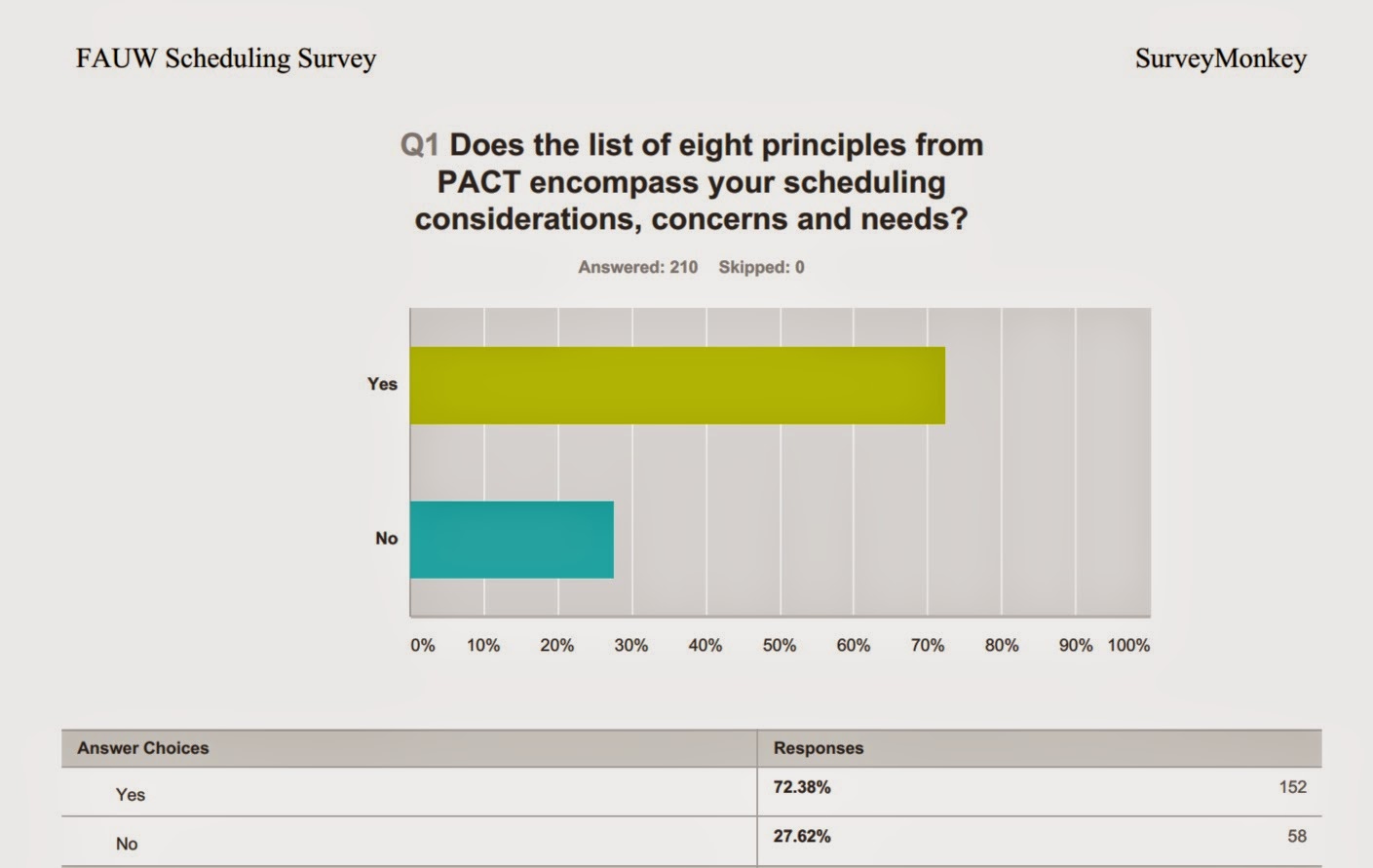
The Provost’s Advisory Committee on Timetabling is considering a list of principles that will govern the functioning of the new scheduling system going forward. FAUW recently conducted a survey on timetabling and more than 200 members responded!  Here are the overall results: 

Question 1:


Question 2:
  • For Q2, we had 57 responses suggesting concerns missing in the principles.


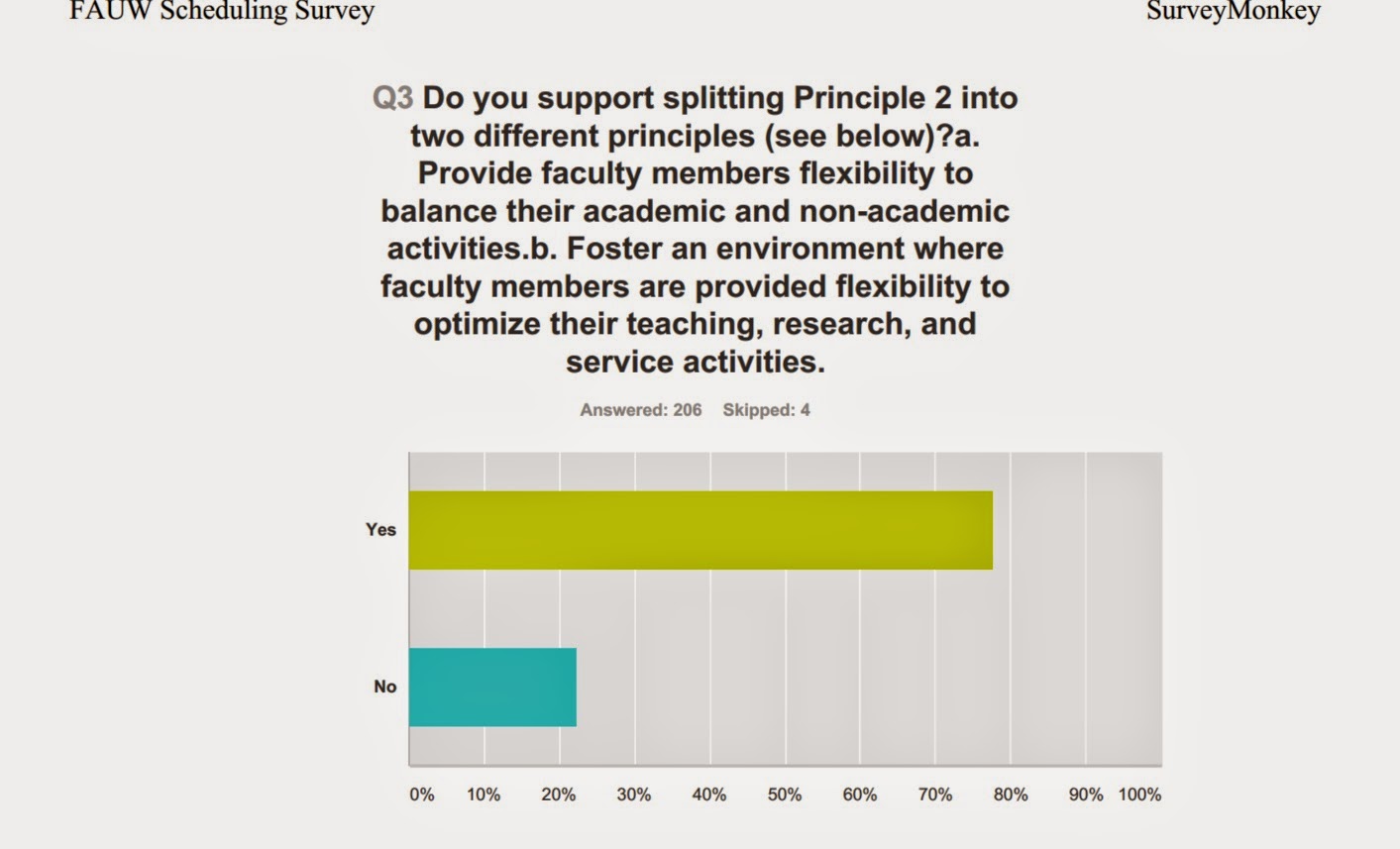
Question 3:


Note: PACT Principle 2 wording is currently as follows:
“Foster an environment where faculty members can harmonize their teaching, research, service, and non-university activities”. 

Scheduling Systems: Same Old Tune

by: David Porreca, FAUW President
This blog post represents a synthesis of my own experience with scheduling systems over my 22 years of involvement with the University of Waterloo, along with the sharp observations of a more senior colleague. (h/t to BC)
Over my time at Waterloo, I reckon I’ve been through at least three (if not four) changes in timetabling systems, and all have followed a recognizable and consistent pattern in their deployment:
1- Disaster is widely predicted.
2- Disaster does not occur but there are numerous problems.
3- People responsible for the new system deny that any problems are real: they will disappear when the system is fully implemented.
4- Departmental administrators gradually discover the levers that control the system and devise workarounds and local optimizations that mitigate the problems.
5- Four or five years later the system has returned to what it was before the change, in terms of functionality.
6- The Registrar discovers that they still have the same problems they had before the change.
7- Acquiring a new system commences.
The current iteration of the scheduling cycle is sitting somewhere between points 2 and 4, with some units working with the system, and others working the system to their advantage – and it’s unclear whether the latter represents a disadvantage to other units.  Any complex system can be gamed to the advantage of certain participants, but not all such systems are zero-sum games. 
The extent to which the InfoSilem system and its attendant procedures amount to zero-sum is still unclear to me.  The number of potentially competing factors is substantial: does one prioritize student completion times, student conflict-free schedules, room usage, professors’ optimal performance in the classroom, efficiency of the process of timetabling itself, pedagogical considerations for individual courses and for programs, or any number of other factors that one could devise?

The issue is as confounding as it is important to our working lives as faculty members.  According to the scheme outlined above, we still have a couple of years to go before the current system is made to work well.  Will it work well enough to (gasp!) break the cycle?  

To include your input on the issue, take part in the FAUW scheduling survey before Friday, March 13. 

Sort of Snow Day

by: The FAUW Board

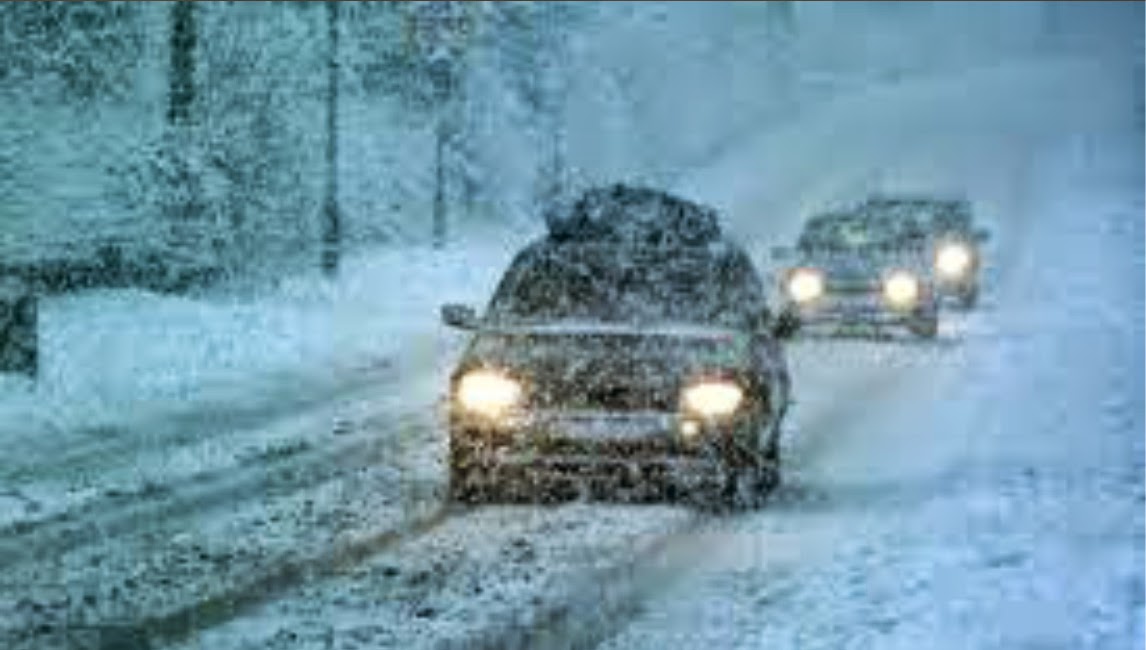
Deciding whether or not to close UW due to harsh weather conditions is a big decision and is not an easy call to make.  However, leaving UW open when the rest of the region is closed for business (all elementary and post-secondary schools, some businesses) during the obviously terrible conditions last Monday morning (February 2) would suggest the possibility that the bar for closure at UW has risen significantly higher than it has been in the past. 
During the inevitable and hopefully multi-stakeholder discussions on this topic, FAUW hopes to see the following questions/issues addressed:

  1. What decision-making body should be responsible for approving the university’s closing procedures?  According to the UW Weather-Emergency Closing Guidelines, this is Executive Council since they approved the current closing guidelines.  Shouldn’t the guidelines be debated and approved by UW Senate? Senate currently approves the schedule each year including closure of UW over the Christmas holidays.
  2. What precisely are the consequences of closing campus?  Asking faculty, staff and students to bear additional risks by travelling to campus during extraordinary weather conditions implies the additional risks are worth taking to avoid the closure consequences.  Note that UW Weather-Emergency Closing Guidelines indicate there is no requirement to reschedule cancelled classes.
  3. What extra resources and preparations (i.e., dollars), beyond a normal weather day, did UW allocate on the morning of February 2nd to safely prepare to have 20,000+ people come to campus?
  4. Why was the announcement confirming the opening campus delayed until after 7:00 am?  What was known at 7:00 am that was not known at 6:00 am?  Should the decision be made (yea or nay) and announced at 6:00 am when there is a severe storm warning?
  5. Is leaving the decision to reschedule a class in response to a UW closure at the discretion of each course instructor (see link above to guidelines) appropriate?  Why not mandate the first lost teaching day to be made up on the first weekday in the period between the last day of classes and the start of examinations?
  6.  Is it a good or bad thing that UW staying open February 2 made the national and international news and lit up social media (UW was trending 3rd in North America on social media on Monday)?

Addressing the above questions directly, among others, will  better prepare UW to repspond to future inclement weather. 


Leave a comment and let us know what you think along with other stories about February 2nd.