We were please by the University’s announcement last week that it was named one of Canada’s Best Diversity Employers for its commitment to gender equity.
We were especially excited to see two initiatives started by FAUW volunteers—Waterloo Women’s Wednesdays and our Equity & Inclusivity Award—specifically mentioned as contributing factors to the University’s selection!
FAUW is actively working on equity issues of all kinds across campus at the Board level, through representatives on policy drafting and other committees, and via our own Status of Women and Equity Committee.
SWEC has working groups investigating a number of areas, including accessibility and accommodations, healthy workplaces, hiring, and the needs of racial and cultural minorities. There will be a call for new members in May.
As an academic community, one of our moral obligations is to openly and freely share our ideas in the hopes that they may benefit others. Given the nature of our jobs, this same principle logically applies to the sharing of teaching materials. Policy 73 describes how intellectual property rights pertain to teaching materials as well as the University’s expectations with regards to the sharing of these materials.
Your rights (section 8b, “Principles”):
The creation of materials required for course management and administration, such as course outlines, final exams and laboratory manuals, is considered an assigned task, and copyright for such material is vested in the University. This does not apply to more detailed teaching materials, such as course notes, for which the copyright belongs to the creator.
Your responsibilities (same section):
However, any of the latter material which has been printed and distributed or made publicly available should also be available for royalty-free use for teaching and research by other members of the University.
Sharing teaching materials respectfully
One of the principles on which the policy is based is that “all contributors to scholarly works should receive appropriate recognition for their contributions.” We would like to remind members of the University community who benefit from royalty-free teaching materials that it is incumbent upon you to respect your colleagues’ work by retaining the original creator’s name on the materials and/or otherwise recognizing their authorship.
Adapted from a message from Ontario College and University Faculty Associations (OCUFA)
February 28 is OCUFA’s annual social media day of action. The day provides an opportunity for faculty, students, staff, and supporters across Ontario to get the issues of precarious work and fairness for contract faculty (sessionals and definite term lecturers, in Waterloo terms) trending on various social media platforms.
This year’s day of action will be use the momentum generated by Bill 148 to build more support for contract faculty in the lead-up to the provincial election in June.
The goal of the day will be to get as many people as possible to tweet and post Facebook messages to their provincial election candidates. The messages will highlight priorities for contract faculty at our institutions, the need to close gaps in Bill 148, how precarity for contract faculty can affect the quality of education, and where we go from here. Continue reading “February 28 is OCUFA’s Bill 148 Social Media Day of Action”→
It is almost election time for FAUW and we are looking for six good people to join the FAUW Board of Directors! (See our website for a description of the open positions and deadlines.) My term as FAUW president runs to June 2019, so we will get to work together for one year!
While I am very fond of all the current Board members and will be saddened to see any of them leave, contested elections are healthy for an organization and we hope to see multiple candidates for all open positions.
In particular, we are seeking a diverse set of candidates including good representation from women and both visible and invisible minorities. Having a variety of perspectives around the table when we debate issues is key to our success. While the current gender balance on our Board is good, we do need better representation of other minority groups, and we need your help in assembling a slate of candidates that moves us in this direction.
To help clarify some of the implications and motivations of items in the new salary settlement, our chief negotiator has provided some commentary. Here is the full text of the agreement with annotations in italics.
Academic Freedom is a hot topic these days, and Waterloo is joining the conversation. An invitation went out today for all FAUW members and University senators to attend a campus roundtable discussion about academic freedom on March 12. The event is jointly presented by the administration and FAUW, and we look forward to meaningful dialogue about what academic freedom means for research, teaching, and service at Waterloo.
One of the panelists who will open the conversation is Shannon Dea, an associate professor in philosophy and women’s studies, a member of Waterloo’s senate, and FAUW’s vice president.
Shannon has recently started a blog, Daily Academic Freedom, to explore what academic freedom looks like across Canada and around the world.
“ My plan with the blog isn’t to write much about my own views on academic freedom. Rather, I will curate a collection of academic freedom resources from around the world.
“This blog won’t be much fun for folks who want to yell about the Right or the Left, or heave long sighs about Kids These Days. But, with time, it will make possible handy one-stop-shopping for folks like me who are trying to develop a better understanding of academic freedom — what it is, why university scholars have it, and what responsibilities come with it. In that way, I hope that this blog will be a useful resource for those who seek to defend academic freedom.”
Shannon’s recent posts focus on comparing definitions of academic freedom at Canadian universities, starting with Waterloo. You might find this good background reading for the March 12 roundtable.
We encourage you to attend the event (there’s free lunch!), and to follow along with Shannon’s blog in the meantime.
Earlier this year, Waterloo’s Vice President of Human Rights, Equity, and Inclusion, Diana Parry, circulated an invitation to a PACE Open Consultation session coming up on February 2.
PACE is not a well-known acronym at Waterloo, so let’s look at what it is, what it does, and who’s on it—and why I think it’s important right now.
What is PACE?
PACE is the Provost’s Advisory Committee on Equity and, its current mandate is to provide a forum for consultation on Equity, advising on Inclusion, Diversity, Equity and Accessibility for Success (IDEAS). Continue reading “Improving Equity at Waterloo”→
Happy 2018 everyone. One of my resolutions this year is to try to find better work-life balance. As an academic, I also believe I should try to improve my work-work balance, ensuring I’m giving the appropriate time to my teaching, research, and service activities. Like most resolutions, turning those intentions into actions is easier said than done.
As FAUW President, I want to see all UW faculty find the appropriate work-life and work-work balance. What that is for each of you is individual and different. I imagine that, to most of us, ideal solutions would include a 36-hr day or cloning ourselves. But there are realistic actions we can take and I want to encourage all of you to do three things in the hopes of improving your work-life and/or work-work balance in 2018:
Make sure the week of February 19–23 is in your calendar as ‘Reading Week’ or ‘Winter Term Study Days’ or ‘Spring Break’. Additionally, to ensure marital bliss, I also strongly suggest those of with families block off February 19 as something called ‘Family Day’.
Plan to do what you want to do on Reading Week! Say no to other things in order to make this happen.
Think twice about scheduling any type of committee/service meetings during Reading Week and maybe even cancel them.
The Canadian Association of University Teachers (CAUT) is a national organization representing 70,000 academic staff across Canada, including you! All faculty at Waterloo who are represented by FAUW are part of CAUT.
CAUT serves as a resource for faculty associations and members through research, legal support, workshops, and conferences, and lobbies governments on behalf of Canadian academic staff. It also provides ways for individual members to take action on issues affecting academic work.
This month, CAUT is asking members to participate in two major campaigns: Get Science Right, and the Fair Copyright campaign. Read on to find out how you can support these initiatives.
Get Science Right
Thanks to a concerted push by the academic community, the government is hearing the importance of acting on the Advisory Panel on Federal Support for Fundamental Science recommendation to deepen federal investment in basic research.
We need to keep up the pressure.
Here are some simple actions you can take to help propel fundamental research to the top of the government’s agenda for Budget 2018.
1. Meet your Member of Parliament.
Kick off the winter semester by meeting with your Member of Parliament (MP) to talk about important research underway or that could be at your institution, and the role this research will have in improving Canadians’ lives. MPs will be in their ridings until January 26, 2018.
CAUT has prepared some tips and templates to support you as reach out to your MP. Bring this flyer with you to leave with the MP.
2. Write letters to Cabinet Ministers.
Cabinet is where government priorities are set and funding decisions are made. In order to prioritize fundamental science, Honourable Kirsty Duncan, the Minister of Science, needs support at the Cabinet table.
Write letters to Cabinet Ministers to share how increased federal investment in fundamental research is essential to fulfilling their mandate. Use CAUT’s letter template to get started.
3. Sign and share CAUT’s petition.
Add your name to CAUT’s petition calling on the government to increase base funding to research granting councils by $1.3 billion over four years.
Once you sign it, share the petition on social media or via email.
4. Tell the federal government what’s in #YourBudget2018.
Visit #YourBudget2018 to take four short surveys and send an email to the Finance Committee with your priority for the upcoming federal budget – funding for fundamental research. Join the conversation online using the hashtag #YourBudget2018.
Fair Copyright
The federal Copyright Act is under legislative review. The review may roll back important rights, including fair dealing that the education community fought for decades to achieve.
Here are some things you can do right now to help defend these past victories, and advance new rights.
2. Take a selfie with your publicationsor other creations and share it on social media using the message: I am a creator and I support fair dealing. #fairdealingworks #faircopyright
3. Encourage students to take a picture of their textbook receipts and share on social media with the message using the hashtags #fairdealingworks #faircopyright
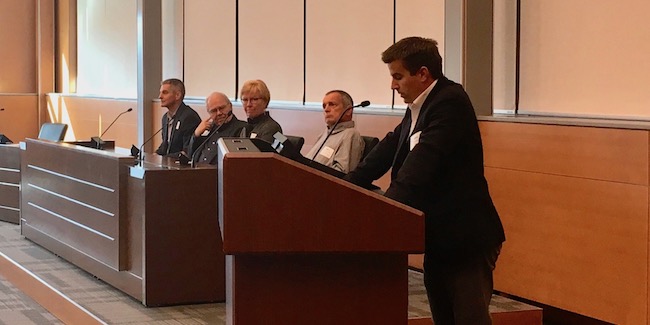
On October 26, FAUW held a 60th anniversary discussion exploring the unique relationship between faculty and the administration at Waterloo, and presented our first Awards of Appreciation to honour members of the University community who have made real differences in the lives of faculty members.
Left to right: David DeVidi, Roman Dubinski, Lynne Taylor, Ian Goulden, Bryan Tolson (FAUW president).
Panelists Roman Dubinski (FAUW president 1970–71), David DeVidi (FAUW president 2007–09), Lynne Taylor (chief negotiator and board member 2014–16), and Ian Goulden (dean of mathematics 2010–15) described the evolution of faculty representation at Waterloo, from the early relationship characterized by the University’s “benign paternalism” (in Dubinski’s words), through three attempts to unionize in the 1970s, ’80s, and ’90s, to the “honest conversation” of the current arrangement.



 The FAUW Blog