
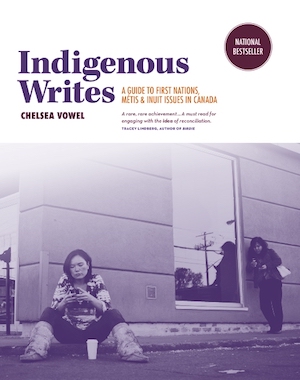
Reading Indigenous Writes by Chelsea Vowel (book review)

indigenous_writes_web

This is the first in a series of book reviews written by FAUW’s Indigenization Working Group.

Vowel, Chelsea. Indigenous Writes: A Guide to First Nations, Métis & Inuit Issues in Canada. Highwater Press, 2016, 240 pages.

—Katy Fulfer, Philosophy/Women’s Studies

I have good intentions when it comes to Indigenizing the university and decolonizing my teaching. I have resources available to help with the latter, but the former leaves me feeling overwhelmed. However, dwelling in a space of inaction is irresponsible. ‘Having good intentions’ won’t address structural injustice (and can perpetuate it).

Thankfully, educator and lawyer Chelsea Vowel wrote a primer for people like me who know that I ought to—and need to—know more than I do about Indigenous issues in Canada. I was attracted to this book because I’m a mega-fan of the Métis in Space podcast, in which Vowel and co-host Molly Swain provide a smart, sarcastic look at representations of indigeneity in science fiction film and television. Vowel brings the same sense of humour to Indigenous Writes: A Guide to First Nations, Métis & Inuit Issues in Canada.

Continue reading “Reading Indigenous Writes by Chelsea Vowel (book review)”

News From Your Board: May 3 Meeting Recap

Here’s what went down at the first Board meeting of the spring term.

A member raised a concern about how FAUW dues are calculated at the Spring General Meeting. Currently, our dues are calculated based on the average salary of all members within a given rank. A review of other institutions revealed that we might be unique in this manner: Other universities charge dues based on a member’s actual salary. Our treasurer Dan Brown informed the Board that he is following up on the potential for this dues structure at Waterloo, and is planning to bring a more detailed assessment of the feasibility of this to the Board shortly.

We debriefed the GoFundMe campaign launched by FAUW to demonstrate support for diversity at the University of Waterloo in light of a planned (and then cancelled) event on campus featuring Faith Goldy and Ricardo Duchesne. Though this fundraising has been successful, the Board acknowledged that ongoing efforts are needed to ensure an open and accepting campus community. The Board also heard that, in response to this cancelled event, some faculty members and students were organizing a teach-in, which is now happening on Thursday, May 10.

FAUW’s executive manager Erin Windibank reported on happenings at the CAUT council meeting in April. In particular, CAUT is asking for any faculty who have recently had issues crossing the US border, for example with security or border services asking for access to social media accounts, computer or cellphone passwords, or questions about what one may be reading. If you have experienced these or similar requests, please email borderissues@caut.ca.

The Board voted to contribute to a fundraiser for Amir Kiumarsi, a faculty member and union steward at Ryerson University who was injured during the recent vehicular assault in Toronto. As contract faculty, Kiumarsi has no benefits or leave time, so his recovery will result in significant financial stress for his family. Ryerson contract faculty have set up a GoFundMe campaign to support Kiumarsi and his family.

Lastly, if you live in the Kitchener-Waterloo riding, or just really love political debates, FAUW is supporting an all-candidates meeting at 10:00 am on May 16 at Lazaridis Hall Auditorium (WLU).

—Peter Johnson, director for the Faculty of Environment

A (Huge) Thank-you and an Update on our #multiculturalUW Campaign

Dear community,

We have been overwhelmed by the generosity of the hundreds of donors who are making clear that they support a #multiculturalUW. [If you don’t know what this is about, see the post “FAUW Supports a Multicultural UW. Will You Help?“]

We created the campaign quickly because we did not want to delay in telling Indigenous and racialized campus members that we have their backs. And, to be honest, we had no idea how quickly this campaign would grow and outstrip the modest goal we had set for it. We should have known that thousands of University of Waterloo students, staff, faculty and alumni, and friends across the country would share our positive message and help us to wildly exceed our fundraising goal.

We are proud to partner with Shatitsirótha’ (the Waterloo Indigenous Student Centre), and with the Collective Movement Award (on the recommendation of UW’s Black Association for Student Expression) for this campaign. But now, as the number continues to climb, we are cognizant of the concern that other campus diversity initiatives—and other racialized and new Canadian groups—in addition to these two could also benefit from the community’s generosity.

We have spoken with our Shatitsirótha’ and Collective Movement partners and they agree. So, in the coming days and weeks, we’ll be consulting with Waterloo’s two student governments and other campus partners for advice on where to direct the funds we have raised, and continue to raise, beyond our initial goal. We’ll take our time to make sure that the decision we make is fair. And then we’ll let you know what we’ve come up with. In the meantime, thank you again for proving that University of Waterloo supports its diverse, multicultural community!

Meet FAUW’s Equity Committee

On April 6, 2018, our members voted to change the name of the Status of Women and Equity Committee to “Equity Committee.”

The Equity Committee is concerned with equity issues, in line with the protected grounds of the Ontario’s Human Rights Code. The committee engages in educational and advocacy activities as appropriate and liaises with other related committees of the University, OCUFA, and CAUT.

The name change was prompted by a desire to better reflect all aspects of the committee’s focus, past and present. The new name also reflects current initiatives on campus to ensure diverse, inclusive, and representative equity-based action. Our mandate is to represent the interests of a range of equity-seeking groups and it’s important to us to more accurately reflect that diversity in our language.

The committee’s name will be followed by “formerly the Status of Women and Equity Committee” for the next several months to facilitate the transition. Please bear with us as we update our website and other documentation. Note that the stand-alone SWEC website will be archived soon and the Equity Committee section of the FAUW website is your best source of up-to-date information.

Learn more about the Equity Committee on the FAUW website.

FAUW Supports a Multicultural UW. Will You Help?

— Bryan Tolson, FAUW President

It has come to FAUW’s attention that an unofficial Laurier club has rented the Theatre of the Arts on April 30 for an event featuring Faith Goldy and Ricardo Duchesne. Goldy is a former commentator with The Rebel Media whose contract was terminated for her appearance on a white nationalist podcast. Duchesne is the author of Canada in Decay: Mass Immigration, Diversity, and the Ethnocide of Euro-Canadians. They will be discussing “multiculturalism, borders, and identity in Canada.”

I’ve checked, and the Theatre of the Arts is indeed available for public rentals whenever it isn’t being used for academic purposes (you might have noticed the dance competitions last week, for example). This is an external event, not supported or endorsed by the University of Waterloo. The speakers were not invited to campus by faculty, staff, or students. Their ideas do not reflect the views or the scholarship of our faculty, staff, or students. I personally don’t want to hear what these speakers have to say and won’t be on campus during this event.

But that’s not enough for me or FAUW because we want people who are marginalized by these messages to know that we support them. Continue reading “FAUW Supports a Multicultural UW. Will You Help?”

News From Your Board: April 19 Meeting Recap

There has been a long gap between our normal two-weekly Board meetings because we had our Spring General meeting on the 5 April and about that, you already know.

Not surprisingly, there was a lot to discuss, much of which was routine: recommendations for appointments to the University Tenure & Promotion Committee (UTPC), debriefing the Spring General Meeting and Bryan Tolson’s presentation to Senate about faculty hiring data (see the slides on our website), discussing representation from AHS on the Board, etc.

The interesting new topic was cycling on campus. There are some key people who have been strong advocates for biking and safe storage of bikes in particular. Johanna Wandel provided a summary of the current situation and a new pilot project that the FAUW will be supporting—we will share more about that soon. You’re also welcome to contact Johanna—and Parking Services!—with your thoughts on improving cycling on campus.

FAUW also agreed to provide financial support for an all-candidates debate (for the Kitchener-Waterloo riding only) that WLU has organized for May 16. Registration details will be posted on our website as soon as they’re available, and we encourage those interested to attend.

Finally, we are making progress on language in the Memorandum of Agreement (MoA) about performance rating histograms. Our original goal for these proved unduly complex and we are working on revisions that will balance transparency, privacy, and feasibility. Recommendations are forthcoming. On a related note, it seems as if some departments still do not have addenda to their Faculty performance review guidelines as per the requirements of the MoA. Even the decision to defer to faculty-wide guidelines needs to be made by the department on a biennial basis (this time ’round, before October 15, 2018) and yet this does not necessarily always occur. Again, we’ll have more on this soon.

—Sally Gunz, past president

What You Missed at our 2018 Spring General Meeting

We had a full agenda at our Spring General Meeting last week. Here are some of the highlights.

Bryan Tolson’s President’s Report included an update on current policy development and the messages shared with MPPs at OCUFA’s lobby day last month. View the President’s Report slides (PDF) (and our blog post about lobby day) for details.

Marcel Pinheiro delivered the Elections Committee report: The successful candidates from Arts, Engineering, Environment, Mathematics, and Science are, respectively: Alice Kuzniar, Paul Ward, Daniel Cockayne, Dan Brown, and Vivian Choh (read more about the directors-elect). Voter turnout was 33% in Arts, 26% in Engineering, and 29% in Science.

We received no nominations from members in Applied Health Sciences, so this position will be vacant until the Board can fill it by appointment.

Members approved the budget for 2018–19 and changes to the constitution regarding the role of past president, the executive committee, and the name and mandate of the Status of Women and Equity Committee—now the Equity Committee. The updated constitution is on our website.

Lead negotiator Benoit Charbonneau gave an overview of the salary negotiation outcomes and a crash course on how our salary structure works, which you can also get from our Faculty Guide page on salaries. A detailed explanation of the negotiation results was posted on our blog in February. Charbonneau also noted the members of the Lecturers Salary Working Group.

Dan Brown, one of our representatives to the fall break working group, gave an update on the fall break pilot project. Thank you to the 506 faculty members who participated in the survey that closed on March 30. We are reviewing the results now.

We introduced a couple of waste-reduction initiatives at this meeting: Thank you to everyone who brought their own plate and/or coffee mug, and to everyone for composting their pizza crusts and paper plates!

The next general meeting will be in December.

A View of Academic Freedom and Top-ten-ness

—George Freeman, Associate Professor, Electrical and Computer Engineering

The President’s Luncheon on Academic Freedom, held March 12, was the start of a great exploration, particularly if the university develops a serious interest in President Hamdullahpur’s vision around seeking to be a top-ten school, seen in his discussion document “Disrupting the 21st Century University, Imagining the University of Waterloo @2025” where it is expressed as the question “do we want to be recognized and respected as one of the best in the world?” [emphasis added].

This first meeting spoke to the general policies protecting academic freedom at Waterloo and focused mostly on aspects protecting our freedom to engage controversial ideas and disseminate controversial results. I take a much wider definition of academic freedom which includes all three of President Hamdullahpur’s “non-negotiable principles” around this topic: institutional autonomy, faculty independence, and academic freedom”. Although dismissable as just semantics, I believe it is important to not forget those institutional- and faculty-autonomy components. There’s a similar trap in the University of Waterloo Act, where our objects are “the pursuit of learning through scholarship, teaching and research within a spirit of free enquiry and expression.” It is too easy to group free enquiry and free expression under a common mental heading of “free talk” and forget that what it is we talk about has to come from someplace. Academic freedom in the large also protects that place (or spirit).

In my opinion, the history of scholarship demonstrates that it is extremely difficult to suppress ideas and their evidence-based evaluation forever. To me, academic freedom, in the freedom-of-expression sense, acts mostly to prevent long delays and prevent the messenger from being punished for the message. This protection of an environment free of recrimination and censorship is obviously important but not the whole story. In a policy sense, it admits to after-the-fact remedies for violations, something easy for us to contemplate.

Continue reading “A View of Academic Freedom and Top-ten-ness”

Where Does FAUW Stand on the Responsible Investing Working Group?

We have received some questions about the Responsible Investing Working Group, which is tasked with making recommendations about whether and how to incorporate environmental, social and governance (ESG) factors into decision making for the investment of the university’s endowment and pension funds.

This working group was created in good part in response to approaches by faculty, students, and staff with interests and concerns about how the university invests, in particular calls for the University to divest from fossil fuels. It is a working group of the Board of Governors, since it is the Board that has primary oversight of investments. The FAUW representative is Alan Macnaughton who is also a member of the Pension and Benefits Committee.

The working group has not yet produced its report. Anyone interested in these issues who has not yet provided input to the group should do so as soon as possible. You can send your input to Mike Grivicic in the Secretariat.

FAUW is looking forward to the release of the working group’s report. We will seek input from members and formulate a response at that time. Please make sure you follow our blog and emails if these are issues of interest to you.

News From Your Board: March 22 Meeting Recap

—Peter Johnson, director for the Faculty of Environment

As we approach the end of the winter term, the FAUW Board of Directors met to discuss a variety of important issues. We discussed the agenda and process for the upcoming Spring General Meeting (April 5th) and reviewed our draft budget for the coming year, which will be presented to the membership at the General Meeting.

Many Board members attended and/or participated in the President’s Luncheon on Academic Freedom. As a result, we discussed this event and its outcomes in depth (see our blog post on the event for more details). Going forward, FAUW respects the efforts made to host this event and the issues and discussion that it raised, but ultimately there is still much work to be done to clarify how Academic Freedom is exercised on campus. Further events and discussions with administration will be very welcome.

The Board had a lengthy discussion about the issues raised at the President’s Advisory Committee on Student Mental Health forum and report. FAUW strongly supports many of the recommendations of this report and is working to provide advice to our members on how to better support student mental health.

We also reviewed several issues raised by individual members. We are always open to addressing specific issues, and receiving direct feedback from the membership, so please get in touch.

Upcoming events include the our annual tenure and promotion workshops, and the Spring General Meeting on April 5 in QNC 2502 from 11:30-1:30pm. Hope to see you there!